Chevrolet · Colorado · 2024
2024 Chevrolet Colorado
3
Recalls
106
Complaints
4/5
NCAP overall
The 2024 Chevrolet Colorado has 3 recalls and 106 owner-reported complaints on file with NHTSA. One stored NHTSA configuration has an overall rating of 4 out of 5 stars, not a rating for all versions. Most frequent stored component label: engine (14 reports).
Stored NHTSA configuration: 2024 Chevrolet Colorado PU/CC RWD NCAP Vehicle ID: 19048
Ratings describe one stored NHTSA configuration, not every trim, body style or drivetrain for this model year. How this configuration is selected
Source: NHTSA Public Records
NHTSA source checks for this vehicle year
- Complaints
- Separate successful check not recorded.
- Recalls
- Separate successful check not recorded.
- Safety ratings
- Separate successful check not recorded.
- Investigations
- Separate successful check not recorded.
- Manufacturer communications
- Separate successful check not recorded.
Checks are recorded separately for each dataset, not for the whole page. Dates use UTC. A missing check date does not mean no records exist.
Vehicle import recorded: Apr 28, 2026. This is the stored import date, not confirmation that every source was successfully refreshed.
Research Context
The 2024 Chevrolet Colorado page works best as a research starting point. Complaint totals show how much owner-reported activity exists, while recalls and investigations help show whether any of that activity turned into formal safety action.
Because this is a newer-era vehicle page, it usually helps to compare this year against nearby model years before deciding whether a complaint pattern looks isolated or persistent. On this page, the most frequent complete stored component label is engine with 14 reported complaints.
Best Research Moves
- Use the complaint log to understand what owners were actually reporting instead of relying only on the raw complaint total.
- Review the recall section even if the total is smaller, because a limited number of recalls can still point to meaningful safety actions.
- This page is primarily a complaints-and-recalls research surface, so compare nearby model years before treating the complaint total as a standalone verdict.
Key Takeaways
- The 2024 Chevrolet Colorado currently shows 3 NHTSA recalls listed on this page and 106 owner-reported complaints.
- This page currently shows no linked NHTSA investigations.
- This page reflects complaint volume, recall history, and NHTSA test data, but it does not diagnose causes or rank reliability by itself.
- Safety data currently shows 4/5 overall NHTSA rating for one stored configuration, not all versions.
- The most frequent complete stored component labels on this page are engine (14), electrical system (10), service brakes (10).
- Vehicle
- 2024 Chevrolet Colorado
- Recalls
- 3
- Complaints
- 106
- Stored Configuration Overall Rating
- 4/5. Stored NHTSA configuration: 2024 Chevrolet Colorado PU/CC RWD. NCAP Vehicle ID: 19048.
How to Interpret This Page
This page combines three types of NHTSA data: recall campaigns (official manufacturer or government actions), owner complaints (unverified consumer reports), and crash test ratings (where available). A vehicle with many complaints is not necessarily less reliable — complaint volume correlates with sales volume and vehicle age. Recalls indicate identified defects, not overall quality. To compare this model year with others, use the year navigation in the sidebar or return to the model overview page.
If you are researching a used vehicle, start with the complaint categories, compare them against the recall list, and then check nearby model years to see whether the same issue profile repeats. That usually produces a better buying or research signal than treating the raw complaint total as a standalone safety ranking.
NHTSA Configuration Test Results
Stored NHTSA configuration: 2024 Chevrolet Colorado PU/CC RWD NCAP Vehicle ID: 19048
Ratings describe one stored NHTSA configuration, not every trim, body style or drivetrain for this model year. How this configuration is selected
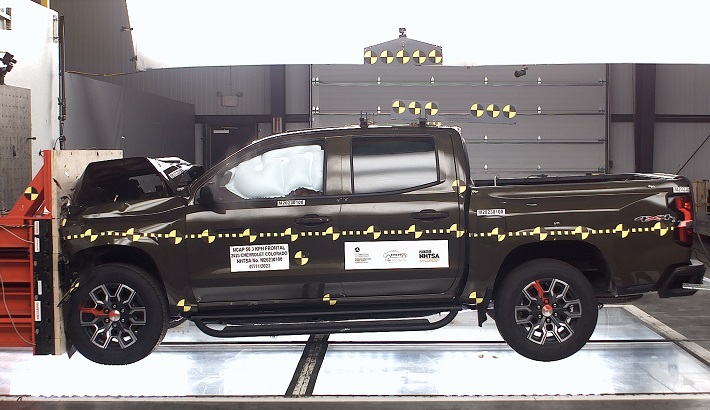
Frontal Crash Test
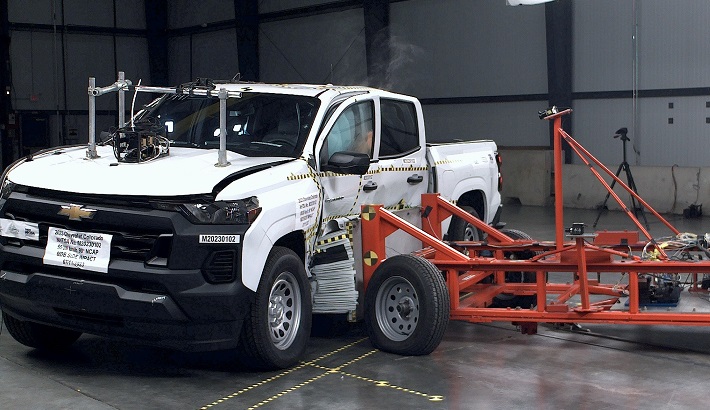
Side Crash Test
Overall Frontal Rating
Driver and Passenger Assessment
Driver Side
Passenger Side
Overall Side Rating
Side Barrier and Side Pole Tests
Driver Side
Passenger Side
Rollover Resistance
No rollover risk estimate available in this dataset
Safety Features
ESC: StandardForward Collision Warning: Standard & OptionalLane Departure Warning: Standard & Optional
Recall Notices
NHTSANHTSA ID: 24V703000September 19, 2024
SEAT BELTS:CRITICAL FASTENERS
General Motors, LLC (GM) is recalling certain 2023-2024 Chevrolet Colorado and 2023 GMC Canyon vehicles. The left or right front seat may have a seat belt buckle attachment bolt that was not tightened properly.
Remedy Status
Dealers will tighten the left and right front seat belt buckle attachment bolts, free of charge. Owner notification letters were mailed October 30, 2024. Owners may contact Chevrolet customer service at 1-800-222-1020, or GMC customer service at 1-800-462-8782. GM's number for this recall is N242453720.
NHTSA ID: 24V491000June 28, 2024
FUEL SYSTEM, GASOLINE:STORAGE:TANK ASSEMBLY
General Motors, LLC (GM) is recalling certain 2024 Chevrolet Colorado and GMC Canyon vehicles. The lock ring that secures the fuel pump to the fuel tank assembly may not have been fully locked during assembly, which can result in a fuel leak during a crash.
Remedy Status
Dealers will inspect and fully lock the fuel tank lock ring as necessary, free of charge. Owner notification letters are expected to be mailed August 13, 2024. Owners may contact Chevrolet customer service at 1-800-222-1020, or GMC Customer Call Center at (888) 988-7267. GM's number for this recall is N242451330.
NHTSA ID: 24V366000May 23, 2024
TIRES
General Motors, LLC (GM) is recalling certain 2024 Chevrolet Colorado vehicles. Incorrect tires may have been installed that do not match the tire label, and the tire pressure monitoring system (TPMS) may provide inaccurate information for the installed tires. As such, these vehicles fail to comply with the requirements of Federal Motor Vehicle Safety Standard numbers 110, "Tire Selection and Rims" and 138, "Tire Pressure Monitoring Systems."
Remedy Status
Dealers will inspect and replace the tires as necessary, free of charge. Owner notification letters were mailed June 19, 2024. Owners may contact Chevrolet customer service at 1-800-222-1020. GM's number for this recall is N242444030.
Owner Complaints
106 totalELECTRICAL SYSTEM
Apr 19, 2026
The backup camera view does not appear on my dash screen along with all other camera views. There were no warnings or indicators. It was working the last time the vehicle was driven and then failed on the next vehicle start up.
POWER TRAIN
Apr 17, 2026
Check engine light with codes p0700 and p2796 has been happening for months with multiple failed repair attempts. Vehicle was returned to me by the dealer supposedly fixed. I drove it 15 minutes to the high school for an art fair my daughter was in. They (my family) rode with ...
Preview excerpt
ENGINE
Apr 16, 2026
I have had my vehicle for less than 2 years and less than 25,000. I had it in for regular maintenance and was told I had no coolant. After a pressure test the dealership told me I had a large crack in the coolant line. It will 2 weeks to get the part and I can’t drive my truck. T...
Preview excerpt
SERVICE BRAKES
Apr 1, 2026
About two weeks ago my truck popped up a message asking if I had installed new brake pads. When I selected no, on my Home Screen, where I can see the systems of my truck the front bake wear indicator no longer showed a percentage. When I inspected my brake pads the front outer pa...
Preview excerpt
ENGINE
Mar 23, 2026
Coolant leaking from the upper radiator inlet hose connection
POWER TRAIN
Mar 22, 2026
When coming to a stop the vehicle slams into 1st gear raising the RPMs and pushing the vehicle forward even when the brakes are being applied. No warning lights no other malfunction or symptoms. Has occurred this I first purchased the vehicle new in January of 2025. Has almost ca...
Preview excerpt
POWER TRAIN,UNKNOWN OR OTHER
Mar 21, 2026
I have a 2024 Chevy Colorado Trail Boss that needs an Upper Radiator Coolant Hose. But apparently this is on nationwide backorder because although there is not a recall GM put a bulletin out they are aware of the issue that appears to be a degraded seal inside hose fitting so the...
Preview excerpt
ENGINE
Mar 20, 2026
Coolant leaking from the upper radiator inlet hose connection. The Malfunction Indicator Lamp (MIL) illuminated in the Driver Information Center (DIC).
SERVICE BRAKES
Mar 10, 2026
My truck only has 16,600 miles on it and the rotors and brakes are already shuddering. The dealership told me I needed my front and rear brakes and rotors replaced. It is beyond ridiculous when my last truck a 2020 Chevy Colorado had no rotor or brake problems and have 90,000 mil...
Preview excerpt
SERVICE BRAKES,FORWARD COLLISION AVOIDANCE
1 injuryMar 5, 2026
there have about 4 incidents where my vehicle has engaged the automatic emergency breaks while I’m driving, even though there are no cars around me close enough to cause that reaction. called 911 on most recent incident to get medical evaluation to check chest from seat belt su...
Preview excerpt
Showing 10 recent complaints from 106 total
View Full Complaint LogCompare Related Vehicles
Why Compare These Pages
The strongest comparison flow is usually: exact vehicle-year page, then nearby years of the same model, then other 2024 Chevrolet models. That sequence helps separate one-off year spikes from broader make-wide patterns.
More Chevrolet Colorado Years
2025 Chevrolet ColoradoCompare this year against 2024 for complaint and recall shifts.1r23c2023 Chevrolet ColoradoCompare this year against 2024 for complaint and recall shifts.3r122c2026 Chevrolet ColoradoCompare this year against 2024 for complaint and recall shifts.1r5c2022 Chevrolet ColoradoCompare this year against 2024 for complaint and recall shifts.1r40c2021 Chevrolet ColoradoCompare this year against 2024 for complaint and recall shifts.1r63c2020 Chevrolet ColoradoCompare this year against 2024 for complaint and recall shifts.76c
More 2024 Chevrolet Models
2024 Chevrolet SilveradoAnother 2024 Chevrolet option for same-year comparison.2r290c2024 Chevrolet TraxAnother 2024 Chevrolet option for same-year comparison.1r148c2024 Chevrolet TraverseAnother 2024 Chevrolet option for same-year comparison.117c2024 Chevrolet TahoeAnother 2024 Chevrolet option for same-year comparison.3r55c2024 Chevrolet EquinoxAnother 2024 Chevrolet option for same-year comparison.1r54c2024 Chevrolet BlazerAnother 2024 Chevrolet option for same-year comparison.1r32c
Frequently Asked Questions
How many recalls does the 2024 Chevrolet Colorado have?
The 2024 Chevrolet Colorado has 3 recalls recorded by NHTSA.
How many complaints have been filed for the 2024 Chevrolet Colorado?
NHTSA has received 106 owner-reported complaints for the 2024 Chevrolet Colorado.
What is the NHTSA safety rating for the 2024 Chevrolet Colorado?
Our stored NHTSA record for the 2024 Chevrolet Colorado has an overall rating of 4 out of 5 stars. Stored NHTSA configuration: 2024 Chevrolet Colorado PU/CC RWD. NCAP Vehicle ID: 19048. Ratings describe one stored NHTSA configuration, not every trim, body style or drivetrain for this model year.
What are the most common problems with the 2024 Chevrolet Colorado?
The most frequent complete stored component labels for the 2024 Chevrolet Colorado are engine (14 reports), electrical system (10 reports), service brakes (10 reports). These are exact-label counts, not broader component-group totals or confirmed defects.
Does the 2024 Chevrolet Colorado have any recalls?
Yes. NHTSA has 3 recalls on record for the 2024 Chevrolet Colorado. Scroll up to review the published recall summaries, consequences, and remedies. To check for unrepaired recalls on your specific vehicle, use your VIN at nhtsa.gov/recalls.
Check Another Vehicle
Look up recalls and complaints for any year, make, and model.
This page summarizes publicly available data from the National Highway Traffic Safety Administration (NHTSA). Complaint counts reflect reports submitted to NHTSA by vehicle owners and do not by themselves prove defect severity or vehicle safety. Safety ratings may not be available for all vehicle-years. This site is not affiliated with NHTSA or any vehicle manufacturer. For official information, visit the official NHTSA page for this vehicle.