Hyundai · Santa Fe · 2026
2026 Hyundai Santa Fe
4
Recalls
14
Complaints
5/5
NCAP overall
The 2026 Hyundai Santa Fe has 4 recalls and 14 owner-reported complaints on file with NHTSA. One stored NHTSA configuration has an overall rating of 5 out of 5 stars, not a rating for all versions. Most frequent stored component label: seats (3 reports).
Stored NHTSA configuration: 2026 HYUNDAI SANTA FE SUV N/A FWD NCAP Vehicle ID: 21132
Ratings describe one stored NHTSA configuration, not every trim, body style or drivetrain for this model year. How this configuration is selected
Source: NHTSA Public Records
NHTSA source checks for this vehicle year
- Complaints
- Separate successful check not recorded.
- Recalls
- Separate successful check not recorded.
- Safety ratings
- Separate successful check not recorded.
- Investigations
- Separate successful check not recorded.
- Manufacturer communications
- Separate successful check not recorded.
Checks are recorded separately for each dataset, not for the whole page. Dates use UTC. A missing check date does not mean no records exist.
Vehicle import recorded: Apr 28, 2026. This is the stored import date, not confirmation that every source was successfully refreshed.
Research Context
The 2026 Hyundai Santa Fe page works best as a research starting point. Complaint totals show how much owner-reported activity exists, while recalls and investigations help show whether any of that activity turned into formal safety action.
Because this is a newer-era vehicle page, it usually helps to compare this year against nearby model years before deciding whether a complaint pattern looks isolated or persistent. On this page, the most frequent complete stored component label is seats with 3 reported complaints.
Best Research Moves
- Use the complaint log to understand what owners were actually reporting instead of relying only on the raw complaint total.
- Review the recall section even if the total is smaller, because a limited number of recalls can still point to meaningful safety actions.
- This page is primarily a complaints-and-recalls research surface, so compare nearby model years before treating the complaint total as a standalone verdict.
Key Takeaways
- The 2026 Hyundai Santa Fe currently shows 4 NHTSA recalls listed on this page and 14 owner-reported complaints.
- This page currently shows no linked NHTSA investigations.
- This page reflects complaint volume, recall history, and NHTSA test data, but it does not diagnose causes or rank reliability by itself.
- Safety data currently shows 5/5 overall NHTSA rating for one stored configuration, not all versions.
- The most frequent complete stored component labels on this page are seats (3), visibility/wiper (2), unknown or other (2).
- Vehicle
- 2026 Hyundai Santa Fe
- Recalls
- 4
- Complaints
- 14
- Stored Configuration Overall Rating
- 5/5. Stored NHTSA configuration: 2026 HYUNDAI SANTA FE SUV N/A FWD. NCAP Vehicle ID: 21132.
How to Interpret This Page
This page combines three types of NHTSA data: recall campaigns (official manufacturer or government actions), owner complaints (unverified consumer reports), and crash test ratings (where available). A vehicle with many complaints is not necessarily less reliable — complaint volume correlates with sales volume and vehicle age. Recalls indicate identified defects, not overall quality. To compare this model year with others, use the year navigation in the sidebar or return to the model overview page.
If you are researching a used vehicle, start with the complaint categories, compare them against the recall list, and then check nearby model years to see whether the same issue profile repeats. That usually produces a better buying or research signal than treating the raw complaint total as a standalone safety ranking.
NHTSA Configuration Test Results
Stored NHTSA configuration: 2026 HYUNDAI SANTA FE SUV N/A FWD NCAP Vehicle ID: 21132
Ratings describe one stored NHTSA configuration, not every trim, body style or drivetrain for this model year. How this configuration is selected
Frontal Crash Test

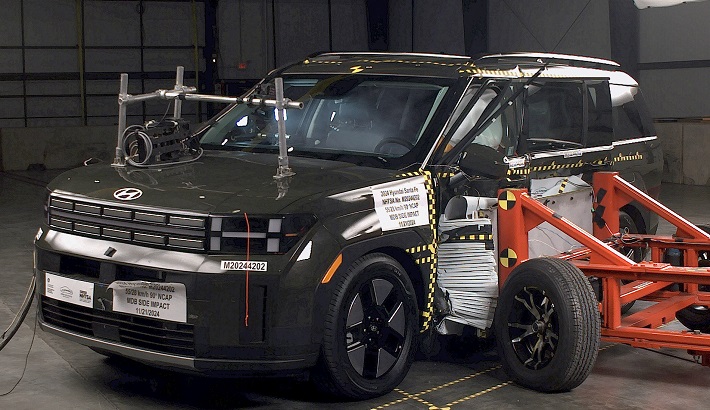
Side Crash Test
Overall Frontal Rating
Driver and Passenger Assessment
Driver Side
Passenger Side
Overall Side Rating
Side Barrier and Side Pole Tests
Driver Side
Passenger Side
Rollover Resistance
No rollover risk estimate available in this dataset
Safety Features
ESC: StandardForward Collision Warning: NoLane Departure Warning: No
Recall Notices
NHTSANHTSA ID: 26V218000April 06, 2026
SEAT BELTS:FRONT:ANCHORAGE
Hyundai Motor America (Hyundai) is recalling certain 2023-2025 Hyundai Ioniq 6, 2023-2026 Genesis G90, 2024-2026 Hyundai Santa Fe, and Hyundai Santa Fe Hybrid vehicles. The driver and passenger seat belt anchors may detach.
Remedy Status
Dealers will inspect and reinforce or replace the seat belt anchors, as necessary, free of charge. Owner notification letters are expected to be mailed June 5, 2026. Owners may contact Hyundai customer service at 1-855-371-9460 and Genesis customer service at 844-340-9741. Hyundai's numbers for this recall are 298 and 032G. Vehicle Identification Numbers (VINs) involved in this recall became searchable on NHTSA.gov April 8, 2026.
NHTSA ID: 26V047000January 27, 2026
ELECTRICAL SYSTEM: INSTRUMENT CLUSTER/PANEL
Hyundai Motor America (Hyundai) is recalling certain 2025-2026 Tucson Hybrid, Tucson Plug-In Hybrid Electric (PHEV), 2026 IONIQ 5, Santa Cruz, Kona, Palisade, Palisade Hybrid, Santa Fe, Santa Fe Hybrid, Sonata, Sonata Hybrid, and Tucson vehicles. Due to a software error, the instrument panel display may fail. As such, these vehicles fail to comply with the requirements of Federal Motor Vehicle Safety Standard (FMVSS) number 101, "Controls and Displays."
Remedy Status
The instrument panel display software will be updated over-the-air (OTA) or by a dealer, free of charge. Owner notification letters were mailed March 24, 2026. Owners may contact Hyundai's customer service at 855-371-9460. Hyundai's number for this recall is 293. Vehicle Identification Numbers (VINs) involved in this recall became searchable on NHTSA.gov on January 28, 2026.
NHTSA ID: 25V809000November 21, 2025
AIR BAGS:SIDE/WINDOW:CURTAIN
Hyundai Motor America (Hyundai) is recalling certain 2025 Tucson, 2025-2026 Santa Cruz, Santa Fe, Santa Fe Hybrid, and 2026 Genesis GV70 vehicles. The side curtain air bags may not have been installed properly, which can cause the air bags not to deploy as intended.
Remedy Status
Dealers will reinstall the side curtain air bags, free of charge. Owner notification letters were mailed beginning December 29, 2025. Owners may contact Hyundai customer service at 1-855-371-9460. Hyundai's numbers for this recall are 289 and 029G. Vehicle Identification Numbers (VINs) involved in this recall became searchable on NHTSA.gov on November 22, 2025.
NHTSA ID: 25V549000August 26, 2025
ENGINE AND ENGINE COOLING:CRITICAL FASTENERS
Hyundai Motor America (Hyundai) is recalling certain 2025-2026 Tucson and Santa Fe vehicles. The connecting rod bolts in the engine may have been improperly tightened, which can cause a loss of drive power and engine damage, possibly resulting in an oil leak.
Remedy Status
Dealers will replace the engine, free of charge. Owner notification letters were mailed October 23, 2025. Owners may contact Hyundai customer service at 1-855-371-9460. Hyundai's number for this recall is 281.
Owner Complaints
14 totalUNKNOWN OR OTHER
Apr 10, 2026
Safety Concern – Lack of Air Conditioning Ventilation in Third Row Seating I am writing to formally report a safety concern regarding a vehicle that lacks adequate air conditioning and ventilation in the third-row seating area. The third row of this vehicle does not receive suf...
Preview excerpt
SEATS
Mar 21, 2026
My 2026 Hyundai Santa Fe has a dangerous power-fold feature for the middle row. This problem is making headlines in another model, the Hyundai Palisade, and for good reason. Why isn't the Santa Fe included in the recall(s) that are intended to correct the problem in the Palisad...
Preview excerpt
SEATS
Mar 20, 2026
vehicle unable to determine when a passenger is seated with seatbelt fastened in 2nd row captains chairs and the ‘one-touch’ tilt-and-slide button is pressed. The seat will keep folding and crushing the passenger. This is a known issue with the Hyundai Palisade at this time and i...
Preview excerpt
SEATS
Mar 13, 2026
The contact owns a 2026 Hyundai Santa Fe. The contact stated that while attempting to adjust the front driver's seat, the second-row passenger’s side seat engaged unintendedly. The child was seated in the booster seat, and the main seat started to fold down. The contact was unawa...
Preview excerpt
FORWARD COLLISION AVOIDANCE,LANE DEPARTURE
Mar 10, 2026
"TAKE A BREAK" - the feature prompts the driver to “Take a Break” with that text and a‘Coffee Cup” logo after a certain period of continuous driving. There are instances when turning it off is necessary and Hyundai has removed that option - high distracting false alarm rate. ...
Preview excerpt
TIRES
Mar 8, 2026
Pirelli Scorpion M+S (size 255/45R20)
POWER TRAIN,ELECTRICAL SYSTEM,ENGINE
Feb 20, 2026
After turning off the radio with the push button control the instrument cluster and navigation display panel went completely dead black. After pushing multiple buttons several times the panel came back to life. This has not yet been reported to the dealer. On 12/12/2025 this s...
Preview excerpt
LANE DEPARTURE
Feb 2, 2026
The vehicle has a feature that puts a message on the dashboard that reads “Consider taking a break “ that is not able to be adjusted by the consumer or the dealer. This message can come up repeatedly and has an audio portion that overrides the audio in the vehicle. Weather cond...
Preview excerpt
STEERING
Feb 1, 2026
A brand new Santa Fe Hybrid AWD SEL(less than 2500 miles) makes squeaky noises when rotating the steering wheel to the counter clock wise. It is very annoying and frustrating. Due to the noise I can't fully concentrate to driving the car. Brought the vehicle to a local dealer ...
Preview excerpt
UNKNOWN OR OTHER
Jan 27, 2026
2026 Hyundai Santa Fe - Front windshield had spontaneous horizontal crack about 8" on driver side WHILE PARKED WITH NO IMPACT. Car is new with NO ROCK CHIPS. Our winter nights were about 15-25 degrees and the crack would spread WHILE PARKED overnight. Within a week it spread to 2...
Preview excerpt
Showing 10 recent complaints from 14 total
View Full Complaint LogCompare Related Vehicles
Why Compare These Pages
The strongest comparison flow is usually: exact vehicle-year page, then nearby years of the same model, then other 2026 Hyundai models. That sequence helps separate one-off year spikes from broader make-wide patterns.
More Hyundai Santa Fe Years
2025 Hyundai Santa FeCompare this year against 2026 for complaint and recall shifts.5r99c2024 Hyundai Santa FeCompare this year against 2026 for complaint and recall shifts.7r104c2023 Hyundai Santa FeCompare this year against 2026 for complaint and recall shifts.1r186c2022 Hyundai Santa FeCompare this year against 2026 for complaint and recall shifts.5r174c2021 Hyundai Santa FeCompare this year against 2026 for complaint and recall shifts.7r154c2020 Hyundai Santa FeCompare this year against 2026 for complaint and recall shifts.2r178c
More 2026 Hyundai Models
2026 Hyundai PalisadeAnother 2026 Hyundai option for same-year comparison.3r67c2026 Hyundai TucsonAnother 2026 Hyundai option for same-year comparison.3r19c2026 Hyundai Ioniq 5Another 2026 Hyundai option for same-year comparison.2r11c2026 Hyundai KonaAnother 2026 Hyundai option for same-year comparison.2r4c2026 Hyundai SonataAnother 2026 Hyundai option for same-year comparison.1r1c2026 Hyundai Ioniq 6Another 2026 Hyundai option for same-year comparison.0c
Frequently Asked Questions
How many recalls does the 2026 Hyundai Santa Fe have?
The 2026 Hyundai Santa Fe has 4 recalls recorded by NHTSA.
How many complaints have been filed for the 2026 Hyundai Santa Fe?
NHTSA has received 14 owner-reported complaints for the 2026 Hyundai Santa Fe.
What is the NHTSA safety rating for the 2026 Hyundai Santa Fe?
Our stored NHTSA record for the 2026 Hyundai Santa Fe has an overall rating of 5 out of 5 stars. Stored NHTSA configuration: 2026 HYUNDAI SANTA FE SUV N/A FWD. NCAP Vehicle ID: 21132. Ratings describe one stored NHTSA configuration, not every trim, body style or drivetrain for this model year.
What are the most common problems with the 2026 Hyundai Santa Fe?
The most frequent complete stored component labels for the 2026 Hyundai Santa Fe are seats (3 reports), visibility/wiper (2 reports), unknown or other (2 reports). These are exact-label counts, not broader component-group totals or confirmed defects.
Does the 2026 Hyundai Santa Fe have any recalls?
Yes. NHTSA has 4 recalls on record for the 2026 Hyundai Santa Fe. Scroll up to review the published recall summaries, consequences, and remedies. To check for unrepaired recalls on your specific vehicle, use your VIN at nhtsa.gov/recalls.
Check Another Vehicle
Look up recalls and complaints for any year, make, and model.
This page summarizes publicly available data from the National Highway Traffic Safety Administration (NHTSA). Complaint counts reflect reports submitted to NHTSA by vehicle owners and do not by themselves prove defect severity or vehicle safety. Safety ratings may not be available for all vehicle-years. This site is not affiliated with NHTSA or any vehicle manufacturer. For official information, visit the official NHTSA page for this vehicle.