Hyundai · Tucson · 2018
2018 Hyundai Tucson
1
Recall
373
Complaints
5/5
NCAP overall
The 2018 Hyundai Tucson has 1 recall and 373 owner-reported complaints on file with NHTSA. One stored NHTSA configuration has an overall rating of 5 out of 5 stars, not a rating for all versions. Most frequent stored component label: engine (138 reports).
Stored NHTSA configuration: 2018 Hyundai Tucson SUV AWD NCAP Vehicle ID: 12662
Ratings describe one stored NHTSA configuration, not every trim, body style or drivetrain for this model year. How this configuration is selected
Source: NHTSA Public Records
NHTSA source checks for this vehicle year
- Complaints
- Separate successful check not recorded.
- Recalls
- Separate successful check not recorded.
- Safety ratings
- Separate successful check not recorded.
- Investigations
- Separate successful check not recorded.
- Manufacturer communications
- Separate successful check not recorded.
Checks are recorded separately for each dataset, not for the whole page. Dates use UTC. A missing check date does not mean no records exist.
Vehicle import recorded: Apr 28, 2026. This is the stored import date, not confirmation that every source was successfully refreshed.
Research Context
The 2018 Hyundai Tucson page works best as a research starting point. Complaint totals show how much owner-reported activity exists, while recalls and investigations help show whether any of that activity turned into formal safety action.
Because this is a newer-era vehicle page, it usually helps to compare this year against nearby model years before deciding whether a complaint pattern looks isolated or persistent. On this page, the most frequent complete stored component label is engine with 138 reported complaints.
Best Research Moves
- Use the complaint log to see whether the 2018 Hyundai Tucson reports cluster around one repeated symptom or spread across multiple systems.
- Review the recall section even if the total is smaller, because a limited number of recalls can still point to meaningful safety actions.
- This page is primarily a complaints-and-recalls research surface, so compare nearby model years before treating the complaint total as a standalone verdict.
Key Takeaways
- The 2018 Hyundai Tucson currently shows 1 NHTSA recall listed on this page and 373 owner-reported complaints.
- This page currently shows no linked NHTSA investigations.
- This page reflects complaint volume, recall history, and NHTSA test data, but it does not diagnose causes or rank reliability by itself.
- Safety data currently shows 5/5 overall NHTSA rating for one stored configuration, not all versions.
- The most frequent complete stored component labels on this page are engine (138), power train (44), power train,engine (25).
- Vehicle
- 2018 Hyundai Tucson
- Recalls
- 1
- Complaints
- 373
- Stored Configuration Overall Rating
- 5/5. Stored NHTSA configuration: 2018 Hyundai Tucson SUV AWD. NCAP Vehicle ID: 12662.
How to Interpret This Page
This page combines three types of NHTSA data: recall campaigns (official manufacturer or government actions), owner complaints (unverified consumer reports), and crash test ratings (where available). A vehicle with many complaints is not necessarily less reliable — complaint volume correlates with sales volume and vehicle age. Recalls indicate identified defects, not overall quality. To compare this model year with others, use the year navigation in the sidebar or return to the model overview page.
If you are researching a used vehicle, start with the complaint categories, compare them against the recall list, and then check nearby model years to see whether the same issue profile repeats. That usually produces a better buying or research signal than treating the raw complaint total as a standalone safety ranking.
NHTSA Configuration Test Results
Stored NHTSA configuration: 2018 Hyundai Tucson SUV AWD NCAP Vehicle ID: 12662
Ratings describe one stored NHTSA configuration, not every trim, body style or drivetrain for this model year. How this configuration is selected
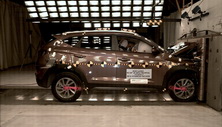
Frontal Crash Test
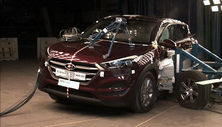
Side Crash Test
Overall Frontal Rating
Driver and Passenger Assessment
Driver Side
Passenger Side
Overall Side Rating
Side Barrier and Side Pole Tests
Driver Side
Passenger Side
Rollover Resistance
No rollover risk estimate available in this dataset
Safety Features
ESC: StandardForward Collision Warning: OptionalLane Departure Warning: Optional
Recall Notices
NHTSANHTSA ID: 20V543000September 04, 2020
SERVICE BRAKES, HYDRAULIC:ANTILOCK/TRACTION CONTROL/ELECTRONIC LIMITED SLIP:CONTROL UNIT/MODULE
Hyundai Motor America (Hyundai) recalled certain 2019-2021 Tucson vehicles on September 4, 2020. On December 30, 2020, Hyundai expanded the recall population, and added certain 2016-2018 Tucson vehicles. The Anti-lock Brake Hydraulic Electronic Control Unit (HECU) could corrode internally and cause an electrical short, possibly resulting in an engine compartment fire.
Remedy Status
Hyundai will notify owners, and dealers will replace the HECU fuse. For 2019-2021 model years, the Electronic Stability Control (ESC) software will also be updated. Recall repairs will be performed free of charge. Owners are advised to park outside and away from structures as a precaution until the recall repair is complete. The recall began November 2, 2020. Owners may contact Hyundai customer service at 1-855-371-9460. Hyundai's number for this recall is 195.
Owner Complaints
373 totalUNKNOWN OR OTHER,ENGINE,FUEL/PROPULSION SYSTEM
FIREApr 5, 2026
Approximately one month ago I had a high pressure fuel pump installed in my 2018 Hyundai Tucson. While driving on the highway, about ten minutes from home, my car suddenly burst into flames. There were no warning lights in the cockpit. There was no smoke in the cabin. Another mot...
Preview excerpt
POWER TRAIN
Mar 30, 2026
The transmission system failed. The vehicle had previously been serviced at a Hyundai dealership for a transmission-related issue and was returned to me as repaired; however, the problem persisted. Shortly after the repair, the transmission failed again, indicating that the issue...
Preview excerpt
ENGINE
Mar 29, 2026
The oil consumption issue has begun. At about 75k miles, my 2018 Hyundai Tucson 1.6L Turbo is burning oil at an insane rate. And there is no indicator of it occurring (no codes or anything on the dash) until it's too late. Hyundai is now WELL KNOWN, and aware, for this problem an...
Preview excerpt
ENGINE
Mar 16, 2026
I bought this car 6 months ago. I did not know it had a recall on the engine. The engine just died a week ago. I brought it to hyundai and the confirmed it was a recall and go ahold of corporate. Corporate is refusing to fix the recall because they said "I should have brought it ...
Preview excerpt
POWER TRAIN
Mar 3, 2026
My specific Tucson is equipped with 1.6L Turbo and a 7 speed Dual-Clutch Transmission. I see there are recalls for the 2016 models equipped with the same transmissions, so I'm concerned as to why there hasn't been a recall for the newer models. My transmission was replaced by Hyu...
Preview excerpt
ENGINE
Feb 16, 2026
I have experienced two near-fatal incidents involving a sudden, uncommanded loss of motive power while traveling at highway speeds (approx. 70 MPH). On February 11, 2026, the vehicle entered "Limp Home Mode" without warning, dropping speed to 60 MPH and 2000 RPM in heavy traffic....
Preview excerpt
ENGINE
Feb 11, 2026
I am writing this letter to formally document a series of catastrophic safety failures and gross negligence regarding my 2018 Hyundai Tucson. On two separate occasions, including as recently as Wednesday, February 11, 2026, I narrowly escaped a fatal high-speed collision because ...
Preview excerpt
POWER TRAIN,VEHICLE SPEED CONTROL
Feb 5, 2026
Hyundai Tucson has been jerking and shaking for over over 4 years now and either when taking to the dealership they reset the dual clutch and have replaced the same part twice in the dual clutch. This shaking has been happening since the car was bought brand new like a year after...
Preview excerpt
WHEELS,UNKNOWN OR OTHER
Jan 22, 2026
The situation I’m about to explain has happened twice—once in December 2025 and again on January 22, 2026. In December, the roads were very icy, but there was no snow on the ground. As I made a right turn into a Walmart parking lot, I heard a loud metal-breaking sound while turn...
Preview excerpt
ENGINE
Jan 12, 2026
My 2018 Hyundai Tucson experienced sudden catastrophic engine failure when a connecting rod threw while driving. The engine burned through its oil and the vehicle became inoperable. Hyundai denied warranty coverage for this engine failure because I had not completed the 2021 KSD...
Preview excerpt
Showing 10 recent complaints from 373 total
View Full Complaint LogCompare Related Vehicles
Why Compare These Pages
The strongest comparison flow is usually: exact vehicle-year page, then nearby years of the same model, then other 2018 Hyundai models. That sequence helps separate one-off year spikes from broader make-wide patterns.
More Hyundai Tucson Years
2019 Hyundai TucsonCompare this year against 2018 for complaint and recall shifts.1r359c2017 Hyundai TucsonCompare this year against 2018 for complaint and recall shifts.3r1,060c2020 Hyundai TucsonCompare this year against 2018 for complaint and recall shifts.1r160c2016 Hyundai TucsonCompare this year against 2018 for complaint and recall shifts.5r1,595c2021 Hyundai TucsonCompare this year against 2018 for complaint and recall shifts.1r63c2015 Hyundai TucsonCompare this year against 2018 for complaint and recall shifts.1r223c
More 2018 Hyundai Models
2018 Hyundai SonataAnother 2018 Hyundai option for same-year comparison.1r353c2018 Hyundai ElantraAnother 2018 Hyundai option for same-year comparison.265c2018 Hyundai Santa FeAnother 2018 Hyundai option for same-year comparison.2r106c2018 Hyundai KonaAnother 2018 Hyundai option for same-year comparison.69c2018 Hyundai AccentAnother 2018 Hyundai option for same-year comparison.1r17c
Frequently Asked Questions
How many recalls does the 2018 Hyundai Tucson have?
The 2018 Hyundai Tucson has 1 recall recorded by NHTSA.
How many complaints have been filed for the 2018 Hyundai Tucson?
NHTSA has received 373 owner-reported complaints for the 2018 Hyundai Tucson.
What is the NHTSA safety rating for the 2018 Hyundai Tucson?
Our stored NHTSA record for the 2018 Hyundai Tucson has an overall rating of 5 out of 5 stars. Stored NHTSA configuration: 2018 Hyundai Tucson SUV AWD. NCAP Vehicle ID: 12662. Ratings describe one stored NHTSA configuration, not every trim, body style or drivetrain for this model year.
What are the most common problems with the 2018 Hyundai Tucson?
The most frequent complete stored component labels for the 2018 Hyundai Tucson are engine (138 reports), power train (44 reports), power train,engine (25 reports). These are exact-label counts, not broader component-group totals or confirmed defects.
Does the 2018 Hyundai Tucson have any recalls?
Yes. NHTSA has 1 recall on record for the 2018 Hyundai Tucson. Scroll up to review the published recall summaries, consequences, and remedies. To check for unrepaired recalls on your specific vehicle, use your VIN at nhtsa.gov/recalls.
Check Another Vehicle
Look up recalls and complaints for any year, make, and model.
This page summarizes publicly available data from the National Highway Traffic Safety Administration (NHTSA). Complaint counts reflect reports submitted to NHTSA by vehicle owners and do not by themselves prove defect severity or vehicle safety. Safety ratings may not be available for all vehicle-years. This site is not affiliated with NHTSA or any vehicle manufacturer. For official information, visit the official NHTSA page for this vehicle.