Toyota · Land Cruiser · 2025
2025 Toyota Land Cruiser
0
Recalls
23
Complaints
4/5
NCAP overall
The 2025 Toyota Land Cruiser has no recalls and 23 owner-reported complaints on file with NHTSA. One stored NHTSA configuration has an overall rating of 4 out of 5 stars, not a rating for all versions. Most frequent stored component label: service brakes (9 reports).
Stored NHTSA configuration: 2025 Toyota LAND CRUISER SUV 4WD NCAP Vehicle ID: 20264
Ratings describe one stored NHTSA configuration, not every trim, body style or drivetrain for this model year. How this configuration is selected
Source: NHTSA Public Records
NHTSA source checks for this vehicle year
- Complaints
- Separate successful check not recorded.
- Recalls
- Separate successful check not recorded.
- Safety ratings
- Separate successful check not recorded.
- Investigations
- Separate successful check not recorded.
- Manufacturer communications
- Separate successful check not recorded.
Checks are recorded separately for each dataset, not for the whole page. Dates use UTC. A missing check date does not mean no records exist.
Vehicle import recorded: Apr 29, 2026. This is the stored import date, not confirmation that every source was successfully refreshed.
Research Context
The 2025 Toyota Land Cruiser page works best as a research starting point. Complaint totals show how much owner-reported activity exists, while recalls and investigations help show whether any of that activity turned into formal safety action.
Because this is a newer-era vehicle page, it usually helps to compare this year against nearby model years before deciding whether a complaint pattern looks isolated or persistent. On this page, the most frequent complete stored component label is service brakes with 9 reported complaints.
Best Research Moves
- Use the complaint log to understand what owners were actually reporting instead of relying only on the raw complaint total.
- Review the recall section even if the total is smaller, because a limited number of recalls can still point to meaningful safety actions.
- This page is primarily a complaints-and-recalls research surface, so compare nearby model years before treating the complaint total as a standalone verdict.
Key Takeaways
- The 2025 Toyota Land Cruiser currently shows no active NHTSA recalls listed on this page and 23 owner-reported complaints.
- This page currently shows no linked NHTSA investigations.
- This page reflects complaint volume, recall history, and NHTSA test data, but it does not diagnose causes or rank reliability by itself.
- Safety data currently shows 4/5 overall NHTSA rating for one stored configuration, not all versions.
- The most frequent complete stored component labels on this page are service brakes (9), power train (3), visibility/wiper (3).
- Vehicle
- 2025 Toyota Land Cruiser
- Recalls
- 0
- Complaints
- 23
- Stored Configuration Overall Rating
- 4/5. Stored NHTSA configuration: 2025 Toyota LAND CRUISER SUV 4WD. NCAP Vehicle ID: 20264.
How to Interpret This Page
This page combines three types of NHTSA data: recall campaigns (official manufacturer or government actions), owner complaints (unverified consumer reports), and crash test ratings (where available). A vehicle with many complaints is not necessarily less reliable — complaint volume correlates with sales volume and vehicle age. Recalls indicate identified defects, not overall quality. To compare this model year with others, use the year navigation in the sidebar or return to the model overview page.
If you are researching a used vehicle, start with the complaint categories, compare them against the recall list, and then check nearby model years to see whether the same issue profile repeats. That usually produces a better buying or research signal than treating the raw complaint total as a standalone safety ranking.
NHTSA Configuration Test Results
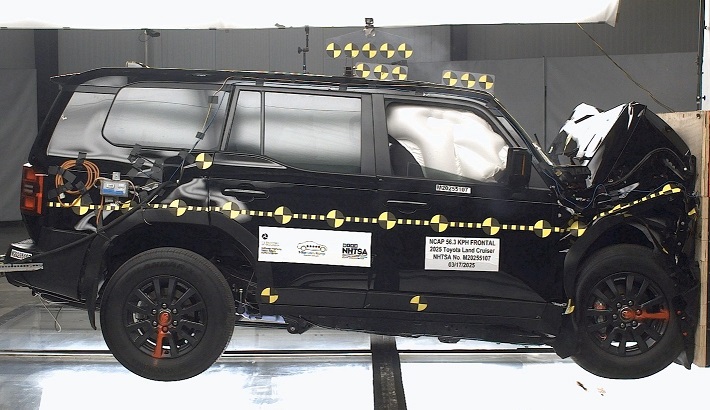
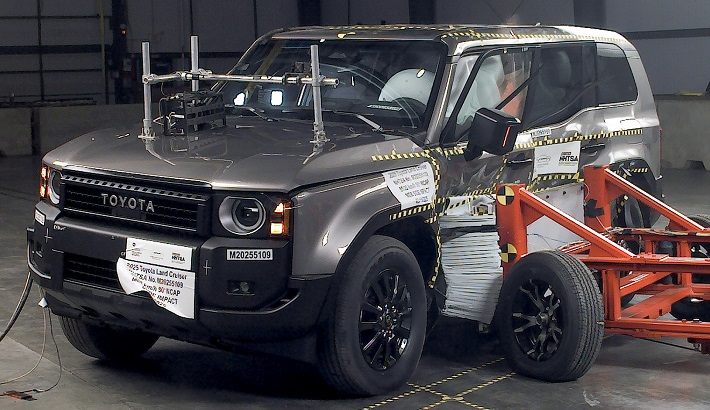
Stored NHTSA configuration: 2025 Toyota LAND CRUISER SUV 4WD NCAP Vehicle ID: 20264
Ratings describe one stored NHTSA configuration, not every trim, body style or drivetrain for this model year. How this configuration is selected
Frontal Crash Test
Side Crash Test
Overall Frontal Rating
Driver and Passenger Assessment
Driver Side
Passenger Side
Overall Side Rating
Side Barrier and Side Pole Tests
Driver Side
Passenger Side
Rollover Resistance
No rollover risk estimate available in this dataset
Safety Features
ESC: StandardForward Collision Warning: StandardLane Departure Warning: Standard
Owner Complaints
23 totalSTRUCTURE
Feb 21, 2026
Several of us on the Toyota forum are noting that the portion of the sunroof positioned toward the rear seat does not form a proper seal and is letting water into the vehicle. This in turn puts electronics at risk or being compromised and unsafe driving conditions.
STRUCTURE
Feb 4, 2026
Spontaneous shatter of rear passenger tempered glass. No prior damage to window.
POWER TRAIN
Jan 31, 2026
Truck has 11000 miles. Waiting in drive thru, felt a jolt, like someone rear ended me. 3 warnings came on “system malfunction, Hybrid system malfunction , and drive/start malfunction. Truck was stuck in 2nd gear. Drove to parking lot, turned truck off. Was able to drive to d...
Preview excerpt
POWER TRAIN
Jan 8, 2026
The owner reports that at slow, consistent speeds [approx. 1–10 mph] on an incline, including steep paved city roads and well-maintained alpine roads, the transmission/EV temperature increases quickly. Under similar low-speed inclines where speed fluctuates [approx. 1–25 mph], te...
Preview excerpt
TIRES
Nov 18, 2025
The contact owns a 2025 Toyota Land Cruiser Hybrid equipped with Yokohama Tires, Tire Line: Geolandar X-CV, Tire Size: 265/60/R20, DOT Number: 14UOHY6L2462. The contact stated that while his wife was driving 60 MPH, the rear driver's side tire unexpectedly experienced a blowout. ...
Preview excerpt
UNKNOWN OR OTHER
Sep 21, 2025
As I was driving with my family at normal freeway speeds, a loud explosion rang out from the top of vehicle. The sunroof glass exploded and fell onto us below. There was no other cars near us, and no overpass. When the glass exploded, it sounded like a bomb, and appeared press...
Preview excerpt
VISIBILITY/WIPER
Sep 9, 2025
We have a brand new Toyota Land Cruiser which is roughy two months old with just over 2000 miles on it. The plastic on our side views mirrors are literally melting as is the plastic on the side of the doors. The dealership refers to this as a “common” Toyota compliant called sol...
Preview excerpt
UNKNOWN OR OTHER
1 injuryAug 27, 2025
The Land Cruiser sent me to the ER for 6 staples in my head. When reaching in through the rear window I hit my head on the sharp camera mount. It has a very hard edge that is also mounted much lower than the window opening.
STEERING,LANE DEPARTURE
Aug 10, 2025
Lane Keeping assistance and Lane Departure warning include components that allow the vehicle to steer itself. They may be subject to cyber-attack and/or otherwise malfunction. it is my experience that one or the other is causing my vehicle to veer into other lanes of traffic as w...
Preview excerpt
SERVICE BRAKES
Jul 18, 2025
Since new, the brakes squeak loudly when backing up.
Showing 10 recent complaints from 23 total
View Full Complaint LogCompare Related Vehicles
Why Compare These Pages
The strongest comparison flow is usually: exact vehicle-year page, then nearby years of the same model, then other 2025 Toyota models. That sequence helps separate one-off year spikes from broader make-wide patterns.
More Toyota Land Cruiser Years
2026 Toyota Land CruiserCompare this year against 2025 for complaint and recall shifts.0c2024 Toyota Land CruiserCompare this year against 2025 for complaint and recall shifts.1r0c2019 Toyota Land CruiserCompare this year against 2025 for complaint and recall shifts.3r0c2018 Toyota Land CruiserCompare this year against 2025 for complaint and recall shifts.2r4c2017 Toyota Land CruiserCompare this year against 2025 for complaint and recall shifts.1r4c2016 Toyota Land CruiserCompare this year against 2025 for complaint and recall shifts.3r4c
More 2025 Toyota Models
2025 Toyota CamryAnother 2025 Toyota option for same-year comparison.1r114c2025 Toyota TundraAnother 2025 Toyota option for same-year comparison.4r101c2025 Toyota RAV4Another 2025 Toyota option for same-year comparison.3r56c2025 Toyota TacomaAnother 2025 Toyota option for same-year comparison.4r50c2025 Toyota 4RunnerAnother 2025 Toyota option for same-year comparison.1r42c2025 Toyota Grand HighlanderAnother 2025 Toyota option for same-year comparison.3r41c
Frequently Asked Questions
How many recalls does the 2025 Toyota Land Cruiser have?
The 2025 Toyota Land Cruiser has 0 recalls recorded by NHTSA.
How many complaints have been filed for the 2025 Toyota Land Cruiser?
NHTSA has received 23 owner-reported complaints for the 2025 Toyota Land Cruiser.
What is the NHTSA safety rating for the 2025 Toyota Land Cruiser?
Our stored NHTSA record for the 2025 Toyota Land Cruiser has an overall rating of 4 out of 5 stars. Stored NHTSA configuration: 2025 Toyota LAND CRUISER SUV 4WD. NCAP Vehicle ID: 20264. Ratings describe one stored NHTSA configuration, not every trim, body style or drivetrain for this model year.
What are the most common problems with the 2025 Toyota Land Cruiser?
The most frequent complete stored component labels for the 2025 Toyota Land Cruiser are service brakes (9 reports), power train (3 reports), visibility/wiper (3 reports). These are exact-label counts, not broader component-group totals or confirmed defects.
Does the 2025 Toyota Land Cruiser have any recalls?
NHTSA does not currently list any recalls on record for the 2025 Toyota Land Cruiser. To verify the status of your specific vehicle, check nhtsa.gov/recalls with your VIN.
Check Another Vehicle
Look up recalls and complaints for any year, make, and model.
This page summarizes publicly available data from the National Highway Traffic Safety Administration (NHTSA). Complaint counts reflect reports submitted to NHTSA by vehicle owners and do not by themselves prove defect severity or vehicle safety. Safety ratings may not be available for all vehicle-years. This site is not affiliated with NHTSA or any vehicle manufacturer. For official information, visit the official NHTSA page for this vehicle.