Volvo · XC90 · 2016
2016 Volvo XC90
8
Recalls
188
Complaints
5/5
NCAP overall
The 2016 Volvo XC90 has 8 recalls and 188 owner-reported complaints on file with NHTSA. One stored NHTSA configuration has an overall rating of 5 out of 5 stars, not a rating for all versions. Most frequent stored component label: engine (59 reports).
Stored NHTSA configuration: 2016 Volvo XC90 T6 SUV AWD NCAP Vehicle ID: 10908
Ratings describe one stored NHTSA configuration, not every trim, body style or drivetrain for this model year. How this configuration is selected
Source: NHTSA Public Records
NHTSA source checks for this vehicle year
- Complaints
- Separate successful check not recorded.
- Recalls
- Separate successful check not recorded.
- Safety ratings
- Separate successful check not recorded.
- Investigations
- Separate successful check not recorded.
- Manufacturer communications
- Separate successful check not recorded.
Checks are recorded separately for each dataset, not for the whole page. Dates use UTC. A missing check date does not mean no records exist.
Vehicle import recorded: Apr 28, 2026. This is the stored import date, not confirmation that every source was successfully refreshed.
Research Context
The 2016 Volvo XC90 page works best as a research starting point. Complaint totals show how much owner-reported activity exists, while recalls and investigations help show whether any of that activity turned into formal safety action.
Because this is a newer-era vehicle page, it usually helps to compare this year against nearby model years before deciding whether a complaint pattern looks isolated or persistent. On this page, the most frequent complete stored component label is engine with 59 reported complaints.
Best Research Moves
- Use the complaint log to understand what owners were actually reporting instead of relying only on the raw complaint total.
- Compare the recall list with the complaint mix to see whether the most reported issues overlap with formal NHTSA safety campaigns.
- This page is primarily a complaints-and-recalls research surface, so compare nearby model years before treating the complaint total as a standalone verdict.
Key Takeaways
- The 2016 Volvo XC90 currently shows 8 NHTSA recalls listed on this page and 188 owner-reported complaints.
- This page currently shows no linked NHTSA investigations.
- This page reflects complaint volume, recall history, and NHTSA test data, but it does not diagnose causes or rank reliability by itself.
- Safety data currently shows 5/5 overall NHTSA rating for one stored configuration, not all versions.
- The most frequent complete stored component labels on this page are engine (59), electrical system (38), unknown or other (21).
- Vehicle
- 2016 Volvo XC90
- Recalls
- 8
- Complaints
- 188
- Stored Configuration Overall Rating
- 5/5. Stored NHTSA configuration: 2016 Volvo XC90 T6 SUV AWD. NCAP Vehicle ID: 10908.
How to Interpret This Page
This page combines three types of NHTSA data: recall campaigns (official manufacturer or government actions), owner complaints (unverified consumer reports), and crash test ratings (where available). A vehicle with many complaints is not necessarily less reliable — complaint volume correlates with sales volume and vehicle age. Recalls indicate identified defects, not overall quality. To compare this model year with others, use the year navigation in the sidebar or return to the model overview page.
If you are researching a used vehicle, start with the complaint categories, compare them against the recall list, and then check nearby model years to see whether the same issue profile repeats. That usually produces a better buying or research signal than treating the raw complaint total as a standalone safety ranking.
NHTSA Configuration Test Results
Stored NHTSA configuration: 2016 Volvo XC90 T6 SUV AWD NCAP Vehicle ID: 10908
Ratings describe one stored NHTSA configuration, not every trim, body style or drivetrain for this model year. How this configuration is selected
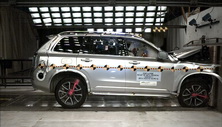
Frontal Crash Test
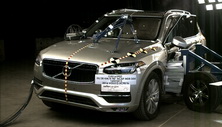
Side Crash Test
Overall Frontal Rating
Driver and Passenger Assessment
Driver Side
Passenger Side
Overall Side Rating
Side Barrier and Side Pole Tests
Driver Side
Passenger Side
Rollover Resistance
No rollover risk estimate available in this dataset
Safety Features
ESC: StandardForward Collision Warning: StandardLane Departure Warning: Standard
Recall Notices
NHTSANHTSA ID: 23V827000December 07, 2023
SEAT BELTS:CRITICAL FASTENERS
Volvo Car USA, LLC (Volvo Car) is recalling certain 2015-2024 XC90 vehicles. The second-row seat belt buckle and lower belt anchor bolts may not be tightened properly.
Remedy Status
Dealers will inspect and tighten the second-row seat belt buckle anchorage bolts, as necessary, free of charge. Owner notification letters were mailed January 19, 2024. Owners may contact Volvo Car customer service at 1-800-458-1552. Volvo Car's number for this recall is R10259.
NHTSA ID: 21V273000April 21, 2021
ELECTRICAL SYSTEM:SOFTWARE
Volvo Car USA, LLC (Volvo Car) is recalling certain 2016-2020 XC90 Excellence vehicles. Liquid or condensation on the rear seat control display may cause the front passenger seat to move back as far as possible.
Remedy Status
Volvo Car will notify owners, and dealers will update the rear seat control display software, free of charge. Owner notification letters were mailed July 14, 2021. Owners may contact Volvo Car customer service at 1-888-458-1552. Volvo Car's number for this recall is R10093.
NHTSA ID: 19V308000April 17, 2019
ENGINE AND ENGINE COOLING:COOLING SYSTEM:HOSES/LINES/PIPING/FITTINGS
Volvo Cars of N.A., LLC (Volvo Cars) is recalling certain 2016 XC90 vehicles. Exposure to heat and humidity may cause the engine coolant bleeder hose to crack, resulting in a coolant leak.
Remedy Status
Volvo Cars will notify owners, and dealers will replace the engine side coolant bleeder hose, free of charge. The recall began June 12, 2019. Owners may contact Volvo customer service at 1-800-458-1552. Volvo's number for this recall is R29936.
NHTSA ID: 16V798000November 02, 2016
SEAT BELTS:FRONT:BUCKLE ASSEMBLY
Volvo Car USA LLC (Volvo) is recalling certain model year 2016-2017 XC90, S90, XC60, V60 Cross Country, V60, S60 Cross Country, S60, and S60 Inscription vehicles manufactured February 16, 2015, to August 22, 2016. On the affected vehicles, the front passenger seat belt buckle attaching stud may loosen, allowing the buckle to separate from the seat belt bracket. As such, these vehicles fail to comply with the requirements of Federal Motor Vehicle Safety Standard (FMVSS) number 210, "Seat Belt Assembly Anchorages" and number 209, "Seat Belt Assemblies."
Remedy Status
Volvo will notify owners, and dealers will inspect the front passenger seat belt buckle stud, replacing the seat belt buckle as needed, free of charge. The recall began January 2017. Owners may contact Volvo customer service at 1-800-458-1552. Volvo's number for this recall is R89708.
NHTSA ID: 16V690000September 26, 2016
EQUIPMENT:APPLIANCE:AIR CONDITIONER
Volvo Cars of North America, LLC (Volvo) is recalling certain model year 2016-2017 Volvo XC90 and S90 vehicles manufactured April 15, 2015 through September 19, 2016. In the affected vehicles, the drain hose for the air conditioning may leak into the passenger compartment due to a drain hose installation error during manufacturing.
Remedy Status
Volvo will notify owners, and dealers will inspect the air conditioning drain hose for proper installation, replacing the hose as necessary, free of charge. The recall is expected to begin on November the 14, 2016. Owners may contact Volvo at 1-800-458-1552. Volvo's number for this campaign is R89707.
NHTSA ID: 16V268000May 04, 2016
VISIBILITY:SUN/MOON ROOF ASSEMBLY
Volvo Car USA LLC (Volvo) is recalling certain model year 2016 XC90 vehicles manufactured January 27, 2015, to April 23, 2016. The sunroofs on the affected vehicles have a switch on the overhead console that may not be adequately recessed to prevent the switch from being unintentionally pressed. When pressed, the sunroof may fully close. As such, these vehicles fail to comply with the requirements of Federal Motor Vehicle Safety Standard (FMVSS) number 118, "Power-Operated Window, Partition, and Roof Panel Systems."
Remedy Status
Volvo will notify owners, and dealers will perform a software upgrade that disables the auto-close function, free of charge. The recall began June 24, 2016. Owners may contact Volvo customer service at 1-800-458-1552 or by visiting http://Volvo.custhelp.com. Volvo's number for this recall is R89702.
NHTSA ID: 15V497000August 06, 2015
AIR BAGS:SIDE/WINDOW
Volvo Cars of N.A., LLC (Volvo) is recalling certain model year 2016 Volvo XC90 vehicles manufactured January 27, 2015, to July 10, 2015. The third row seating side curtain air bags may not fully inflate.
Remedy Status
Volvo will notify owners, and dealers will modify the D-pillar interior panels to allow full inflation of the third row airbags, free of charge. The recall began on September 21, 2015. Owners may contact Volvo Customer Care at 1-800-458-1552.
NHTSA ID: 15V342000June 03, 2015
AIR BAGS:SIDE/WINDOW
Volvo Cars of N.A., LLC (Volvo) is recalling certain model year 2016 Volvo XC90 vehicles manufactured January 27, 2015, to May 19, 2015. The affected vehicles have front seats whose wiring harness for the Side Impact Protection System (SIPS) may have been routed incorrectly.
Remedy Status
Volvo will notify owners, and dealers will inspect the routing of the SIPS wiring, correcting the routing and installing a protective sleeve as necessary, free of charge. The recall began on June 30, 2015. Owners may contact Volvo customer service at 1-800-458-1552. Volvo's number for this recall is R89571.
Owner Complaints
188 totalENGINE
Apr 16, 2026
Hey I purchased a Volvo xc90 2016 seven months ago and I currently still have this car. Also others with the same model, are having problems with oil consumption who is the problem that I’m sadly dealing with, My car burns so much oil and I’m only 19 I got this hoping for a relia...
Preview excerpt
UNKNOWN OR OTHER
FIREFeb 27, 2026
My car started smoking on the road, I parked it. It smoked, Then it caught on fire.
ENGINE
Dec 27, 2025
My vehicle was signaling me to add oil every 600 - 1000 miles around 85,000 miles. The dealership charged me for a chemical treatment to stop the oil burning around 90,000 miles. At about 95,000 miles, my engine failed while driving on the interstate. There was no warning light...
Preview excerpt
ENGINE
Sep 30, 2025
On September 30, 2025, a 2016 Volvo XC90 T6 experienced sudden engine failure while driving westbound on I-75 (Alligator Alley) at highway speed. The vehicle abruptly went into reduced power mode (“turtle mode”) without warning. This forced the driver to stop on the roadside, cre...
Preview excerpt
POWER TRAIN
Sep 9, 2025
Known supercharger leak on 2016 Volvo XC90 at 60,000 miles. Numerous reports of the same failure. Dealer and Volvo declined goodwill repair. Potential safety/fire issue if oil leakage worsens
ENGINE
Aug 12, 2025
This car is consuming oil and has the potential to catastrophically fail, or catch fire.
ENGINE
Jul 30, 2025
Piston ring failure, excessive oil consumption. There was an extended warranty regarding the issue, but it has since been closed. I know there have been multiple lawsuits regarding this issue.
UNKNOWN OR OTHER
1 injuryMay 20, 2025
The back door, or liftgate, closes automatically (without me pressing the close button). This is inconsistent, as it doesn't happen all the time. Each time the car has been off, and maybe it's on some kind of timer. It's happened 3 times, at random, where each time it caught me o...
Preview excerpt
ENGINE
Mar 19, 2025
*the engine is the part that failed due to excessive oil consumption. *it became a safety risk once it started selecting its own driving speed after dropping driving speed to 31mph on [XXX in Raleigh. *the problem was confirmed by the dealer, Volvo of Cary *it has not been inspe...
Preview excerpt
SEAT BELTS
Mar 1, 2025
Safety belt will not retract in pillar when unbuckled.
Showing 10 recent complaints from 188 total
View Full Complaint LogCompare Related Vehicles
Why Compare These Pages
The strongest comparison flow is usually: exact vehicle-year page, then nearby years of the same model, then other 2016 Volvo models. That sequence helps separate one-off year spikes from broader make-wide patterns.
More Volvo XC90 Years
2017 Volvo XC90Compare this year against 2016 for complaint and recall shifts.7r71c2015 Volvo XC90Compare this year against 2016 for complaint and recall shifts.1r0c2018 Volvo XC90Compare this year against 2016 for complaint and recall shifts.3r42c2019 Volvo XC90Compare this year against 2016 for complaint and recall shifts.6r32c2013 Volvo XC90Compare this year against 2016 for complaint and recall shifts.11c2020 Volvo XC90Compare this year against 2016 for complaint and recall shifts.7r24c
More 2016 Volvo Models
2016 Volvo XC60Another 2016 Volvo option for same-year comparison.3r37c2016 Volvo S60Another 2016 Volvo option for same-year comparison.4r26c2016 Volvo V60Another 2016 Volvo option for same-year comparison.4r13c2016 Volvo XC70Another 2016 Volvo option for same-year comparison.2r7c2016 Volvo S90Another 2016 Volvo option for same-year comparison.2r0c
Frequently Asked Questions
How many recalls does the 2016 Volvo XC90 have?
The 2016 Volvo XC90 has 8 recalls recorded by NHTSA.
How many complaints have been filed for the 2016 Volvo XC90?
NHTSA has received 188 owner-reported complaints for the 2016 Volvo XC90.
What is the NHTSA safety rating for the 2016 Volvo XC90?
Our stored NHTSA record for the 2016 Volvo XC90 has an overall rating of 5 out of 5 stars. Stored NHTSA configuration: 2016 Volvo XC90 T6 SUV AWD. NCAP Vehicle ID: 10908. Ratings describe one stored NHTSA configuration, not every trim, body style or drivetrain for this model year.
What are the most common problems with the 2016 Volvo XC90?
The most frequent complete stored component labels for the 2016 Volvo XC90 are engine (59 reports), electrical system (38 reports), unknown or other (21 reports). These are exact-label counts, not broader component-group totals or confirmed defects.
Does the 2016 Volvo XC90 have any recalls?
Yes. NHTSA has 8 recalls on record for the 2016 Volvo XC90. Scroll up to review the published recall summaries, consequences, and remedies. To check for unrepaired recalls on your specific vehicle, use your VIN at nhtsa.gov/recalls.
Check Another Vehicle
Look up recalls and complaints for any year, make, and model.
This page summarizes publicly available data from the National Highway Traffic Safety Administration (NHTSA). Complaint counts reflect reports submitted to NHTSA by vehicle owners and do not by themselves prove defect severity or vehicle safety. Safety ratings may not be available for all vehicle-years. This site is not affiliated with NHTSA or any vehicle manufacturer. For official information, visit the official NHTSA page for this vehicle.