Audi · A3 · 2016
2016 Audi A3
4
Recalls
119
Complaints
5/5
NCAP overall
The 2016 Audi A3 has 4 recalls and 119 owner-reported complaints on file with NHTSA. One stored NHTSA configuration has an overall rating of 5 out of 5 stars, not a rating for all versions. Most frequent stored component label: air bags (37 reports).
Stored NHTSA configuration: 2016 Audi A3 4 DR AWD NCAP Vehicle ID: 10082
Ratings describe one stored NHTSA configuration, not every trim, body style or drivetrain for this model year. How this configuration is selected
Source: NHTSA Public Records
NHTSA source checks for this vehicle year
- Complaints
- Separate successful check not recorded.
- Recalls
- Separate successful check not recorded.
- Safety ratings
- Separate successful check not recorded.
- Investigations
- Separate successful check not recorded.
- Manufacturer communications
- Separate successful check not recorded.
Checks are recorded separately for each dataset, not for the whole page. Dates use UTC. A missing check date does not mean no records exist.
Vehicle import recorded: Aug 31, 2026. This is the stored import date, not confirmation that every source was successfully refreshed.
Research Context
The 2016 Audi A3 page works best as a research starting point. Complaint totals show how much owner-reported activity exists, while recalls and investigations help show whether any of that activity turned into formal safety action.
Because this is a newer-era vehicle page, it usually helps to compare this year against nearby model years before deciding whether a complaint pattern looks isolated or persistent. On this page, the most frequent complete stored component label is air bags with 37 reported complaints.
Best Research Moves
- Use the complaint log to understand what owners were actually reporting instead of relying only on the raw complaint total.
- Review the recall section even if the total is smaller, because a limited number of recalls can still point to meaningful safety actions.
- This page is primarily a complaints-and-recalls research surface, so compare nearby model years before treating the complaint total as a standalone verdict.
Key Takeaways
- The 2016 Audi A3 currently shows 4 NHTSA recalls listed on this page and 119 owner-reported complaints.
- This page currently shows no linked NHTSA investigations.
- This page reflects complaint volume, recall history, and NHTSA test data, but it does not diagnose causes or rank reliability by itself.
- Safety data currently shows 5/5 overall NHTSA rating for one stored configuration, not all versions.
- The most frequent complete stored component labels on this page are air bags (37), fuel/propulsion system (13), electrical system (8).
- Vehicle
- 2016 Audi A3
- Recalls
- 4
- Complaints
- 119
- Stored Configuration Overall Rating
- 5/5. Stored NHTSA configuration: 2016 Audi A3 4 DR AWD. NCAP Vehicle ID: 10082.
How to Interpret This Page
This page combines three types of NHTSA data: recall campaigns (official manufacturer or government actions), owner complaints (unverified consumer reports), and crash test ratings (where available). A vehicle with many complaints is not necessarily less reliable — complaint volume correlates with sales volume and vehicle age. Recalls indicate identified defects, not overall quality. To compare this model year with others, use the year navigation in the sidebar or return to the model overview page.
If you are researching a used vehicle, start with the complaint categories, compare them against the recall list, and then check nearby model years to see whether the same issue profile repeats. That usually produces a better buying or research signal than treating the raw complaint total as a standalone safety ranking.
NHTSA Configuration Test Results
Stored NHTSA configuration: 2016 Audi A3 4 DR AWD NCAP Vehicle ID: 10082
Ratings describe one stored NHTSA configuration, not every trim, body style or drivetrain for this model year. How this configuration is selected
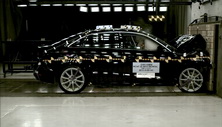
Frontal Crash Test
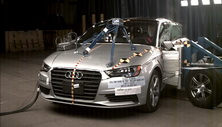
Side Crash Test
Overall Frontal Rating
Driver and Passenger Assessment
Driver Side
Passenger Side
Overall Side Rating
Side Barrier and Side Pole Tests
Driver Side
Passenger Side
Rollover Resistance
No rollover risk estimate available in this dataset
Safety Features
ESC: StandardForward Collision Warning: OptionalLane Departure Warning: Optional
Recall Notices
NHTSANHTSA ID: 24V110000February 14, 2024
FUEL SYSTEM, GASOLINE
Volkswagen Group of America, Inc. (Volkswagen) is recalling certain front-wheel drive 2015-2020 Audi A3 Sedan, 2015-2019 Audi A3 Cabriolet, 2019-2020 Volkswagen Jetta GLI, 2018 Golf Sportwagen GP, 2018-2019 Golf Sportwagen A7, 2015-2017 Golf Sportwagen, 2015-2020 Golf GTI, and 2015-2020 Golf A7 vehicles. Due to a problem with a suction jet pump seal inside the fuel tank, fuel may flow into the evaporative emissions (EVAP) system and possibly leak out of the charcoal canister.
Remedy Status
Dealers will replace the suction pump, free of charge. Final owner notification letters for Audi owners were mailed on July 25, 2024. Final owner letters for VW owners were mailed on August 13, 2024. Owners may contact Volkswagen customer service at 1-800-893-5298 or Audi customer service at 1-800-253-2834. Volkswagen's numbers for this recall are VW: 20UF/Audi: 20YF. Vehicles that were previously recalled under 16V-647 will need to have the new remedy completed. This recall expands and replaces previous recall number 16V-647.
NHTSA ID: 22V543000July 27, 2022
AIR BAGS:FRONTAL:PASSENGER SIDE:INFLATOR MODULE
Volkswagen Group of America, Inc. (Volkswagen) is recalling certain 2016 Audi TT Roadster, TT Coupe, S3 Sedan, R8 Coupe, A3 Sedan, A3 Etron, A3 Cabriolet, 2016 Golf Sportwagen, Golf R, Golf GTI, Golf A7, and E Golf vehicles. During air bag deployment, the front passenger air bag may explode or deploy improperly.
Remedy Status
Dealers will replace the front-passenger air bag module, free of charge. Owner notification letters were mailed December 16, 2022. Owners may contact Volkswagen's customer service at 1-800-893-5298. Audi's customer service at 1-800-253-2834. Volkswagen's number for this recall is 69DY and 61C1.
NHTSA ID: 21V198000March 22, 2021
AIR BAGS:SENSOR:OCCUPANT CLASSIFICATION:FRONT PASSENGER
Volkswagen Group of America, Inc. (Audi) is recalling certain 2015-2020 Audi S3 Sedan, A3 Sedan, 2016-2018 A3 Etron, 2017-2020 RS3 Sedan, and 2015-2019 A3 Cabriolet vehicles. The passenger occupant detection system (PODS) may malfunction and switch off the passenger air bag even when the seat is occupied.
Remedy Status
Dealers will replace the PODS sensor mat and update the PODS control module, free of charge. Owners letters were mailed December 23, 2021. Owners may contact Audi customer service at 1-800-253-2834. Audi's number for this recall is 69BY.
NHTSA ID: 19V474000June 19, 2019
AIR BAGS:SENSOR:OCCUPANT CLASSIFICATION
Volkswagen Group of America, Inc. (Audi) is recalling certain 2015-2016 Audi S3 Sedan, 2015-2019 A3 Sedan and A3 Cabriolet, 2016-2018 A3 e-tron, and 2017-2019 RS3 vehicles. An improper electrical contact may cause the Passenger Occupant Detection System (PODS) to falsely detect a malfunction and deactivate the passenger air bag.
Remedy Status
Audi will notify owners, and dealers will replace the connector and reroute the cable, free of charge. The recall began September 12, 2019. Owners may contact Volkswagen customer service at 1-800-253-2834. Audi's number for this recall is 69Z4.
Owner Complaints
119 totalENGINE AND ENGINE COOLING,AIR BAGS
Jul 21, 2026
The contact owns a 2016 Audi A3. The contact stated that the front passenger’s side air bag occupant sensor failed to identify a passenger seat in the seat. A dealer was contacted. No warning light was illuminated. The vehicle was taken to a dealer where it was diagnosed and dete...
Preview excerpt
ELECTRICAL SYSTEM,FUEL/PROPULSION SYSTEM
Apr 9, 2026
Electrical problems and fuel leak
SUSPENSION,EXTERIOR LIGHTING,STRUCTURE
CRASH1 injuryNov 8, 2025
This vehicle was involved in a rear end collision in late 2025. The vehicle was just sold at auction with a clean title even though it has frame damage that is more than 100% of the cost of this vehicle. It is sold with a clean title and I am worried that a used car dealership wi...
Preview excerpt
FUEL/PROPULSION SYSTEM
FIRESep 24, 2025
FUEL LEAKED ALL MY GARAGE ALMOST CAUSING A FIRE IN MY HOME WHILE I WAS SLEEPING. I HAVE HAD THE FUEL TANK REPLACED 3 TIMES. AND I HAD TO PAY OUT OF POCKET TO HAVE IT REPLACED BECAUSE AUDI WOULD NOT REPLACE THE RECALL OF IT SO I AM REACHING OUT TO YOU SO YOU CAN REACH OUT TO AUDI ...
Preview excerpt
ELECTRICAL SYSTEM
Sep 12, 2025
The contact owns a 2016 Audi A3. The contact stated that while the vehicle was parked with the engine running, the vehicle experienced a sudden loss of motive power. During the failure, the message “Driver System Fault” was displayed on the instrument panel. The contact was unabl...
Preview excerpt
ELECTRICAL SYSTEM
Sep 12, 2025
My 2016 Audi A3 Sportsback E-tron vehicle was parked at my house. When I went to start it the engine did nothing, no power. The message “Driver System Fault” and a red triangle with a red ! in the middle was displayed on the instrument panel. I was unable to start or operate the ...
Preview excerpt
AIR BAGS
Aug 5, 2025
Passenger airbag not activated when passenger is seated
AIR BAGS
Jul 15, 2025
Passenger Occupancy Detection System is malfunctioning. Pre-sense system fault
UNKNOWN OR OTHER
Apr 23, 2025
The rearview camera is failed. Yes I can have an inspection done. Yes, dealer confirmed that camera is failed but wanted hundreds of dollars to troubleshoot. Has not been inspected by police or insurance. No it just stopped working one day.
POWER TRAIN,FUEL/PROPULSION SYSTEM
Apr 10, 2025
Mechatronics unit failed, stalled on freeway nearly caused an accident behind me.
Showing 10 recent complaints from 119 total
View Full Complaint LogCompare Related Vehicles
Why Compare These Pages
The strongest comparison flow is usually: exact vehicle-year page, then nearby years of the same model, then other 2016 Audi models. That sequence helps separate one-off year spikes from broader make-wide patterns.
More Audi A3 Years
2017 Audi A3Compare this year against 2016 for complaint and recall shifts.3r70c2015 Audi A3Compare this year against 2016 for complaint and recall shifts.2r178c2018 Audi A3Compare this year against 2016 for complaint and recall shifts.3r45c2019 Audi A3Compare this year against 2016 for complaint and recall shifts.3r14c2013 Audi A3Compare this year against 2016 for complaint and recall shifts.3r20c2020 Audi A3Compare this year against 2016 for complaint and recall shifts.3r17c
More 2016 Audi Models
2016 Audi Q5Another 2016 Audi option for same-year comparison.5r77c2016 Audi A6Another 2016 Audi option for same-year comparison.3r51c2016 Audi Q3Another 2016 Audi option for same-year comparison.3r28c2016 Audi A4Another 2016 Audi option for same-year comparison.3r25c2016 Audi A7Another 2016 Audi option for same-year comparison.3r15c2016 Audi S3Another 2016 Audi option for same-year comparison.3r14c
Frequently Asked Questions
How many recalls does the 2016 Audi A3 have?
The 2016 Audi A3 has 4 recalls recorded by NHTSA.
How many complaints have been filed for the 2016 Audi A3?
NHTSA has received 119 owner-reported complaints for the 2016 Audi A3.
What is the NHTSA safety rating for the 2016 Audi A3?
Our stored NHTSA record for the 2016 Audi A3 has an overall rating of 5 out of 5 stars. Stored NHTSA configuration: 2016 Audi A3 4 DR AWD. NCAP Vehicle ID: 10082. Ratings describe one stored NHTSA configuration, not every trim, body style or drivetrain for this model year.
What are the most common problems with the 2016 Audi A3?
The most frequent complete stored component labels for the 2016 Audi A3 are air bags (37 reports), fuel/propulsion system (13 reports), electrical system (8 reports). These are exact-label counts, not broader component-group totals or confirmed defects.
Does the 2016 Audi A3 have any recalls?
Yes. NHTSA has 4 recalls on record for the 2016 Audi A3. Scroll up to review the published recall summaries, consequences, and remedies. To check for unrepaired recalls on your specific vehicle, use your VIN at nhtsa.gov/recalls.
Check Another Vehicle
Look up recalls and complaints for any year, make, and model.
This page summarizes publicly available data from the National Highway Traffic Safety Administration (NHTSA). Complaint counts reflect reports submitted to NHTSA by vehicle owners and do not by themselves prove defect severity or vehicle safety. Safety ratings may not be available for all vehicle-years. This site is not affiliated with NHTSA or any vehicle manufacturer. For official information, visit the official NHTSA page for this vehicle.