Cadillac · Escalade · 2017
2017 Cadillac Escalade
2
Recalls
84
Complaints
4/5
NCAP overall
The 2017 Cadillac Escalade has 2 recalls and 84 owner-reported complaints on file with NHTSA. One stored NHTSA configuration has an overall rating of 4 out of 5 stars, not a rating for all versions. Most frequent stored component label: engine (17 reports).
Stored NHTSA configuration: 2017 Cadillac Escalade SUV RWD NCAP Vehicle ID: 11282
Ratings describe one stored NHTSA configuration, not every trim, body style or drivetrain for this model year. How this configuration is selected
Source: NHTSA Public Records
NHTSA source checks for this vehicle year
- Complaints
- Separate successful check not recorded.
- Recalls
- Separate successful check not recorded.
- Safety ratings
- Separate successful check not recorded.
- Investigations
- Separate successful check not recorded.
- Manufacturer communications
- Separate successful check not recorded.
Checks are recorded separately for each dataset, not for the whole page. Dates use UTC. A missing check date does not mean no records exist.
Vehicle import recorded: Apr 28, 2026. This is the stored import date, not confirmation that every source was successfully refreshed.
Research Context
The 2017 Cadillac Escalade page works best as a research starting point. Complaint totals show how much owner-reported activity exists, while recalls and investigations help show whether any of that activity turned into formal safety action.
Because this is a newer-era vehicle page, it usually helps to compare this year against nearby model years before deciding whether a complaint pattern looks isolated or persistent. On this page, the most frequent complete stored component label is engine with 17 reported complaints.
Best Research Moves
- Use the complaint log to understand what owners were actually reporting instead of relying only on the raw complaint total.
- Review the recall section even if the total is smaller, because a limited number of recalls can still point to meaningful safety actions.
- This page is primarily a complaints-and-recalls research surface, so compare nearby model years before treating the complaint total as a standalone verdict.
Key Takeaways
- The 2017 Cadillac Escalade currently shows 2 NHTSA recalls listed on this page and 84 owner-reported complaints.
- This page currently shows no linked NHTSA investigations.
- This page reflects complaint volume, recall history, and NHTSA test data, but it does not diagnose causes or rank reliability by itself.
- Safety data currently shows 4/5 overall NHTSA rating for one stored configuration, not all versions.
- The most frequent complete stored component labels on this page are engine (17), service brakes (11), power train (10).
- Vehicle
- 2017 Cadillac Escalade
- Recalls
- 2
- Complaints
- 84
- Stored Configuration Overall Rating
- 4/5. Stored NHTSA configuration: 2017 Cadillac Escalade SUV RWD. NCAP Vehicle ID: 11282.
How to Interpret This Page
This page combines three types of NHTSA data: recall campaigns (official manufacturer or government actions), owner complaints (unverified consumer reports), and crash test ratings (where available). A vehicle with many complaints is not necessarily less reliable — complaint volume correlates with sales volume and vehicle age. Recalls indicate identified defects, not overall quality. To compare this model year with others, use the year navigation in the sidebar or return to the model overview page.
If you are researching a used vehicle, start with the complaint categories, compare them against the recall list, and then check nearby model years to see whether the same issue profile repeats. That usually produces a better buying or research signal than treating the raw complaint total as a standalone safety ranking.
NHTSA Configuration Test Results
Stored NHTSA configuration: 2017 Cadillac Escalade SUV RWD NCAP Vehicle ID: 11282
Ratings describe one stored NHTSA configuration, not every trim, body style or drivetrain for this model year. How this configuration is selected
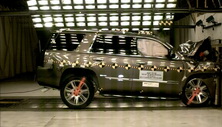
Frontal Crash Test
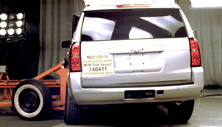
Side Crash Test
Overall Frontal Rating
Driver and Passenger Assessment
Driver Side
Passenger Side
Overall Side Rating
Side Barrier and Side Pole Tests
Driver Side
Passenger Side
Rollover Resistance
No rollover risk estimate available in this dataset
Safety Features
ESC: StandardForward Collision Warning: OptionalLane Departure Warning: Optional
Recall Notices
NHTSANHTSA ID: 19V645000September 06, 2019
SERVICE BRAKES, HYDRAULIC:POWER ASSIST:VACUUM
General Motors LLC (GM) is recalling certain 2015-2017 Cadillac Escalade, 2014-2018 Chevrolet Silverado, GMC Sierra, 2015-2018 Chevrolet Suburban, Tahoe, GMC Yukon vehicles. The amount of vacuum created by the vacuum pump may decrease over time.
Remedy Status
GM will notify owners, and dealers will reprogram the Electronic Brake Control Module, free of charge. The recall began October 8, 2019. Owners may contact Chevrolet customer service at 1-800-630-2438, Cadillac customer service at 1-800-458-8006 or GMC customer service at 1-800-462-8782. GM's number for this recall is N192268490.
NHTSA ID: 16V651000September 08, 2016
AIR BAGS:FRONTAL
General Motors LLC (GM) is recalling certain model year 2015-2017 Chevrolet Silverado 2500 HD, 3500 HD, Tahoe, Suburban, GMC Sierra 2500 HD and 3500 HD, GMC Yukon, GMC Yukon XL, Cadillac Escalade and Cadillac Escalade ESV vehicles and 2014-2017 Chevrolet Corvette, Silverado 1500, Trax, Caprice Police Pursuit Vehicle, GMC Sierra 1500, Buick Encore, and 2014-2016 Buick Lacrosse, Chevrolet Spark EV and SS vehicles. In the affected vehicles, certain driving conditions may cause the air bag sensing and diagnostic module (SDM) software to activate a diagnostic test. During this test, deployment of the frontal air bags and the seat belt pretensioners would not occur in the event of a crash.
Remedy Status
GM will notify owners, and dealers will reflash the SDM software. Vehicles that have had a previous air bag deployment will have the SDM replaced. These repairs will be performed free of charge. The recall began on October 13, 2016. Owners may contact Buick customer service at 1-800-521-7300, Cadillac customer service at 1-800-458-8006, Chevrolet customer service at 1-800-222-1020, or GMC customer service at 1-800-462-8782. GM's number for this recall is 16007.
Owner Complaints
84 totalENGINE
Apr 8, 2026
Engine misfire, AFM lifter collapse, defective AFM/DOD lifter technology. The three diagnosis I have had done to check for multiple opinions have all come back the same with a collapsed AFM lifter causing camshaft damage, overall failure of an AFM/DOD deactiviating lifter in the ...
Preview excerpt
POWER TRAIN,ENGINE
Mar 3, 2026
My 2017 Cadillac Escalade with the 6.2L V8 engine experienced AFM (Active Fuel Management) valve lifter failure. While driving on the freeway the vehicle began stuttering and shaking violently, and it felt as though I had lost control of the vehicle. The check engine light illumi...
Preview excerpt
SERVICE BRAKES
Nov 22, 2025
2017 Cadillac Escalade ESV VIN: [XXX] Dealership: Jim Coleman Cadillac, Bethesda, MD I am reporting a brake safety failure involving severe and abnormal brake component wear that created an immediate safety risk with breaks completely failing while driving at high speed on the ...
Preview excerpt
SERVICE BRAKES
Nov 22, 2025
Incident date: 2025-11-22 Location: I-70 (while taking an exit) Dealership: Jim Coleman Cadillac (vehicle purchased and routinely serviced here) I am reporting a sudden and severe brake system failure that created an immediate risk to vehicle occupants. On 2025-11-22 my wife wa...
Preview excerpt
STEERING
Nov 22, 2025
System that failed/malfunctioned: power steering (EPS) system How was your safety or the safety of others put at risk? Power steering went out while driving. Steering wheel immediately became stiff and made it extremely to turn the wheel in either direction. Has the problem be...
Preview excerpt
STEERING,UNKNOWN OR OTHER
1 injuryAug 21, 2025
I am the owner of a 2017 Cadillac Escalade affected by Special Coverage Adjustment 17016 (Program ID N162058750). The issue involves the chrome trim on the steering wheel separating, creating a sharp edge that poses a safety hazard to the driver. I contacted Cadillac to request ...
Preview excerpt
FUEL SYSTEM, GASOLINE
Jul 16, 2025
The contact owns a 2017 Cadillac Escalade. The contact stated while driving 25 MPH, the vehicle briefly jerked and was unable to accelerate as needed. The check engine warning light was illuminated. The vehicle was taken to an independent mechanic, who diagnosed a failure with th...
Preview excerpt
ENGINE
Jun 27, 2025
Widely known problem with the 2017 Escalade motor with the active fuel management system. Driving in a very remote part of Wisconsin when engine light went on, indicating a lifter failure due to the afv shutting down cylinders. This is an extremly common problem with this engine/...
Preview excerpt
ENGINE
Jun 2, 2025
At 86,000 miles my 6.2 engine had to be rebuilt. Costing $14,000
ENGINE
Jun 1, 2025
With only 78k miles on my 2017 Escalade the same issue happened with the lifters like in the 2021-2025 models. We had to pay out 14k to replace the motor. GM has known about this problem for almost a decade and it’s not fair that we had to pay out this much money to replace an en...
Preview excerpt
Showing 10 recent complaints from 84 total
View Full Complaint LogCompare Related Vehicles
Why Compare These Pages
The strongest comparison flow is usually: exact vehicle-year page, then nearby years of the same model, then other 2017 Cadillac models. That sequence helps separate one-off year spikes from broader make-wide patterns.
More Cadillac Escalade Years
2018 Cadillac EscaladeCompare this year against 2017 for complaint and recall shifts.1r20c2016 Cadillac EscaladeCompare this year against 2017 for complaint and recall shifts.4r100c2019 Cadillac EscaladeCompare this year against 2017 for complaint and recall shifts.21c2015 Cadillac EscaladeCompare this year against 2017 for complaint and recall shifts.7r101c2020 Cadillac EscaladeCompare this year against 2017 for complaint and recall shifts.2r13c2014 Cadillac EscaladeCompare this year against 2017 for complaint and recall shifts.2r19c
More 2017 Cadillac Models
2017 Cadillac XT5Another 2017 Cadillac option for same-year comparison.1r117c2017 Cadillac ATSAnother 2017 Cadillac option for same-year comparison.2r31c2017 Cadillac CTSAnother 2017 Cadillac option for same-year comparison.2r26c2017 Cadillac CT6Another 2017 Cadillac option for same-year comparison.2r25c2017 Cadillac XTSAnother 2017 Cadillac option for same-year comparison.24c2017 Cadillac Escalade ESVAnother 2017 Cadillac option for same-year comparison.1r0c
Frequently Asked Questions
How many recalls does the 2017 Cadillac Escalade have?
The 2017 Cadillac Escalade has 2 recalls recorded by NHTSA.
How many complaints have been filed for the 2017 Cadillac Escalade?
NHTSA has received 84 owner-reported complaints for the 2017 Cadillac Escalade.
What is the NHTSA safety rating for the 2017 Cadillac Escalade?
Our stored NHTSA record for the 2017 Cadillac Escalade has an overall rating of 4 out of 5 stars. Stored NHTSA configuration: 2017 Cadillac Escalade SUV RWD. NCAP Vehicle ID: 11282. Ratings describe one stored NHTSA configuration, not every trim, body style or drivetrain for this model year.
What are the most common problems with the 2017 Cadillac Escalade?
The most frequent complete stored component labels for the 2017 Cadillac Escalade are engine (17 reports), service brakes (11 reports), power train (10 reports). These are exact-label counts, not broader component-group totals or confirmed defects.
Does the 2017 Cadillac Escalade have any recalls?
Yes. NHTSA has 2 recalls on record for the 2017 Cadillac Escalade. Scroll up to review the published recall summaries, consequences, and remedies. To check for unrepaired recalls on your specific vehicle, use your VIN at nhtsa.gov/recalls.
Check Another Vehicle
Look up recalls and complaints for any year, make, and model.
This page summarizes publicly available data from the National Highway Traffic Safety Administration (NHTSA). Complaint counts reflect reports submitted to NHTSA by vehicle owners and do not by themselves prove defect severity or vehicle safety. Safety ratings may not be available for all vehicle-years. This site is not affiliated with NHTSA or any vehicle manufacturer. For official information, visit the official NHTSA page for this vehicle.