Honda · CR-V · 2020
2020 Honda CR-V
6
Recalls
312
Complaints
5/5
NCAP overall
The 2020 Honda CR-V has 6 recalls and 312 owner-reported complaints on file with NHTSA. One stored NHTSA configuration has an overall rating of 5 out of 5 stars, not a rating for all versions. Most frequent stored component label: forward collision avoidance (50 reports).
Stored NHTSA configuration: 2020 Honda CR-V SUV FWD NCAP Vehicle ID: 14820
Ratings describe one stored NHTSA configuration, not every trim, body style or drivetrain for this model year. How this configuration is selected
Source: NHTSA Public Records
NHTSA source checks for this vehicle year
- Complaints
- Separate successful check not recorded.
- Recalls
- Separate successful check not recorded.
- Safety ratings
- Separate successful check not recorded.
- Investigations
- Separate successful check not recorded.
- Manufacturer communications
- Separate successful check not recorded.
Checks are recorded separately for each dataset, not for the whole page. Dates use UTC. A missing check date does not mean no records exist.
Vehicle import recorded: May 4, 2026. This is the stored import date, not confirmation that every source was successfully refreshed.
Research Context
The 2020 Honda CR-V page works best as a research starting point. Complaint totals show how much owner-reported activity exists, while recalls and investigations help show whether any of that activity turned into formal safety action.
Because this is a newer-era vehicle page, it usually helps to compare this year against nearby model years before deciding whether a complaint pattern looks isolated or persistent. On this page, the most frequent complete stored component label is forward collision avoidance with 50 reported complaints.
Best Research Moves
- Use the complaint log to see whether the 2020 Honda CR-V reports cluster around one repeated symptom or spread across multiple systems.
- Compare the recall list with the complaint mix to see whether the most reported issues overlap with formal NHTSA safety campaigns.
- Check the linked investigations for extra ODI context if you want to see whether owner complaints escalated into formal defect review.
Key Takeaways
- The 2020 Honda CR-V currently shows 6 NHTSA recalls listed on this page and 312 owner-reported complaints.
- This page currently shows 2 NHTSA investigations linked to this page.
- This page reflects complaint volume, recall history, and NHTSA test data, but it does not diagnose causes or rank reliability by itself.
- Safety data currently shows 5/5 overall NHTSA rating for one stored configuration, not all versions.
- The most frequent complete stored component labels on this page are forward collision avoidance (50), air bags (38), steering (24).
- Vehicle
- 2020 Honda CR-V
- Recalls
- 6
- Complaints
- 312
- Stored Configuration Overall Rating
- 5/5. Stored NHTSA configuration: 2020 Honda CR-V SUV FWD. NCAP Vehicle ID: 14820.
How to Interpret This Page
This page combines three types of NHTSA data: recall campaigns (official manufacturer or government actions), owner complaints (unverified consumer reports), and crash test ratings (where available). A vehicle with many complaints is not necessarily less reliable — complaint volume correlates with sales volume and vehicle age. Recalls indicate identified defects, not overall quality. To compare this model year with others, use the year navigation in the sidebar or return to the model overview page.
If you are researching a used vehicle, start with the complaint categories, compare them against the recall list, and then check nearby model years to see whether the same issue profile repeats. That usually produces a better buying or research signal than treating the raw complaint total as a standalone safety ranking.
NHTSA Configuration Test Results
Stored NHTSA configuration: 2020 Honda CR-V SUV FWD NCAP Vehicle ID: 14820
Ratings describe one stored NHTSA configuration, not every trim, body style or drivetrain for this model year. How this configuration is selected
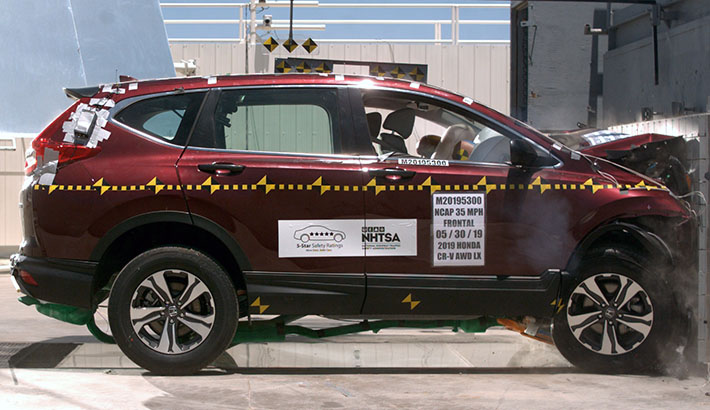
Frontal Crash Test
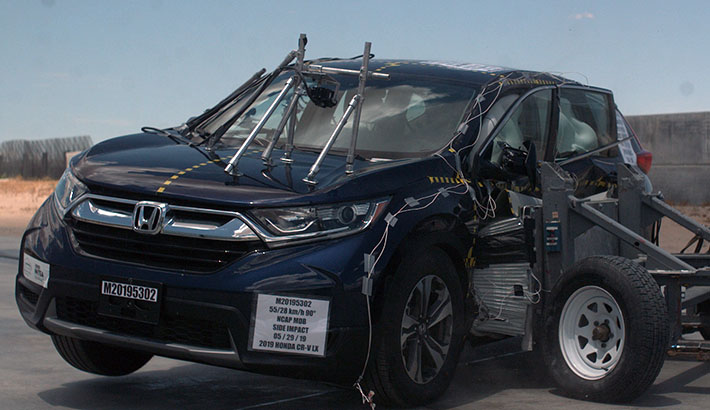
Side Crash Test
Overall Frontal Rating
Driver and Passenger Assessment
Driver Side
Passenger Side
Overall Side Rating
Side Barrier and Side Pole Tests
Driver Side
Passenger Side
Rollover Resistance
No rollover risk estimate available in this dataset
Safety Features
ESC: StandardForward Collision Warning: StandardLane Departure Warning: Standard
Recall Notices
NHTSANHTSA ID: 24V064000February 01, 2024
AIR BAGS:SENSOR:OCCUPANT CLASSIFICATION:FRONT PASSENGER
Honda (American Honda Motor Co.) is recalling certain 2020-2022 Pilot, Accord, Civic sedan, HR-V, Odyssey, 2020 Civic coupe, Fit, 2021-2022 Civic hatchback, 2021 Civic Type R, Insight, 2020-2021 CR-V, CR-V Hybrid, Passport, Ridgeline, Accord Hybrid, 2020 Acura MDX, 2022 Acura MDX, 2020-2022 Acura RDX, and 2020-2021 Acura TLX vehicles. The front passenger seat weight sensor may crack and short circuit, failing to suppress the air bag as intended.
Remedy Status
Dealers will replace the seat weight sensors, free of charge. Owner notification letters were mailed March 28, 2024, October 18, 2024, and August 2025. This is a phased recall. Owners may contact Honda customer service at 1-888-234-2138. Honda's numbers for these recalls are XHP and VHQ.
NHTSA ID: 23V858000December 18, 2023
FUEL SYSTEM, GASOLINE:DELIVERY:FUEL PUMP
Honda (American Honda Motor Co.) is recalling certain 2013-2023 Honda Accord, Civic Coupe, Civic Sedan, Civic Hatchback, Civic Type R, CR-V, HR-V, Ridgeline, Odyssey, Acura ILX, MDX, MDX Hybrid, RDX, RLX, TLX, 2019-2022 Honda Insight, Passport, 2020 Honda CR-V Hybrid, 2018-2019 Honda Clarity PHEV, Fit, and 2015-2020 Honda Accord Hybrid, Pilot, Acura NSX vehicles. The fuel pump inside the fuel tank may fail.
Remedy Status
Dealers will replace the fuel pump module, free of charge. Owner letters were mailed September 6, 2024. Owners may contact Honda customer service at 1-888-234-2138. Honda's numbers for this recall are KGC and KGD. This recall is an expansion of NHTSA recall numbers 21V-215 and 20V-314.
NHTSA ID: 23V524000July 27, 2023
EQUIPMENT:OTHER:LABELS
Honda (American Honda Motor Co.) is recalling certain 2017, 2020, and 2022 CR-V vehicles. The certification label on the driver's side door states incorrect Gross Vehicle Weight Rating (GVWR), Gross Axle Weight Rating (GAWR), and tire size information. As such, these vehicles fail to comply with the requirements of Federal Motor Vehicle Safety Standard number 110, "Tire Selection and Rims."
Remedy Status
Dealers will install a new corrected label, free of charge. Owner notification letters were mailed September 18, 2023. Owners may contact Honda customer service at 1-888-234-2138. Honda's number for this recall is CF7.
NHTSA ID: 23V158000March 09, 2023
SEAT BELTS:FRONT:BUCKLE ASSEMBLY
Honda (American Honda Motor Co.) is recalling certain 2017-2020 CR-V, 2018-2019 Accord and Accord Hybrid, 2018-2020 Odyssey, 2019 Insight, and 2019-2020 Acura RDX vehicles. A manufacturing issue with the front seat belts may cause the seat belt buckle channel to interfere with the release button, preventing the seat belt buckle from latching.
Remedy Status
Dealers will replace the driver and front passenger seat belt buckle release buttons or the buckle assemblies as necessary, free of charge. Owner notification letters were mailed April 18, 2023. Owners may contact Honda customer service at 1-888-234-2138. Honda's numbers for this recall are NDA, QDB, BDC, MDD, LD9. TDF, FDG, ODH, YDI, ZDE.
NHTSA ID: 22V380000May 26, 2022
FUEL SYSTEM, GASOLINE:STORAGE:TANK ASSEMBLY
Honda (American Honda Motor Co.) is recalling certain 2020 CR-V vehicles. The clip for the absorber inside the fuel tank was not secured properly and may detach, which can cause an inaccurate fuel gauge reading.
Remedy Status
Dealers will replace the fuel tank, free of charge. Owner notification letters were mailed July 5, 2022. Owners may contact Honda customer service at 1-888-234-2138. Honda's number for this recall is RCB.
NHTSA ID: 19V865000December 05, 2019
STRUCTURE:FRAME AND MEMBERS
Honda (American Honda Motor Co.) is recalling certain 2019-2020 CR-V vehicles. The rear subframe bolts were improperly manufactured and may loosen, allowing the rear subframe to separate.
Remedy Status
Honda will notify owners, and dealers will inspect the rear subframe bolts and retorque them or replace them, as necessary, free of charge. The recall began January 27, 2020. Owners may contact Honda customer service at 1-888-234-2138. Honda's number for this recall is R6M.
Investigations
2 totalOn February 21, 2022, the Office of Defects Investigation (ODI) opened Preliminary Evaluation (PE22003) to assess reports of inadvertent activation of the Collision Mitigation Braking System (CMBS), an automatic emergency braking (AEB) system, in model year 2017-2019 Honda CR-V and 2018-2019 Honda Accord vehicles. The reports allege that activation of the AEB system occurs while driving with no apparent obstruction in the vehicle's forward path, resulting in sudden vehicle deceleration. Honda indicated that they were aware of a total of X,XXX reports that may relate to the alleged defect. Honda provided analysis of the alleged defect and alleges that some customers possibly had an inadequate understanding of the CMBS and its limitations. However, many consumer complaints allege that Honda dealerships were unable to reproduce the condition or state that they were informed that this is considered normal CMBS operation. To date, ODI has received a total of 1,294 consumer complaints of inadvertent activation of CMBS in 2017-2022 Honda CR-V and 2018-2022 Honda Accord vehicles. A total of 31 complaints alleged a crash and 50 alleged an injury. The Total column in the Failure Report Summary removes duplicate reports and shows the total number of reports with unique VINs from all Manufacturer, ODI, and EWR data sources. In some cases, there were multiple reports associated with a particular vehicle in which recurring failures were alleged. In total, there were X,XXX reports, 93 injury incidents and 47 crashes involving vehicles with unique VINs that may relate to the alleged defect. PE22-003 has been upgraded to an Engineering Analysis to further assess the scope, frequency, and potential safety related consequences of the inadvertent AEB activations. The scope has been expanded to include assessment of model year 2020-2022 Honda CR-V and Accord vehicles. To review the ODI reports cited in the Opening Resume ODI Report Identification Number document, go to NHTSA.gov.
Component: FORWARD COLLISION AVOIDANCE: AUTOMATIC EMERGENCY BRAKINGOpened: Apr 15, 2024
PEClosed
On November 29, 2022, the Office of Defects Investigation (ODI) opened PE 22-011 after reviewing field reports alleging rear differential seizure in 2018-2022MY Honda CR-V and HR-V vehicles equipped with all wheel drive. To date, ODI has not received any consumer complaints. Some of the field reports received alleged the vehicle’s wheels locked up with no warning while the vehicle was in motion. These vehicles were towed to a dealership. Examination of these vehicles showed the driveshaft had broken and the differential unit was completely damaged. The field reports cited a lack of oil due to damaged oil seals as the cause. Honda provided data including consumer complaints, field reports, and warranty claims they received relating to the loss of oil retention and resulting differential damage. Honda’s data cited 1201 incidents with unique vehicle identification numbers (VINs). The rear differential oil seals prevent the oil from leaking out and protect internal components from contaminants. A loss of oil lubrication results in failure of the vehicle differential. Honda stated that the oil seal’s lip contact with the driveshaft may become unstable due to intermittent changes in internal pressure. Their review of field report and warranty data indicated that these failures occurred early in the vehicle’s life thus the failures were covered by the manufacturer’s warranty. Honda stated that in November 2021 they changed the seal specifications and improved the packaging process of the parts for transport. Honda also enacted an enhanced visual inspection process both before and after the oil seal installation on the assembly line. Honda stated that in the event of differential failure, the operator can control the vehicle without stability loss. After the drive shafts break due to differential failure, the operator will hear noises and the vehicle will still function as a 2WD vehicle preventing complete loss of motive power. Based on the following factors, ODI is closing this investigation: · Information regarding field failures does not indicate hazardous outcomes · The failures are occurring early in the life of the vehicle · Repairs are covered under the manufacturer’s warranty · The vehicle can continue functioning as a 2WD without loss of stability control in the event of failure The closing of this investigation does not constitute a finding by NHTSA that a safety-related defect does not exist, and the agency reserves the right to take additional action if warranted by new circumstances.
Component: POWER TRAIN:AXLE ASSEMBLY:AXLE SHAFTOpened: Nov 28, 2022Closed: Jul 22, 2024
Owner Complaints
312 totalUNKNOWN OR OTHER
Apr 28, 2026
While driving the car at the speed limit on a flat, paved road the sunroof spontaineously shattered..
SUSPENSION
Apr 26, 2026
Last night I turned left out of an ally and heard a loud thunk like noise similar to when you run over a rock and it shoots out from under your tire. Noise was in the front passenger side. Thought nothing of it at the time. Then today I heard it again turning into the gas station...
Preview excerpt
STEERING
Apr 22, 2026
Noticed problems with steering the vehicle. Initially the was not smooth when driving or turning and the steering would go through a very brief but light indecisive bump This problem started a week ago and has become worse. Plan to take car to dealer for diagnostics. Called Hond...
Preview excerpt
FUEL/PROPULSION SYSTEM
Apr 18, 2026
Vehicle slow cranks when engine is being turned on. When driving and rpm reaches over 2000, vehicle stalls and puts the owner at risk of crash or injury. All warning lights are turned on. Safety is at risk due to the vehicle stalling It has been confirmed by an independent ser...
Preview excerpt
ENGINE
Apr 13, 2026
On April 13, 20026 while traveling on a divided highway at about 70 mph, the car suddenly experienced rapid de-acceleration, similar to if someone slammed on the brakes. At the same time all dashboard warning lights began flashing. The car had failed and couldn't be driven. The H...
Preview excerpt
ENGINE,FUEL/PROPULSION SYSTEM
Apr 7, 2026
1. What component or system failed or malfunctioned, and is it available for inspection upon request? The fuel delivery system and engine power management. The vehicle suffers from sudden "Limp Mode" activation and total loss of acceleration. The vehicle is available for inspecti...
Preview excerpt
ELECTRICAL SYSTEM,SERVICE BRAKES
Apr 1, 2026
The contact owns a 2020 Honda CR-V. The contact stated that while driving in a parking lot and depressing the brake pedal, there was a clunking sound coming from the braking system before the brakes became inoperable. The contact forcefully depressed the brake pedal, and the vehi...
Preview excerpt
SERVICE BRAKES, HYDRAULIC
Mar 25, 2026
The contact owns a 2020 Honda CR-V. The contact stated that while driving at 30 MPH, the brake warning light flashed and illuminated, and the vehicle hesitated while depressing the brake pedal. Neither an independent mechanic nor a dealer was contacted. The failure had occurred f...
Preview excerpt
VEHICLE SPEED CONTROL,UNKNOWN OR OTHER,FORWARD COLLISION AVOIDANCE
Mar 23, 2026
I was driving on the freewayin the night time on several occasions and the Emissions light and check engine light comes on and the car lost speed and would not accelerate. I had to put my hazards on to exit the freeway slowly to pull over turn the car off, sometimes this corrects...
Preview excerpt
VEHICLE SPEED CONTROL,ENGINE
Mar 16, 2026
I am experiencing intermittent loss of motive power. Without warning at highway speeds I get a flashing check engine light immediately before the loss of motive power occurs. Motive power can be restored by turning the ignition off and back on. However, this action also clears ...
Preview excerpt
Showing 10 recent complaints from 312 total
View Full Complaint LogCompare Related Vehicles
Why Compare These Pages
The strongest comparison flow is usually: exact vehicle-year page, then nearby years of the same model, then other 2020 Honda models. That sequence helps separate one-off year spikes from broader make-wide patterns.
More Honda CR-V Years
2021 Honda CR-VCompare this year against 2020 for complaint and recall shifts.3r2i277c2019 Honda CR-VCompare this year against 2020 for complaint and recall shifts.7r3i1,025c2022 Honda CR-VCompare this year against 2020 for complaint and recall shifts.2r2i197c2018 Honda CR-VCompare this year against 2020 for complaint and recall shifts.4r3i2,007c2023 Honda CR-VCompare this year against 2020 for complaint and recall shifts.3r1i495c2017 Honda CR-VCompare this year against 2020 for complaint and recall shifts.6r2i1,708c
More 2020 Honda Models
2020 Honda PilotAnother 2020 Honda option for same-year comparison.9r4i448c2020 Honda OdysseyAnother 2020 Honda option for same-year comparison.12r4i376c2020 Honda AccordAnother 2020 Honda option for same-year comparison.4r1i320c2020 Honda CivicAnother 2020 Honda option for same-year comparison.4r209c2020 Honda RidgelineAnother 2020 Honda option for same-year comparison.7r2i159c2020 Honda PassportAnother 2020 Honda option for same-year comparison.8r3i85c
Frequently Asked Questions
How many recalls does the 2020 Honda CR-V have?
The 2020 Honda CR-V has 6 recalls recorded by NHTSA.
How many complaints have been filed for the 2020 Honda CR-V?
NHTSA has received 312 owner-reported complaints for the 2020 Honda CR-V.
What is the NHTSA safety rating for the 2020 Honda CR-V?
Our stored NHTSA record for the 2020 Honda CR-V has an overall rating of 5 out of 5 stars. Stored NHTSA configuration: 2020 Honda CR-V SUV FWD. NCAP Vehicle ID: 14820. Ratings describe one stored NHTSA configuration, not every trim, body style or drivetrain for this model year.
What are the most common problems with the 2020 Honda CR-V?
The most frequent complete stored component labels for the 2020 Honda CR-V are forward collision avoidance (50 reports), air bags (38 reports), steering (24 reports). These are exact-label counts, not broader component-group totals or confirmed defects.
Does the 2020 Honda CR-V have any recalls?
Yes. NHTSA has 6 recalls on record for the 2020 Honda CR-V. Scroll up to review the published recall summaries, consequences, and remedies. To check for unrepaired recalls on your specific vehicle, use your VIN at nhtsa.gov/recalls.
Check Another Vehicle
Look up recalls and complaints for any year, make, and model.
This page summarizes publicly available data from the National Highway Traffic Safety Administration (NHTSA). Complaint counts reflect reports submitted to NHTSA by vehicle owners and do not by themselves prove defect severity or vehicle safety. Safety ratings may not be available for all vehicle-years. This site is not affiliated with NHTSA or any vehicle manufacturer. For official information, visit the official NHTSA page for this vehicle.