Honda · CR-V · 2022
2022 Honda CR-V
2
Recalls
197
Complaints
5/5
NCAP overall
The 2022 Honda CR-V has 2 recalls and 197 owner-reported complaints on file with NHTSA. One stored NHTSA configuration has an overall rating of 5 out of 5 stars, not a rating for all versions. Most frequent stored component label: steering (85 reports).
Stored NHTSA configuration: 2022 Honda CR-V SUV FWD NCAP Vehicle ID: 16479
Ratings describe one stored NHTSA configuration, not every trim, body style or drivetrain for this model year. How this configuration is selected
Source: NHTSA Public Records
NHTSA source checks for this vehicle year
- Complaints
- Separate successful check not recorded.
- Recalls
- Separate successful check not recorded.
- Safety ratings
- Separate successful check not recorded.
- Investigations
- Separate successful check not recorded.
- Manufacturer communications
- Separate successful check not recorded.
Checks are recorded separately for each dataset, not for the whole page. Dates use UTC. A missing check date does not mean no records exist.
Vehicle import recorded: May 4, 2026. This is the stored import date, not confirmation that every source was successfully refreshed.
Research Context
The 2022 Honda CR-V page works best as a research starting point. Complaint totals show how much owner-reported activity exists, while recalls and investigations help show whether any of that activity turned into formal safety action.
Because this is a newer-era vehicle page, it usually helps to compare this year against nearby model years before deciding whether a complaint pattern looks isolated or persistent. On this page, the most frequent complete stored component label is steering with 85 reported complaints.
Best Research Moves
- Use the complaint log to understand what owners were actually reporting instead of relying only on the raw complaint total.
- Review the recall section even if the total is smaller, because a limited number of recalls can still point to meaningful safety actions.
- Check the linked investigations for extra ODI context if you want to see whether owner complaints escalated into formal defect review.
Key Takeaways
- The 2022 Honda CR-V currently shows 2 NHTSA recalls listed on this page and 197 owner-reported complaints.
- This page currently shows 2 NHTSA investigations linked to this page.
- This page reflects complaint volume, recall history, and NHTSA test data, but it does not diagnose causes or rank reliability by itself.
- Safety data currently shows 5/5 overall NHTSA rating for one stored configuration, not all versions.
- The most frequent complete stored component labels on this page are steering (85), forward collision avoidance (27), unknown or other (11).
- Vehicle
- 2022 Honda CR-V
- Recalls
- 2
- Complaints
- 197
- Stored Configuration Overall Rating
- 5/5. Stored NHTSA configuration: 2022 Honda CR-V SUV FWD. NCAP Vehicle ID: 16479.
How to Interpret This Page
This page combines three types of NHTSA data: recall campaigns (official manufacturer or government actions), owner complaints (unverified consumer reports), and crash test ratings (where available). A vehicle with many complaints is not necessarily less reliable — complaint volume correlates with sales volume and vehicle age. Recalls indicate identified defects, not overall quality. To compare this model year with others, use the year navigation in the sidebar or return to the model overview page.
If you are researching a used vehicle, start with the complaint categories, compare them against the recall list, and then check nearby model years to see whether the same issue profile repeats. That usually produces a better buying or research signal than treating the raw complaint total as a standalone safety ranking.
NHTSA Configuration Test Results
Stored NHTSA configuration: 2022 Honda CR-V SUV FWD NCAP Vehicle ID: 16479
Ratings describe one stored NHTSA configuration, not every trim, body style or drivetrain for this model year. How this configuration is selected
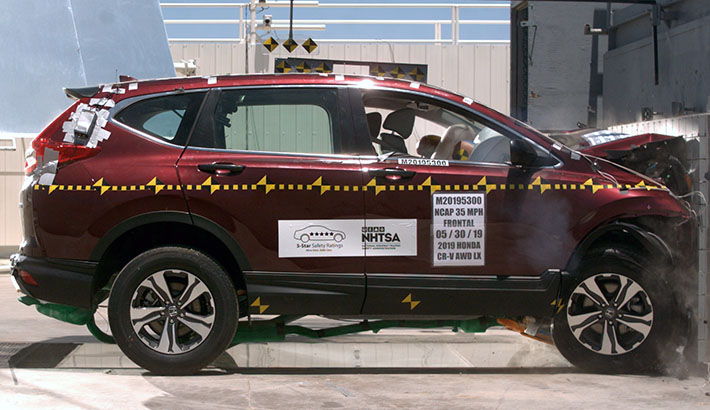
Frontal Crash Test
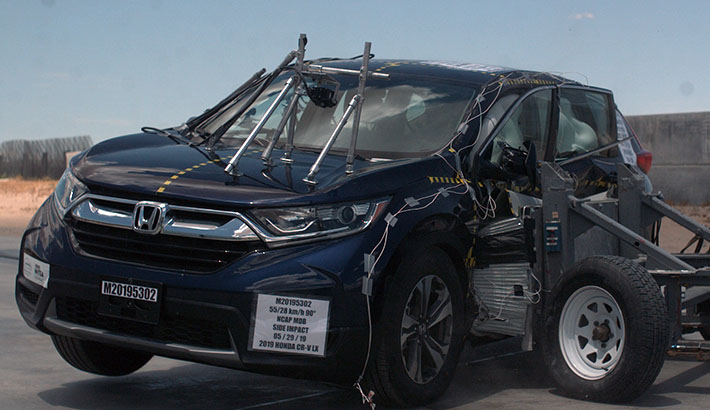
Side Crash Test
Overall Frontal Rating
Driver and Passenger Assessment
Driver Side
Passenger Side
Overall Side Rating
Side Barrier and Side Pole Tests
Driver Side
Passenger Side
Rollover Resistance
No rollover risk estimate available in this dataset
Safety Features
ESC: StandardForward Collision Warning: StandardLane Departure Warning: Standard
Recall Notices
NHTSANHTSA ID: 23V858000December 18, 2023
FUEL SYSTEM, GASOLINE:DELIVERY:FUEL PUMP
Honda (American Honda Motor Co.) is recalling certain 2013-2023 Honda Accord, Civic Coupe, Civic Sedan, Civic Hatchback, Civic Type R, CR-V, HR-V, Ridgeline, Odyssey, Acura ILX, MDX, MDX Hybrid, RDX, RLX, TLX, 2019-2022 Honda Insight, Passport, 2020 Honda CR-V Hybrid, 2018-2019 Honda Clarity PHEV, Fit, and 2015-2020 Honda Accord Hybrid, Pilot, Acura NSX vehicles. The fuel pump inside the fuel tank may fail.
Remedy Status
Dealers will replace the fuel pump module, free of charge. Owner letters were mailed September 6, 2024. Owners may contact Honda customer service at 1-888-234-2138. Honda's numbers for this recall are KGC and KGD. This recall is an expansion of NHTSA recall numbers 21V-215 and 20V-314.
NHTSA ID: 23V524000July 27, 2023
EQUIPMENT:OTHER:LABELS
Honda (American Honda Motor Co.) is recalling certain 2017, 2020, and 2022 CR-V vehicles. The certification label on the driver's side door states incorrect Gross Vehicle Weight Rating (GVWR), Gross Axle Weight Rating (GAWR), and tire size information. As such, these vehicles fail to comply with the requirements of Federal Motor Vehicle Safety Standard number 110, "Tire Selection and Rims."
Remedy Status
Dealers will install a new corrected label, free of charge. Owner notification letters were mailed September 18, 2023. Owners may contact Honda customer service at 1-888-234-2138. Honda's number for this recall is CF7.
Investigations
2 totalOn February 21, 2022, the Office of Defects Investigation (ODI) opened Preliminary Evaluation (PE22003) to assess reports of inadvertent activation of the Collision Mitigation Braking System (CMBS), an automatic emergency braking (AEB) system, in model year 2017-2019 Honda CR-V and 2018-2019 Honda Accord vehicles. The reports allege that activation of the AEB system occurs while driving with no apparent obstruction in the vehicle's forward path, resulting in sudden vehicle deceleration. Honda indicated that they were aware of a total of X,XXX reports that may relate to the alleged defect. Honda provided analysis of the alleged defect and alleges that some customers possibly had an inadequate understanding of the CMBS and its limitations. However, many consumer complaints allege that Honda dealerships were unable to reproduce the condition or state that they were informed that this is considered normal CMBS operation. To date, ODI has received a total of 1,294 consumer complaints of inadvertent activation of CMBS in 2017-2022 Honda CR-V and 2018-2022 Honda Accord vehicles. A total of 31 complaints alleged a crash and 50 alleged an injury. The Total column in the Failure Report Summary removes duplicate reports and shows the total number of reports with unique VINs from all Manufacturer, ODI, and EWR data sources. In some cases, there were multiple reports associated with a particular vehicle in which recurring failures were alleged. In total, there were X,XXX reports, 93 injury incidents and 47 crashes involving vehicles with unique VINs that may relate to the alleged defect. PE22-003 has been upgraded to an Engineering Analysis to further assess the scope, frequency, and potential safety related consequences of the inadvertent AEB activations. The scope has been expanded to include assessment of model year 2020-2022 Honda CR-V and Accord vehicles. To review the ODI reports cited in the Opening Resume ODI Report Identification Number document, go to NHTSA.gov.
Component: FORWARD COLLISION AVOIDANCE: AUTOMATIC EMERGENCY BRAKINGOpened: Apr 15, 2024
PEClosed
On November 29, 2022, the Office of Defects Investigation (ODI) opened PE 22-011 after reviewing field reports alleging rear differential seizure in 2018-2022MY Honda CR-V and HR-V vehicles equipped with all wheel drive. To date, ODI has not received any consumer complaints. Some of the field reports received alleged the vehicle’s wheels locked up with no warning while the vehicle was in motion. These vehicles were towed to a dealership. Examination of these vehicles showed the driveshaft had broken and the differential unit was completely damaged. The field reports cited a lack of oil due to damaged oil seals as the cause. Honda provided data including consumer complaints, field reports, and warranty claims they received relating to the loss of oil retention and resulting differential damage. Honda’s data cited 1201 incidents with unique vehicle identification numbers (VINs). The rear differential oil seals prevent the oil from leaking out and protect internal components from contaminants. A loss of oil lubrication results in failure of the vehicle differential. Honda stated that the oil seal’s lip contact with the driveshaft may become unstable due to intermittent changes in internal pressure. Their review of field report and warranty data indicated that these failures occurred early in the vehicle’s life thus the failures were covered by the manufacturer’s warranty. Honda stated that in November 2021 they changed the seal specifications and improved the packaging process of the parts for transport. Honda also enacted an enhanced visual inspection process both before and after the oil seal installation on the assembly line. Honda stated that in the event of differential failure, the operator can control the vehicle without stability loss. After the drive shafts break due to differential failure, the operator will hear noises and the vehicle will still function as a 2WD vehicle preventing complete loss of motive power. Based on the following factors, ODI is closing this investigation: · Information regarding field failures does not indicate hazardous outcomes · The failures are occurring early in the life of the vehicle · Repairs are covered under the manufacturer’s warranty · The vehicle can continue functioning as a 2WD without loss of stability control in the event of failure The closing of this investigation does not constitute a finding by NHTSA that a safety-related defect does not exist, and the agency reserves the right to take additional action if warranted by new circumstances.
Component: POWER TRAIN:AXLE ASSEMBLY:AXLE SHAFTOpened: Nov 28, 2022Closed: Jul 22, 2024
Owner Complaints
197 totalENGINE
Apr 27, 2026
When car was at 44,000 miles, check engine light repeatedly went on, and Honda dealership determined the car needed adjusted valve job. Car rode rough, and I was worried it would cut out on drive. Now that car is at 77,000 miles, check engine light came on with the exact same p...
Preview excerpt
STEERING
Apr 24, 2026
While driving, the steering can stick momentarily and cause a jerking of the steering wheel. When taking the vehicle to the Honda dealer, the recall for this issue only covers 23-25 cr-v vehicles and since there are no warning lights or codes for it, their recommendation is to dr...
Preview excerpt
STEERING
Apr 16, 2026
Steering seems to feel "sticky" while driving on highways straight. Steering wheel seems to stay in place until I tug just a little on wheel to bring the wheel to correct position
SERVICE BRAKES
Apr 16, 2026
Emergency Brake activates without warning.
ELECTRICAL SYSTEM
Apr 13, 2026
Subject: Safety Concern: Electronic System/BCM Failure – 2022 Honda CR-V Hybrid Vehicle Information: Year/Make/Model: 2022 Honda CR-V Hybrid VIN: [XXX] ] Approximate Mileage: [45,200] Component: Electrical System / Body Control Module (BCM) Description of Incident: On [04/13/202...
Preview excerpt
STEERING
Apr 11, 2026
When driving long distance (car is warmed up), and taking a left turn or a left curve on freeway, the steering wheel sticks, and does not return to center. When doing it manually, there is a popping sound before it returns to center. Its the same thing when taking the car out of ...
Preview excerpt
STEERING
Apr 9, 2026
When I am driving at highway speeds, my steering wheel sticks. I can't make small, smooth adjustments. The steering wheel pops loose and then over corrects. I have noticed this a little bit in the past, but lately it has gotten worse.
STEERING
Apr 4, 2026
2022 Honda CRV with 39,000 miles: When driving at high speeds (55+) when coming out of a turn/curve in the road, the steering wheel sticks/grabs for a split second, then releases, making steering seem unsafe. Issue seems more likely to happen in warmer temperatures 60 degrees and...
Preview excerpt
STEERING
Apr 3, 2026
Difficulties with steering for a month, progressively getting worse and did not present dashboard warnings. A grabbing sensation and clicking noise occurs in steering wheel while turning when driving both high and slow speeds. Certified dealer service center able to replicate t...
Preview excerpt
STEERING
Apr 1, 2026
We are experiencing “sticky steering” issue that has been recalled in 2023-2025 Honda CRV yet ours does not seem to have a recall at this time. Driving down the highway on curves car needs to be pulled back as it does not go back to neutral on it’s own This issue affects our sa...
Preview excerpt
Showing 10 recent complaints from 197 total
View Full Complaint LogCompare Related Vehicles
Why Compare These Pages
The strongest comparison flow is usually: exact vehicle-year page, then nearby years of the same model, then other 2022 Honda models. That sequence helps separate one-off year spikes from broader make-wide patterns.
More Honda CR-V Years
2023 Honda CR-VCompare this year against 2022 for complaint and recall shifts.3r1i495c2021 Honda CR-VCompare this year against 2022 for complaint and recall shifts.3r2i277c2024 Honda CR-VCompare this year against 2022 for complaint and recall shifts.2r1i357c2020 Honda CR-VCompare this year against 2022 for complaint and recall shifts.6r2i312c2025 Honda CR-VCompare this year against 2022 for complaint and recall shifts.1r198c2019 Honda CR-VCompare this year against 2022 for complaint and recall shifts.7r3i1,025c
More 2022 Honda Models
2022 Honda CivicAnother 2022 Honda option for same-year comparison.3r2i871c2022 Honda AccordAnother 2022 Honda option for same-year comparison.3r1i170c2022 Honda OdysseyAnother 2022 Honda option for same-year comparison.8r2i121c2022 Honda PilotAnother 2022 Honda option for same-year comparison.3r1i116c2022 Honda RidgelineAnother 2022 Honda option for same-year comparison.2r2i109c2022 Honda HR-VAnother 2022 Honda option for same-year comparison.3r1i74c
Frequently Asked Questions
How many recalls does the 2022 Honda CR-V have?
The 2022 Honda CR-V has 2 recalls recorded by NHTSA.
How many complaints have been filed for the 2022 Honda CR-V?
NHTSA has received 197 owner-reported complaints for the 2022 Honda CR-V.
What is the NHTSA safety rating for the 2022 Honda CR-V?
Our stored NHTSA record for the 2022 Honda CR-V has an overall rating of 5 out of 5 stars. Stored NHTSA configuration: 2022 Honda CR-V SUV FWD. NCAP Vehicle ID: 16479. Ratings describe one stored NHTSA configuration, not every trim, body style or drivetrain for this model year.
What are the most common problems with the 2022 Honda CR-V?
The most frequent complete stored component labels for the 2022 Honda CR-V are steering (85 reports), forward collision avoidance (27 reports), unknown or other (11 reports). These are exact-label counts, not broader component-group totals or confirmed defects.
Does the 2022 Honda CR-V have any recalls?
Yes. NHTSA has 2 recalls on record for the 2022 Honda CR-V. Scroll up to review the published recall summaries, consequences, and remedies. To check for unrepaired recalls on your specific vehicle, use your VIN at nhtsa.gov/recalls.
Check Another Vehicle
Look up recalls and complaints for any year, make, and model.
This page summarizes publicly available data from the National Highway Traffic Safety Administration (NHTSA). Complaint counts reflect reports submitted to NHTSA by vehicle owners and do not by themselves prove defect severity or vehicle safety. Safety ratings may not be available for all vehicle-years. This site is not affiliated with NHTSA or any vehicle manufacturer. For official information, visit the official NHTSA page for this vehicle.