Hyundai · Ioniq 5 · 2022
2022 Hyundai Ioniq 5
3
Recalls
389
Complaints
5/5
NCAP overall
The 2022 Hyundai Ioniq 5 has 3 recalls and 389 owner-reported complaints on file with NHTSA. One stored NHTSA configuration has an overall rating of 5 out of 5 stars, not a rating for all versions. Most frequent stored component label: electrical system (156 reports).
Stored NHTSA configuration: 2022 Hyundai Ioniq 5 SUV AWD NCAP Vehicle ID: 16597
Ratings describe one stored NHTSA configuration, not every trim, body style or drivetrain for this model year. How this configuration is selected
Source: NHTSA Public Records
NHTSA source checks for this vehicle year
- Complaints
- Separate successful check not recorded.
- Recalls
- Separate successful check not recorded.
- Safety ratings
- Separate successful check not recorded.
- Investigations
- Separate successful check not recorded.
- Manufacturer communications
- Separate successful check not recorded.
Checks are recorded separately for each dataset, not for the whole page. Dates use UTC. A missing check date does not mean no records exist.
Vehicle import recorded: Apr 28, 2026. This is the stored import date, not confirmation that every source was successfully refreshed.
Research Context
The 2022 Hyundai Ioniq 5 page works best as a research starting point. Complaint totals show how much owner-reported activity exists, while recalls and investigations help show whether any of that activity turned into formal safety action.
Because this is a newer-era vehicle page, it usually helps to compare this year against nearby model years before deciding whether a complaint pattern looks isolated or persistent. On this page, the most frequent complete stored component label is electrical system with 156 reported complaints.
Best Research Moves
- Use the complaint log to see whether the 2022 Hyundai Ioniq 5 reports cluster around one repeated symptom or spread across multiple systems.
- Review the recall section even if the total is smaller, because a limited number of recalls can still point to meaningful safety actions.
- This page is primarily a complaints-and-recalls research surface, so compare nearby model years before treating the complaint total as a standalone verdict.
Key Takeaways
- The 2022 Hyundai Ioniq 5 currently shows 3 NHTSA recalls listed on this page and 389 owner-reported complaints.
- This page currently shows no linked NHTSA investigations.
- This page reflects complaint volume, recall history, and NHTSA test data, but it does not diagnose causes or rank reliability by itself.
- Safety data currently shows 5/5 overall NHTSA rating for one stored configuration, not all versions.
- The most frequent complete stored component labels on this page are electrical system (156), electrical system,fuel/propulsion system (31), power train,electrical system (25).
- Vehicle
- 2022 Hyundai Ioniq 5
- Recalls
- 3
- Complaints
- 389
- Stored Configuration Overall Rating
- 5/5. Stored NHTSA configuration: 2022 Hyundai Ioniq 5 SUV AWD. NCAP Vehicle ID: 16597.
How to Interpret This Page
This page combines three types of NHTSA data: recall campaigns (official manufacturer or government actions), owner complaints (unverified consumer reports), and crash test ratings (where available). A vehicle with many complaints is not necessarily less reliable — complaint volume correlates with sales volume and vehicle age. Recalls indicate identified defects, not overall quality. To compare this model year with others, use the year navigation in the sidebar or return to the model overview page.
If you are researching a used vehicle, start with the complaint categories, compare them against the recall list, and then check nearby model years to see whether the same issue profile repeats. That usually produces a better buying or research signal than treating the raw complaint total as a standalone safety ranking.
NHTSA Configuration Test Results
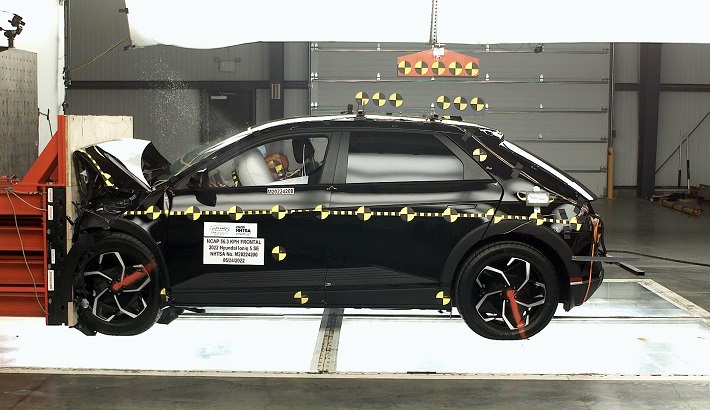
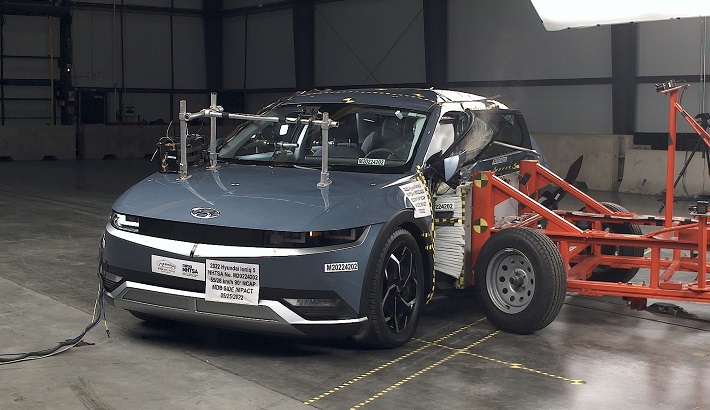
Stored NHTSA configuration: 2022 Hyundai Ioniq 5 SUV AWD NCAP Vehicle ID: 16597
Ratings describe one stored NHTSA configuration, not every trim, body style or drivetrain for this model year. How this configuration is selected
Frontal Crash Test
Side Crash Test
Overall Frontal Rating
Driver and Passenger Assessment
Driver Side
Passenger Side
Overall Side Rating
Side Barrier and Side Pole Tests
Driver Side
Passenger Side
Rollover Resistance
No rollover risk estimate available in this dataset
Safety Features
ESC: StandardForward Collision Warning: NoLane Departure Warning: No
Recall Notices
NHTSANHTSA ID: 24V868000November 18, 2024
ELECTRICAL SYSTEM:12V/24V/48V BATTERY
Hyundai Motor America (Hyundai) is recalling certain 2022-2024 IONIQ 5, 2023-2025 IONIQ 6, Genesis GV60, Genesis GV70 "Electrified," and Genesis G80 "Electrified" vehicles. The Integrated Charging Control Unit (ICCU) may become damaged and stop charging the 12-volt battery, which can result in a loss of drive power.
Remedy Status
Dealers will inspect and replace the ICCU and its fuse, as necessary. In addition, dealers will update the ICCU software. All repairs will be performed free of charge. Owner notification letters were mailed December 20, 2024. Owners may contact Hyundai customer service at 1-855-371-9460 or Genesis customer service at 1-844-340-9741. Hyundai's numbers for this recall are 272 (Hyundai) and 025G (Genesis). This recall expands and replaces previous recall number 24V-204. Vehicles previously repaired under recall 24V-204 will need to have the new remedy completed.
NHTSA ID: 24V204000March 15, 2024
ELECTRICAL SYSTEM:12V/24V/48V BATTERY
Hyundai Motor America (Hyundai) is recalling certain 2022-2024 IONIQ 5, 2023-2024 IONIQ 6, Genesis GV60, Genesis GV70 "Electrified," and Genesis G80 "Electrified" vehicles. The Integrated Charging Control Unit (ICCU) may become damaged and stop charging the 12-Volt battery, which can result in a loss of drive power.
Remedy Status
This recall is replaced by NHTSA recall number 24V-868. Vehicles already repaired under this recall will need to have the new remedy completed. Dealers will inspect and replace the ICCU and its fuse, as necessary. In addition, dealers will update the ICCU software. All repairs will be performed free of charge. Owner notification letters were mailed April 22, 2024. Owners may contact Hyundai customer service at 1-855-371-9460. Hyundai's number for this recall is 257/021G.
NHTSA ID: 22V324000May 11, 2022
PARKING BRAKE:ELECTRICAL:CONTROL MODULE:SOFTWARE
Hyundai Motor America (Hyundai) is recalling certain 2022 Ioniq 5 vehicles. A software error in the Shifter Control Unit (SCU) may disengage the parking mechanism, which can allow the vehicle to rollaway.
Remedy Status
Drivers are recommended to use the Electronic Parking Brake (EPB) when parking their vehicles until the remedy has been performed. Dealers will update the Shifter Control Unit software, free of charge. Owner notification letters were mailed July 14, 2022. Owners may contact Hyundai customer service at 1-855-371-9460. Hyundai's number for this recall is 228.
Owner Complaints
389 totalELECTRICAL SYSTEM
Apr 19, 2026
The ICCU unit went out rendering the car inoperable
POWER TRAIN,ELECTRICAL SYSTEM,FUEL/PROPULSION SYSTEM
Apr 18, 2026
Finished charge, low battery indicator on the dashboard. started to drive, within mile "pull over immediatedly" well documented and continued flaw with vechile ICCU component (that I had the software "patches" applied). Car will no longer accept charge (so now has the remaining c...
Preview excerpt
ELECTRICAL SYSTEM
Mar 28, 2026
Upon starting the car, it made an audible "pop", and the dash indicated to check the 12V power supply and "low available power" with a turtle indicator, and an "EV!" warning lamp. The car struggled to accelerate out of the parking lot, and within a minute, the dash displayed a "p...
Preview excerpt
ELECTRICAL SYSTEM
Mar 23, 2026
Car gave a "electrical error" message and would no longer charge at any charger. It slowly lost power and eventually stopped driving fully on the highway. The dealer says the ICCU is responsible. I inquired if this recall was not fixed already, they said it was but can still happ...
Preview excerpt
ELECTRICAL SYSTEM,ENGINE,FUEL/PROPULSION SYSTEM
Mar 17, 2026
The 2022 ioniq 5 was bought used with 43k MI and within 2k miles of driving in 50-85F climate and 7kwh l2 charging I witnessed the orange check EV light flash while I was driving on the highway. I exited and powrr cycled the car and the EV light remained. The next morning the or...
Preview excerpt
POWER TRAIN,ELECTRICAL SYSTEM,VEHICLE SPEED CONTROL
Mar 14, 2026
ICCU failure
ELECTRICAL SYSTEM
Mar 13, 2026
The ICCU has failed for the 2nd time in a year requiring lengthy repairs. The car cannot be driven with a faulty ICCU. The ICCU is responsible for converting AC power to DC for and stepping it up to 800 volts to charge the primary battery. It is also responsible for keeping the s...
Preview excerpt
ELECTRICAL SYSTEM
Mar 8, 2026
My ioniq 5 EV experienced an integrated charge control unit (ICCU) failure. A couple days prior to complete failure, we were unable to charge the vehicle using either level 1 or level 2 chargers. Our local Hyundai service center advised us that it was likely an ICCU failure and w...
Preview excerpt
POWER TRAIN,ELECTRICAL SYSTEM
Mar 6, 2026
While driving my IONIQ 5 it flashed a power limited warning, went into turtle mode, and then experienced a total loss of power. The 12V battery was dead.
POWER TRAIN,ELECTRICAL SYSTEM
Mar 5, 2026
Car lost propulsion in the middle of the road and would drive over 20 MPH. ICCU failure, which nearly caused me to get into an accident.
Showing 10 recent complaints from 389 total
View Full Complaint LogCompare Related Vehicles
Why Compare These Pages
The strongest comparison flow is usually: exact vehicle-year page, then nearby years of the same model, then other 2022 Hyundai models. That sequence helps separate one-off year spikes from broader make-wide patterns.
More Hyundai Ioniq 5 Years
2023 Hyundai Ioniq 5Compare this year against 2022 for complaint and recall shifts.3r367c2024 Hyundai Ioniq 5Compare this year against 2022 for complaint and recall shifts.2r202c2025 Hyundai Ioniq 5Compare this year against 2022 for complaint and recall shifts.8r234c2026 Hyundai Ioniq 5Compare this year against 2022 for complaint and recall shifts.2r11c
More 2022 Hyundai Models
2022 Hyundai TucsonAnother 2022 Hyundai option for same-year comparison.3r344c2022 Hyundai PalisadeAnother 2022 Hyundai option for same-year comparison.5r274c2022 Hyundai Santa FeAnother 2022 Hyundai option for same-year comparison.5r174c2022 Hyundai Santa CruzAnother 2022 Hyundai option for same-year comparison.4r172c2022 Hyundai ElantraAnother 2022 Hyundai option for same-year comparison.5r91c2022 Hyundai KonaAnother 2022 Hyundai option for same-year comparison.89c
Frequently Asked Questions
How many recalls does the 2022 Hyundai Ioniq 5 have?
The 2022 Hyundai Ioniq 5 has 3 recalls recorded by NHTSA.
How many complaints have been filed for the 2022 Hyundai Ioniq 5?
NHTSA has received 389 owner-reported complaints for the 2022 Hyundai Ioniq 5.
What is the NHTSA safety rating for the 2022 Hyundai Ioniq 5?
Our stored NHTSA record for the 2022 Hyundai Ioniq 5 has an overall rating of 5 out of 5 stars. Stored NHTSA configuration: 2022 Hyundai Ioniq 5 SUV AWD. NCAP Vehicle ID: 16597. Ratings describe one stored NHTSA configuration, not every trim, body style or drivetrain for this model year.
What are the most common problems with the 2022 Hyundai Ioniq 5?
The most frequent complete stored component labels for the 2022 Hyundai Ioniq 5 are electrical system (156 reports), electrical system,fuel/propulsion system (31 reports), power train,electrical system (25 reports). These are exact-label counts, not broader component-group totals or confirmed defects.
Does the 2022 Hyundai Ioniq 5 have any recalls?
Yes. NHTSA has 3 recalls on record for the 2022 Hyundai Ioniq 5. Scroll up to review the published recall summaries, consequences, and remedies. To check for unrepaired recalls on your specific vehicle, use your VIN at nhtsa.gov/recalls.
Check Another Vehicle
Look up recalls and complaints for any year, make, and model.
This page summarizes publicly available data from the National Highway Traffic Safety Administration (NHTSA). Complaint counts reflect reports submitted to NHTSA by vehicle owners and do not by themselves prove defect severity or vehicle safety. Safety ratings may not be available for all vehicle-years. This site is not affiliated with NHTSA or any vehicle manufacturer. For official information, visit the official NHTSA page for this vehicle.