Toyota · 4Runner · 2005
2005 Toyota 4Runner
5
Recalls
423
Complaints
N/A
NCAP overall
The 2005 Toyota 4Runner has 5 recalls and 423 owner-reported complaints on file with NHTSA. Most frequent stored component label: structure (119 reports).
Stored NHTSA configuration: 2005 Toyota 4Runner 4-DR. NCAP Vehicle ID: 1532
Ratings describe one stored NHTSA configuration, not every trim, body style or drivetrain for this model year. How this configuration is selected
Source: NHTSA Public Records
NHTSA source checks for this vehicle year
- Complaints
- Separate successful check not recorded.
- Recalls
- Separate successful check not recorded.
- Safety ratings
- Separate successful check not recorded.
- Investigations
- Separate successful check not recorded.
- Manufacturer communications
- Separate successful check not recorded.
Checks are recorded separately for each dataset, not for the whole page. Dates use UTC. A missing check date does not mean no records exist.
Vehicle import recorded: Apr 29, 2026. This is the stored import date, not confirmation that every source was successfully refreshed.
Research Context
The 2005 Toyota 4Runner page works best as a research starting point. Complaint totals show how much owner-reported activity exists, while recalls and investigations help show whether any of that activity turned into formal safety action.
Because this is a newer-era vehicle page, it usually helps to compare this year against nearby model years before deciding whether a complaint pattern looks isolated or persistent. On this page, the most frequent complete stored component label is structure with 119 reported complaints.
Best Research Moves
- Use the complaint log to see whether the 2005 Toyota 4Runner reports cluster around one repeated symptom or spread across multiple systems.
- Compare the recall list with the complaint mix to see whether the most reported issues overlap with formal NHTSA safety campaigns.
- Check the linked investigations for extra ODI context if you want to see whether owner complaints escalated into formal defect review.
Key Takeaways
- The 2005 Toyota 4Runner currently shows 5 NHTSA recalls listed on this page and 423 owner-reported complaints.
- This page currently shows 2 NHTSA investigations linked to this page.
- This page reflects complaint volume, recall history, and NHTSA test data, but it does not diagnose causes or rank reliability by itself.
- Safety data currently shows no overall NHTSA safety rating in our current dataset.
- The most frequent complete stored component labels on this page are structure (119), unknown or other (40), suspension (23).
- Vehicle
- 2005 Toyota 4Runner
- Recalls
- 5
- Complaints
- 423
- Stored Configuration Overall Rating
- Not available in this dataset
How to Interpret This Page
This page combines three types of NHTSA data: recall campaigns (official manufacturer or government actions), owner complaints (unverified consumer reports), and crash test ratings (where available). A vehicle with many complaints is not necessarily less reliable — complaint volume correlates with sales volume and vehicle age. Recalls indicate identified defects, not overall quality. To compare this model year with others, use the year navigation in the sidebar or return to the model overview page.
If you are researching a used vehicle, start with the complaint categories, compare them against the recall list, and then check nearby model years to see whether the same issue profile repeats. That usually produces a better buying or research signal than treating the raw complaint total as a standalone safety ranking.
NHTSA Configuration Test Results
Stored NHTSA configuration: 2005 Toyota 4Runner 4-DR. NCAP Vehicle ID: 1532
Ratings describe one stored NHTSA configuration, not every trim, body style or drivetrain for this model year. How this configuration is selected
No overall score is available in our current dataset. The individual results below are not a combined safety rating; compare vehicles within the same test program and model year.
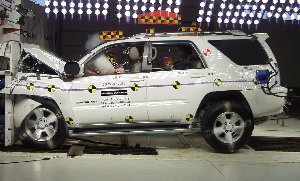
Frontal Crash Test
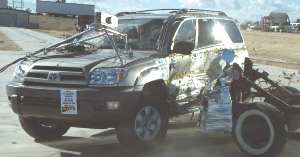
Side Crash Test
Overall Frontal Rating
Driver and Passenger Assessment
Driver Side
Passenger Side
Overall Side Rating
Side Barrier and Side Pole Tests
Driver Side
Passenger Side
Rollover Resistance
No rollover risk estimate available in this dataset
Safety Features
ESC: StandardForward Collision Warning: NoLane Departure Warning: No
Recall Notices
NHTSANHTSA ID: 16V396000June 02, 2016
SEATS:FRONT ASSEMBLY:SEAT HEATER/COOLER
Southeast Toyota Distributors, LLC (SET) is recalling certain 2005-2011 4Runner, Highlander, Sequoia, and Sienna, 2005-2010 Avalon and Tundra, 2006-2008 Camry Solara, 2006-2010 Highlander hybrid, 2006-2011 Rav4 and Tacoma, 2007-2010 FJ Cruiser, 2007-2011 Camry hybrid, 2009-2010 Venza, 2010-2012 Prius, 1988-1990 and 2005-2010 Camry, and 1989 and 2009-2010 Corolla vehicles equipped with aftermarket accessory seat heaters with a copper strand heating element. The electrical wiring in the seat heaters may be damaged when the seat cushion is compressed.
Remedy Status
SET will notify owners, and dealers will disconnect the seat heaters, free of charge, and refund the purchase price of the seat heater accessory. The recall began on July 14, 2016. Owners may contact SET customer service at 1-866-405-4226. SET number for this recall is SET16B.
NHTSA ID: 16V065000February 05, 2016
AIR BAGS:SIDE/WINDOW
Toyota Motor Engineering & Manufacturing (Toyota) is recalling certain model year 2003-2006 Toyota Land Cruiser and Lexus LX470, 2005-2006 Toyota Tundra and Sequoia, 2004-2006 Toyota 4Runner and Lexus GX470 vehicles equipped with side curtain-shield-air bags. The affected vehicles have an air bag control module that may be improperly programmed, causing the side curtain-shield-air bags to deploy inadvertently.
Remedy Status
Toyota will notify owners, and dealers will replace the air bag control module with one that has improved programming, free of charge. The recall began on December 1, 2016. Owners may contact Toyota customer service at 1-888-271-9371. Toyota's number for this recall is G0C and GLB.
NHTSA ID: 11V113000February 24, 2011
VEHICLE SPEED CONTROL:ACCELERATOR PEDAL
TOYOTA IS RECALLING CERTAIN MODEL YEAR 2008 THROUGH 2011 LEXUS LX570, 2003 THROUGH 2009 TOYOTA 4RUNNER, AND 2006 THROUGH 2010 RAV4 VEHICLES. THE ACCELERATOR PEDAL CAN GET STUCK IN THE WIDE OPEN POSITION DUE TO ITS BEING TRAPPED BY AN UNSECURED OR INCOMPATIBLE DRIVER'S FLOOR MAT.
Remedy Status
THE REMEDY IS NOW AVAILABLE. THE SAFETY RECALL BEGAN EARLY APRIL 2011. THE REMEDY WILL INVOLVE MODIFICATION OR REPLACEMENT OF THE ACCELERATOR PEDAL AND REPLACEMENT OF ANY TOYOTA ALL-WEATHER FLOOR MAT. OWNERS MAY CONTACT TOYOTA AT 1-800-331-4331 OR LEXUS AT 1-800-255-3987.
NHTSA ID: 10V035000February 03, 2010
EQUIPMENT:OTHER:LABELS
GULF STATES TOYOTA IS RECALLING CERTAIN MODEL YEAR 2005-2010 VEHICLES FOR FAILING TO COMPLY WITH THE REQUIREMENTS OF FEDERAL MOTOR VEHICLE SAFETY STANDARD NO. 110, "TIRE SELECTION AND RIMS." THESE VEHICLES WERE SOLD BETWEEN SEPTEMBER 1, 2005 AND JUNE 2, 2008 WITHOUT THE REQUISITE LOAD CARRYING CAPACITY MODIFICATION LABELS.
Remedy Status
DEALERS WILL MAIL TO CONSUMERS THE CORRECTED LABEL OR THE CUSTOMER WILL HAVE THE OPTION FOR DEALERS TO INSTALL THE LABEL FREE OF CHARGE. DEALERS WILL ALSO CORRECT THE OWNER'S MANUAL. THE SAFETY RECALL BEGAN ON MAY 27, 2010. OWNERS MAY CONTACT GULF STATES TOYOTA AT 713-580-3300.
NHTSA ID: 10V036000February 03, 2010
EQUIPMENT:OTHER:LABELS
SOUTHEAST TOYOTA IS RECALLING CERTAIN MODEL YEAR 2005-2011 PASSENGER VEHICLES FOR FAILING TO COMPLY WITH THE REQUIREMENTS OF FEDERAL MOTOR VEHICLE SAFETY STANDARD NO. 110, "TIRE SELECTION AND RIMS." THESE VEHICLES WERE SOLD WITHOUT THE REQUISITE LOAD CARRYING CAPACITY MODIFICATION LABELS.
Remedy Status
DEALERS WILL MAIL TO CONSUMERS THE CORRECTED LABEL OR THE CUSTOMER WILL HAVE THE OPTION FOR DEALERS TO INSTALL THE LABEL FREE OF CHARGE. THE SAFETY RECALL BEGAN ON MAY 27, 2010. OWNERS MAY CONTACT SOUTHEAST TOYOTA AT 1-800-301-6859.
Investigations
2 totalDPClosed
On August 7, 2018, the Office of Defects Investigation (ODI) received a defect petition from Mr. Gary Weinreich alleging premature frame corrosion failure in model year (MY) 2002 - 2006 Toyota 4Runner vehicles. The petitioner based his request upon a corrosion-related front suspension failure he experienced in his MY 2005 Toyota 4Runner, a class action lawsuit settlement involving other Toyota products, and other complaints of underbody corrosion in Toyota 4Runner vehicles that he found in NHTSA?s online complaint database. The petitioner submitted a complaint to NHTSA documenting his experience (NHTSA ID 11098055). On August 17, 2018, ODI opened DP18-002 to evaluate the petitioner?s request. ODI?s evaluation included information provided by the petitioner regarding his vehicle, facts related to the class action lawsuit cited by the petitioner, and consumer complaint data received by NHTSA regarding underbody corrosion in third and fourth-generation Toyota 4Runner vehicles.The undercarriage of the petitioner?s vehicle exhibited severe corrosion damage indicative of seawater immersion. The vehicle?s service history shows that concerns with underbody corrosion were first noted by a Toyota dealer in a multi-point vehicle inspection performed on April 28, 2011. The invoice for that inspection noted ?severe and excessive amount of rust on the undercarriage and on the drive shaft transmission.? Two years later, on October 21, 2013, another multi-point inspection by a Toyota dealer observed further progression of underbody corrosion damage, noting: ?rust on shocks/struts and other components,? ?rust on exhaust system,? ?both splash shields severely rusted,? and ?undercarriage very rusty.? On July 17, 2017, approximately 10 months prior to experiencing the suspension failure incident, an independent repair facility performing routine oil change and brake maintenance informed the Petitioner of a concern with ?excessive frame corrosion? on his vehicle. The service history, severe general corrosion damage, failure age, and environment do not support the petitioner?s allegation of premature corrosion failure.ODI?s analysis of NHTSA complaint data identified fifteen incidents of front lower control arm failure in fourth-generation Toyota 4Runner sport utility vehicles. Two of the failures, including the petitioner?s vehicle, involve vehicles operated in ocean front communities with continuous exposure to aerosolized marine salts and potential exposure to seawater immersion. The remaining thirteen failures all involved vehicles owned or previously registered in states with the greatest use of deicing salts to treat road surfaces in winter months (?Salt states?). On average, the front lower control arm failures occurred after 13.1 years in service in highly corrosive environments. The failure ages and environments do not support the petitioner?s allegation of premature corrosion failure. NHTSA is authorized to issue an order requiring notification and remedy of a defect if the Agency?s investigation shows a defect in design, construction, or performance of a motor vehicle that presents an unreasonable risk to safety. 49 U.S.C. ?? 30102(a)(9), 30118. Since the information before the Agency is not indicative of a vehicle-based defect, it is unlikely that any investigation opened because of granting this petition would result in an order concerning the notification and remedy of a safety-related defect. Therefore, upon full consideration of the information presented in the petition and the potential risks to safety, the petition is denied. The denial of this petition does not foreclose the Agency from taking further action if warranted or the p
Component: STRUCTURE:FRAME AND MEMBERSOpened: Aug 17, 2018Closed: Mar 18, 2022
On February 16, 2010, NHTSA's Office of Defects Investigation (ODI) opened RQ10-003 to determine whether the scope of prior Toyota recalls relating to potential unintended acceleration were sufficiently broad, including, among others, Toyota recalls 07E-082, 09V-388, 10V-017, and 10V-023.NHTSA also requested information regarding potential electronic causes of unintended acceleration in Toyota and Lexus vehicles.I. Pedal Interference from Floor mats, Carpet Covers and Plastic Pads in Carpets.During the RQ10-003 investigation, ODI reviewed a large volume of documents to assess whether additional vehicles should be recalled.Following the agency's analysis, NHTSA requested that Toyota recall additional vehicles.Toyota complied with the agency's request.The details of these recalls are set forth more fully in Toyota's reports to NHTSA pursuant to 49 CFR Part 573.These recalls are as follows:Recall 11V-112: (1) model year (MY) 2004-2006 Toyota Highlander and Highlander Hybrid; and, (2) MY 2004-2007 Lexus RX330,RX350, and RX400h (hybrid model). The total estimated population under this recall is 769,379 vehicles.This recall remedies potential accelerator pedal entrapment caused by a loose floor carpet cover (trim panel). Recall 11V-113: (1) MY 2003-2009 through 2009 Toyota 4Runner; (2) MY 2006-2010 Toyota RAV4; and, (3) MY 2008-2011 Lexus LX570.The total estimated population under this recall is 1,381,000 vehicles.This recall supplements recall 09V-388 and remedies potential accelerator pedal entrapment by an unsecured floor mat.Recall 11V-115: (1) MY 2006-2007 Lexus GS300 (all wheel drive vehicles); and, (2) MY 2006-2007 Lexus GS350 (all wheel drive vehicles). The total estimated population under this recall is 19,647 vehicles.This recall remedies potential accelerator pedal entrapment caused by inadequate clearance between the pedal linkage and a plastic pad embedded in the vehicle's carpet.II. Potential Electronic Causes of Unintended Acceleration.After NHTSA opened RQ10-003, NHTSA launched a ten-month study of potential electronic causes of unintended acceleration in Toyota vehicles.NHTSA launched the study in the spring of 2010 in light of concerns aired in Congressional hearings.NHTSA enlisted engineers at the National Aeronautics and Space Administration (NASA) with expertise in areas such as computer controlled electronic systems, electromagnetic interference and software integrity to assess whether electronic systems or electromagnetic interference played a role in incidents of unintended acceleration in Toyota vehicles.That study has concluded.Two reports are associated with the study and are available on NHTSA's website.NASA's report is entitled Technical Support to the National Highway Traffic Safety Administration (NHTSA) on the Reported Toyota Motor Corporation (TMC) Unintended Acceleration (UA) Investigation, NESC Assessment No. TI-10-00618 (Jan. 18, 2011).NHTSA's report is entitled Technical Assessment of Toyota Electronic Throttle Control (ETC) Systems (Feb. 2011).Both reports should be read in conjunction with each other. As stated in its report, NASA did not find an electronic cause of large throttle openings that can result in unintended acceleration incidents. NHTSA did not find a vehicle-based cause of unintended acceleration incidents other than the physical pedal interference causes that are being addressed by Toyota's recalls. This RQ is closed.
Component: ELECTRICAL SYSTEM:SOFTWAREOpened: Feb 16, 2010Closed: Mar 1, 2011Related recall: 11V112000
Owner Complaints
423 totalUNKNOWN OR OTHER
Dec 5, 2025
Premature/unsafe frame rot
ELECTRICAL SYSTEM
Nov 3, 2025
Odometer Fraud. The contact purchased a 2005 Toyota 4Runner. It was discovered that there was a mileage discrepancy. The vehicle was a private sale. At the time of purchase, the vehicle mileage was 217,000, and at the time of registration, it was discovered that the mileage was 3...
Preview excerpt
STRUCTURE,VEHICLE SPEED CONTROL,ENGINE
Aug 4, 2025
The contact owns a 2005 Toyota 4Runner. The contact stated that while driving at an undisclosed speed, the vehicle briefly hesitated and was unable to accelerate, prompting the contact to discontinue driving the vehicle. The check engine warning light was illuminated. The vehicle...
Preview excerpt
POWER TRAIN,STRUCTURE
Jun 1, 2025
- The undercarriage and frame have had premature rusting for years. The car is otherwise in excellent condition due to my care of it over the last 20 years. 5 years ago, a service person at my local Toyota dealership said, "I'm really disappointed in Toyota, I've never seen rus...
Preview excerpt
SUSPENSION,UNKNOWN OR OTHER
May 28, 2025
ENTIRE body frame has excessive rust, holes, and cracks. It is available for inspection. Toyota dealership says it is safe to drive for now but it is failing. I feel any cracks, rust, holes, separation of frame components places all occupants and anyone near the vehicle at risk f...
Preview excerpt
STRUCTURE
Jan 22, 2025
Under frame is rusted. The area between the doors in the passenger side is gone. only the top face of the member is present.
STRUCTURE,UNKNOWN OR OTHER
Nov 13, 2024
Frame rot. The frame on the 4Runner is a known problem for excessive rot. My frame is shot. There is no reason a frame on a 2005 should be rotted. I was advised by my mechanic that my frame is dangerously close to snapping in half. This needs fixed by Toyota!
STRUCTURE
Aug 19, 2024
Frame has very severe rust and has started to come part in places. Soon vehicle will no longer be road worthy.
STRUCTURE,UNKNOWN OR OTHER,ENGINE
May 15, 2024
When I first saw the pictures on the internet, I noticed that the front underside appeared to have rust issues. (Frontal shot) I contacted that sales person and he blew me off when I requested photos of the underbody. After several attempts, he finally sent a couple of pictures. ...
Preview excerpt
VISIBILITY/WIPER
Jan 5, 2024
Rear hatch glass broke during defroster operation. Started to smell a burning smell and then moments later the entire rear hatch glass shattered. Known issue by Toyota. They issued a brief Warranty Enhancement Program (ZG7) in March 2017 thru April 2018 but are refusing to honor ...
Preview excerpt
Showing 10 recent complaints from 423 total
View Full Complaint LogCompare Related Vehicles
Why Compare These Pages
The strongest comparison flow is usually: exact vehicle-year page, then nearby years of the same model, then other 2005 Toyota models. That sequence helps separate one-off year spikes from broader make-wide patterns.
More Toyota 4Runner Years
2006 Toyota 4RunnerCompare this year against 2005 for complaint and recall shifts.5r2i379c2004 Toyota 4RunnerCompare this year against 2005 for complaint and recall shifts.2r2i677c2007 Toyota 4RunnerCompare this year against 2005 for complaint and recall shifts.5r1i154c2003 Toyota 4RunnerCompare this year against 2005 for complaint and recall shifts.3r2i695c2008 Toyota 4RunnerCompare this year against 2005 for complaint and recall shifts.5r1i96c2002 Toyota 4RunnerCompare this year against 2005 for complaint and recall shifts.3r1i224c
More 2005 Toyota Models
2005 Toyota SiennaAnother 2005 Toyota option for same-year comparison.12r6i1,130c2005 Toyota PriusAnother 2005 Toyota option for same-year comparison.6r3i1,051c2005 Toyota CorollaAnother 2005 Toyota option for same-year comparison.10r4i938c2005 Toyota CamryAnother 2005 Toyota option for same-year comparison.5r2i721c2005 Toyota TacomaAnother 2005 Toyota option for same-year comparison.10r706c2005 Toyota TundraAnother 2005 Toyota option for same-year comparison.14r5i374c
Frequently Asked Questions
How many recalls does the 2005 Toyota 4Runner have?
The 2005 Toyota 4Runner has 5 recalls recorded by NHTSA.
How many complaints have been filed for the 2005 Toyota 4Runner?
NHTSA has received 423 owner-reported complaints for the 2005 Toyota 4Runner.
What is the NHTSA safety rating for the 2005 Toyota 4Runner?
An overall NHTSA safety rating is not available in our current dataset for the 2005 Toyota 4Runner. Individual crash-test results may still be available.
What are the most common problems with the 2005 Toyota 4Runner?
The most frequent complete stored component labels for the 2005 Toyota 4Runner are structure (119 reports), unknown or other (40 reports), suspension (23 reports). These are exact-label counts, not broader component-group totals or confirmed defects.
Does the 2005 Toyota 4Runner have any recalls?
Yes. NHTSA has 5 recalls on record for the 2005 Toyota 4Runner. Scroll up to review the published recall summaries, consequences, and remedies. To check for unrepaired recalls on your specific vehicle, use your VIN at nhtsa.gov/recalls.
Check Another Vehicle
Look up recalls and complaints for any year, make, and model.
This page summarizes publicly available data from the National Highway Traffic Safety Administration (NHTSA). Complaint counts reflect reports submitted to NHTSA by vehicle owners and do not by themselves prove defect severity or vehicle safety. Safety ratings may not be available for all vehicle-years. This site is not affiliated with NHTSA or any vehicle manufacturer. For official information, visit the official NHTSA page for this vehicle.