Honda · HR-V · 2016
2016 Honda HR-V
2
Recalls
232
Complaints
5/5
NCAP overall
The 2016 Honda HR-V has 2 recalls and 232 owner-reported complaints on file with NHTSA. One stored NHTSA configuration has an overall rating of 5 out of 5 stars, not a rating for all versions. Most frequent stored component label: power train (59 reports).
Stored NHTSA configuration: 2016 Honda HR-V SUV FWD NCAP Vehicle ID: 10330
Ratings describe one stored NHTSA configuration, not every trim, body style or drivetrain for this model year. How this configuration is selected
Source: NHTSA Public Records
NHTSA source checks for this vehicle year
- Complaints
- Separate successful check not recorded.
- Recalls
- Separate successful check not recorded.
- Safety ratings
- Separate successful check not recorded.
- Investigations
- Separate successful check not recorded.
- Manufacturer communications
- Separate successful check not recorded.
Checks are recorded separately for each dataset, not for the whole page. Dates use UTC. A missing check date does not mean no records exist.
Vehicle import recorded: Apr 28, 2026. This is the stored import date, not confirmation that every source was successfully refreshed.
Research Context
The 2016 Honda HR-V page works best as a research starting point. Complaint totals show how much owner-reported activity exists, while recalls and investigations help show whether any of that activity turned into formal safety action.
Because this is a newer-era vehicle page, it usually helps to compare this year against nearby model years before deciding whether a complaint pattern looks isolated or persistent. On this page, the most frequent complete stored component label is power train with 59 reported complaints.
Best Research Moves
- Use the complaint log to understand what owners were actually reporting instead of relying only on the raw complaint total.
- Review the recall section even if the total is smaller, because a limited number of recalls can still point to meaningful safety actions.
- This page is primarily a complaints-and-recalls research surface, so compare nearby model years before treating the complaint total as a standalone verdict.
Key Takeaways
- The 2016 Honda HR-V currently shows 2 NHTSA recalls listed on this page and 232 owner-reported complaints.
- This page currently shows no linked NHTSA investigations.
- This page reflects complaint volume, recall history, and NHTSA test data, but it does not diagnose causes or rank reliability by itself.
- Safety data currently shows 5/5 overall NHTSA rating for one stored configuration, not all versions.
- The most frequent complete stored component labels on this page are power train (59), electrical system (30), unknown or other (29).
- Vehicle
- 2016 Honda HR-V
- Recalls
- 2
- Complaints
- 232
- Stored Configuration Overall Rating
- 5/5. Stored NHTSA configuration: 2016 Honda HR-V SUV FWD. NCAP Vehicle ID: 10330.
How to Interpret This Page
This page combines three types of NHTSA data: recall campaigns (official manufacturer or government actions), owner complaints (unverified consumer reports), and crash test ratings (where available). A vehicle with many complaints is not necessarily less reliable — complaint volume correlates with sales volume and vehicle age. Recalls indicate identified defects, not overall quality. To compare this model year with others, use the year navigation in the sidebar or return to the model overview page.
If you are researching a used vehicle, start with the complaint categories, compare them against the recall list, and then check nearby model years to see whether the same issue profile repeats. That usually produces a better buying or research signal than treating the raw complaint total as a standalone safety ranking.
NHTSA Configuration Test Results
Stored NHTSA configuration: 2016 Honda HR-V SUV FWD NCAP Vehicle ID: 10330
Ratings describe one stored NHTSA configuration, not every trim, body style or drivetrain for this model year. How this configuration is selected
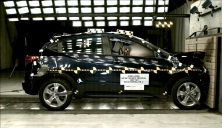
Frontal Crash Test
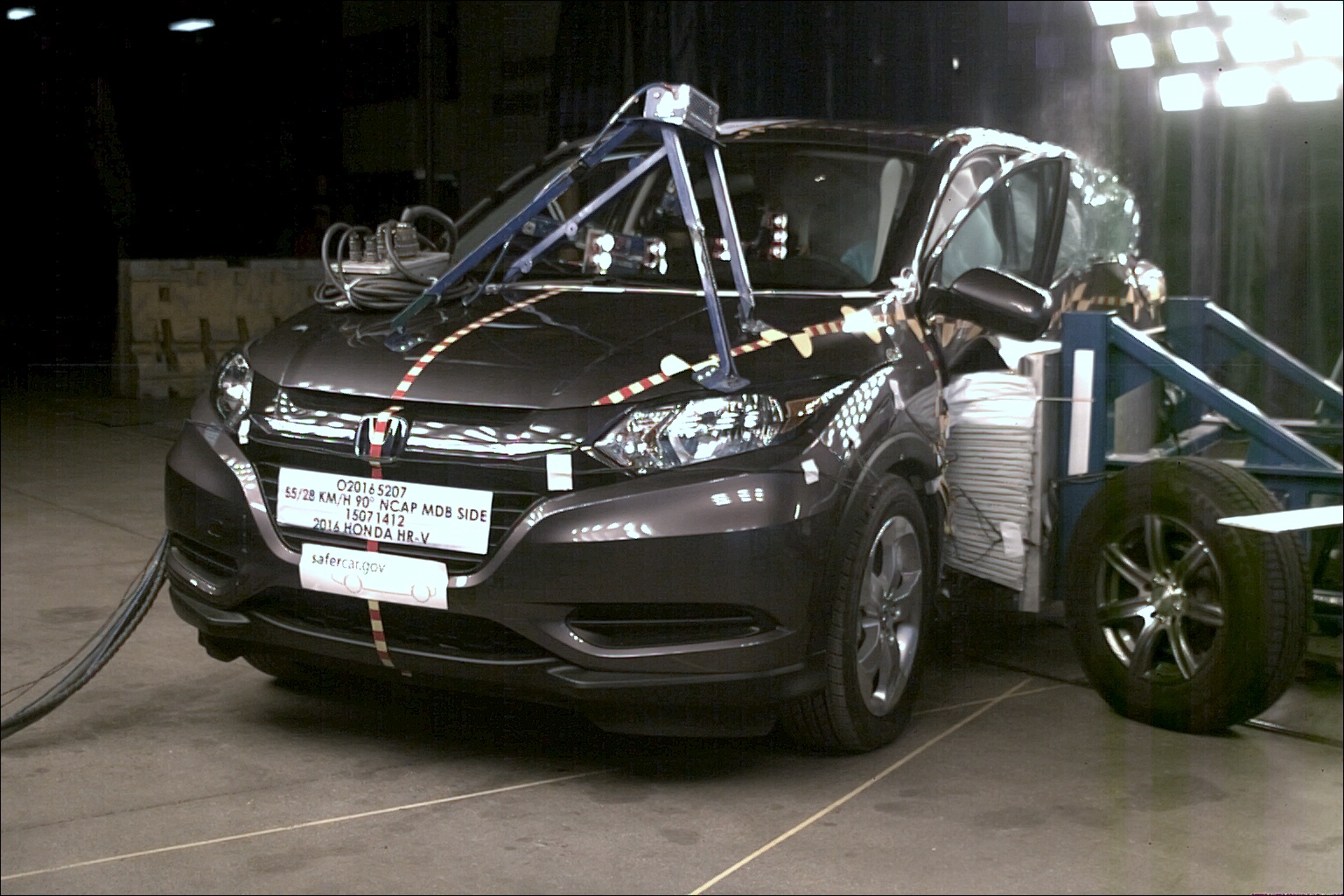
Side Crash Test
Overall Frontal Rating
Driver and Passenger Assessment
Driver Side
Passenger Side
Overall Side Rating
Side Barrier and Side Pole Tests
Driver Side
Passenger Side
Rollover Resistance
No rollover risk estimate available in this dataset
Safety Features
ESC: StandardForward Collision Warning: NoLane Departure Warning: No
Recall Notices
NHTSANHTSA ID: 18V777000November 01, 2018
SERVICE BRAKES, HYDRAULIC:FOUNDATION COMPONENTS:DISC:CALIPER
Honda (American Honda Motor Co.) is recalling certain 2017-2019 Acura MDX, 2017-2018 Acura MDX Sport Hybrid, 2018-2019 Honda HR-V and Honda Odyssey, and 2016 Honda HR-V vehicles. The rear brake caliper pistons may have an insufficient coating, causing gas pockets to form, reducing brake performance. As such, these vehicles fail to comply with the requirements of Federal Motor Vehicle Safety Standard (FMVSS) number 135, "Light Vehicle Brake Systems."
Remedy Status
Owners will be notified, and Honda or Acura dealers will bleed the brakes, free of charge. The recall began December 11, 2018. Owners may contact Honda customer service at 1-888-234-2138. Honda's numbers for this recall are C31 and L30.
NHTSA ID: 15V472000July 28, 2015
EQUIPMENT:OTHER:LABELS
Honda (American Honda Motor Co.) is recalling certain model year 2016 HR-V vehicles manufactured January 12, 2015, to May 20, 2015. The affected vehicles may be missing the required tire placard indicating "Tire and Loading Information." These vehicles fail to comply with the requirements of Federal Motor Vehicle Safety Standard (FMVSS) 110, "Tire Selection and Rims and Motor Home/Recreation Vehicle Trailer Load Carrying Capacity Information for Motor Vehicles with a GVWR of 4,536 kilograms (10,000 pounds) or less."
Remedy Status
Honda will notify owners, and dealers will inspect the vehicle, and apply a new label, free of charge. The recall began on September 18, 2015. Owners may contact Honda customer service at 1-888-234-2138. Honda's number for this recall is JT2, or JT4.
Owner Complaints
232 totalUNKNOWN OR OTHER
Mar 20, 2026
FULL CATASTROPHIC FAILURE OF THE CVT BELT IN THE TRANSMISSION, A KNOWN ISSUE THAT HONDA HAD AN EXTENDED WARRANTY FOR FOR UP TO 150K MILES AND OR 7 YEARS FROM PURCHASE (THAT LETTER WAS NEVER MAILED TO MY HOUSE, IT WAS FOUND AFTER THE FACT WHILE LOOKING FOR THE TITLE AT A FAMILY ME...
Preview excerpt
SERVICE BRAKES, HYDRAULIC
Mar 5, 2026
The contact owns a 2016 Honda HR-V. The contact stated that while stopped, the ABS, Brake, traction control, and several other warning lights flashed on the instrument panel. The contact called the dealer and was informed that the vehicle was safe to drive to the residence, but n...
Preview excerpt
UNKNOWN OR OTHER
Feb 23, 2026
Hello, I am reaching out with extreme dissatisfaction of my recently purchased 2016 Honda HR-V. This car was part of the extended warranty via service bulletin 21-046 Warranty Extension: 2016-20 HR-V CVT Premature Belt Deterioration. My car has been cared for extremely closely, a...
Preview excerpt
POWER TRAIN
Jan 20, 2026
The transmission seized while driving no lights no warnings. I could have been killed so could other people! when no lights no check engine light or service lights are on. And your car is properly maintained there should be no reason the transmission should just seize while Drivi...
Preview excerpt
POWER TRAIN
Jan 15, 2026
The CVT transmission, which is part of the vehicle’s powertrain system, experienced a premature failure. The vehicle became inoperable and was in an unsafe location, so the police had to tow it. I am not sure if a police report was issued. The tow resulted in extensive impound fe...
Preview excerpt
POWER TRAIN
Dec 2, 2025
I am submitting this complaint regarding a sudden and unsafe CVT transmission failure on my Honda vehicle. While driving, the vehicle began shaking violently, lost the ability to accelerate, and multiple warning indicators illuminated, including the check engine light. The vehic...
Preview excerpt
ELECTRICAL SYSTEM,STRUCTURE
Nov 20, 2025
My vehicle suddenly developed electrical problems and would not start. Before it completely failed, I began seeing warning lights on the dashboard, including a PARK warning and an engine oil light. The vehicle had been operating normally earlier that day, but later became totally...
Preview excerpt
POWER TRAIN
Nov 8, 2025
Transmission belt failure at 100k miles. This incident occurred after the recall repair for the software update related to the transmission. Most hazard indicators switched on, vehicle could not go over 50 miles per hour. Took vehicle into honda service center. They determined it...
Preview excerpt
POWER TRAIN
Oct 1, 2025
Belt inside CVT transmission has failed. Numerous broken shards of metal in fluid and surrounding parts. Cost to replace $7,500 avg.
STRUCTURE,UNKNOWN OR OTHER
Sep 27, 2025
Extensive and widespread peeling and de-lamination of paint across entire vehicle beginning in 2025 (two years after extended warranty expired). About $6000 to repair and Honda refusing to assist/contribute to repairs.
Showing 10 recent complaints from 232 total
View Full Complaint LogCompare Related Vehicles
Why Compare These Pages
The strongest comparison flow is usually: exact vehicle-year page, then nearby years of the same model, then other 2016 Honda models. That sequence helps separate one-off year spikes from broader make-wide patterns.
Quick Compare
More Honda HR-V Years
2017 Honda HR-VCompare this year against 2016 for complaint and recall shifts.114c2018 Honda HR-VCompare this year against 2016 for complaint and recall shifts.3r1i145c2019 Honda HR-VCompare this year against 2016 for complaint and recall shifts.6r1i196c2020 Honda HR-VCompare this year against 2016 for complaint and recall shifts.4r1i79c2021 Honda HR-VCompare this year against 2016 for complaint and recall shifts.3r1i56c2022 Honda HR-VCompare this year against 2016 for complaint and recall shifts.3r1i74c
More 2016 Honda Models
2016 Honda PilotAnother 2016 Honda option for same-year comparison.7r4i1,623c2016 Honda CivicAnother 2016 Honda option for same-year comparison.4r1,034c2016 Honda AccordAnother 2016 Honda option for same-year comparison.3r573c2016 Honda CR-VAnother 2016 Honda option for same-year comparison.3r1i386c2016 Honda OdysseyAnother 2016 Honda option for same-year comparison.6r251c2016 Honda FitAnother 2016 Honda option for same-year comparison.1r1i116c
Frequently Asked Questions
How many recalls does the 2016 Honda HR-V have?
The 2016 Honda HR-V has 2 recalls recorded by NHTSA.
How many complaints have been filed for the 2016 Honda HR-V?
NHTSA has received 232 owner-reported complaints for the 2016 Honda HR-V.
What is the NHTSA safety rating for the 2016 Honda HR-V?
Our stored NHTSA record for the 2016 Honda HR-V has an overall rating of 5 out of 5 stars. Stored NHTSA configuration: 2016 Honda HR-V SUV FWD. NCAP Vehicle ID: 10330. Ratings describe one stored NHTSA configuration, not every trim, body style or drivetrain for this model year.
What are the most common problems with the 2016 Honda HR-V?
The most frequent complete stored component labels for the 2016 Honda HR-V are power train (59 reports), electrical system (30 reports), unknown or other (29 reports). These are exact-label counts, not broader component-group totals or confirmed defects.
Does the 2016 Honda HR-V have any recalls?
Yes. NHTSA has 2 recalls on record for the 2016 Honda HR-V. Scroll up to review the published recall summaries, consequences, and remedies. To check for unrepaired recalls on your specific vehicle, use your VIN at nhtsa.gov/recalls.
Check Another Vehicle
Look up recalls and complaints for any year, make, and model.
This page summarizes publicly available data from the National Highway Traffic Safety Administration (NHTSA). Complaint counts reflect reports submitted to NHTSA by vehicle owners and do not by themselves prove defect severity or vehicle safety. Safety ratings may not be available for all vehicle-years. This site is not affiliated with NHTSA or any vehicle manufacturer. For official information, visit the official NHTSA page for this vehicle.