Tesla · Model X · 2017
2017 Tesla Model X
10
Recalls
265
Complaints
5/5
NCAP overall
The 2017 Tesla Model X has 10 recalls and 265 owner-reported complaints on file with NHTSA. One stored NHTSA configuration has an overall rating of 5 out of 5 stars, not a rating for all versions. Most frequent stored component label: electrical system (62 reports).
Stored NHTSA configuration: 2017 Tesla Model X 60D SUV AWD NCAP Vehicle ID: 11814
Ratings describe one stored NHTSA configuration, not every trim, body style or drivetrain for this model year. How this configuration is selected
Source: NHTSA Public Records
NHTSA source checks for this vehicle year
- Complaints
- Separate successful check not recorded.
- Recalls
- Separate successful check not recorded.
- Safety ratings
- Separate successful check not recorded.
- Investigations
- Separate successful check not recorded.
- Manufacturer communications
- Separate successful check not recorded.
Checks are recorded separately for each dataset, not for the whole page. Dates use UTC. A missing check date does not mean no records exist.
Vehicle import recorded: Apr 28, 2026. This is the stored import date, not confirmation that every source was successfully refreshed.
Research Context
The 2017 Tesla Model X page works best as a research starting point. Complaint totals show how much owner-reported activity exists, while recalls and investigations help show whether any of that activity turned into formal safety action.
Because this is a newer-era vehicle page, it usually helps to compare this year against nearby model years before deciding whether a complaint pattern looks isolated or persistent. On this page, the most frequent complete stored component label is electrical system with 62 reported complaints.
Best Research Moves
- Use the complaint log to see whether the 2017 Tesla Model X reports cluster around one repeated symptom or spread across multiple systems.
- Compare the recall list with the complaint mix to see whether the most reported issues overlap with formal NHTSA safety campaigns.
- This page is primarily a complaints-and-recalls research surface, so compare nearby model years before treating the complaint total as a standalone verdict.
Key Takeaways
- The 2017 Tesla Model X currently shows 10 NHTSA recalls listed on this page and 265 owner-reported complaints.
- This page currently shows no linked NHTSA investigations.
- This page reflects complaint volume, recall history, and NHTSA test data, but it does not diagnose causes or rank reliability by itself.
- Safety data currently shows 5/5 overall NHTSA rating for one stored configuration, not all versions.
- The most frequent complete stored component labels on this page are electrical system (62), suspension (54), steering (33).
- Vehicle
- 2017 Tesla Model X
- Recalls
- 10
- Complaints
- 265
- Stored Configuration Overall Rating
- 5/5. Stored NHTSA configuration: 2017 Tesla Model X 60D SUV AWD. NCAP Vehicle ID: 11814.
How to Interpret This Page
This page combines three types of NHTSA data: recall campaigns (official manufacturer or government actions), owner complaints (unverified consumer reports), and crash test ratings (where available). A vehicle with many complaints is not necessarily less reliable — complaint volume correlates with sales volume and vehicle age. Recalls indicate identified defects, not overall quality. To compare this model year with others, use the year navigation in the sidebar or return to the model overview page.
If you are researching a used vehicle, start with the complaint categories, compare them against the recall list, and then check nearby model years to see whether the same issue profile repeats. That usually produces a better buying or research signal than treating the raw complaint total as a standalone safety ranking.
NHTSA Configuration Test Results
Stored NHTSA configuration: 2017 Tesla Model X 60D SUV AWD NCAP Vehicle ID: 11814
Ratings describe one stored NHTSA configuration, not every trim, body style or drivetrain for this model year. How this configuration is selected
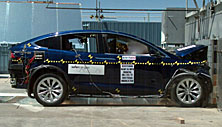
Frontal Crash Test
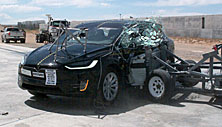
Side Crash Test
Overall Frontal Rating
Driver and Passenger Assessment
Driver Side
Passenger Side
Overall Side Rating
Side Barrier and Side Pole Tests
Driver Side
Passenger Side
Rollover Resistance
No rollover risk estimate available in this dataset
Safety Features
ESC: StandardForward Collision Warning: StandardLane Departure Warning: Standard
Recall Notices
NHTSANHTSA ID: 24V376000May 28, 2024
SEAT BELTS:FRONT:WARNING LIGHT/DEVICES
Tesla, Inc. (Tesla) is recalling certain 2012-2024 Model S, 2015-2024 Model X, 2017-2023 Model 3, and 2020-2023 Model Y vehicles. In the event of an unbelted driver, the seat belt warning light and audible chime may not activate as intended. As such, these vehicles fail to comply with the requirements of Federal Motor Vehicle Safety Standard number 208, "Occupant Crash Protection."
Remedy Status
Tesla will release an over-the-air (OTA) software update. Owner notification letters were mailed July 26, 2024. Owners may contact Tesla customer service at 1-877-798-3752. Tesla's number for this recall is SB-24-00-008.
NHTSA ID: 24V051000January 30, 2024
ELECTRICAL SYSTEM: INSTRUMENT CLUSTER/PANEL
Tesla, Inc. (Tesla) is recalling certain 2012-2023 Model S, 2016-2024 Model X, 2017-2023 Model 3, 2019-2024 Model Y, and 2024 Cybertruck vehicles. An incorrect font size is displayed on the instrument panel for the Brake, Park, and Antilock Brake System (ABS) warning lights. As such, these vehicles fail to comply with the requirements of Federal Motor Vehicle Safety Standard number 105, "Hydraulic and Electric Brake Systems" and 135, "Light Vehicle Brake Systems."
Remedy Status
Tesla began releasing an over-the-air (OTA) software update, free of charge. Owners may contact Tesla customer service at 1-877-798-3752. Tesla's number for this recall is SB-24-00-003.
NHTSA ID: 23V838000December 12, 2023
ELECTRICAL SYSTEM:ADAS:AUTONOMOUS/SELF DRIVING:SOFTWARE
Tesla, Inc. (Tesla) is recalling 2012-2023 Model S, 2016-2023 Model X, 2017-2023 Model 3, and 2020-2023 Model Y vehicles equipped with all versions of Autosteer leading up to the version(s) that contains the recall remedy. In certain circumstances when Autosteer is engaged, the prominence and scope of the feature's controls may not be sufficient to prevent driver misuse of the SAE Level 2 advanced driver-assistance feature.
Remedy Status
Tesla will release an over-the-air (OTA) software update, free of charge. Owner notification letters were mailed February 10, 2024. Owners may contact Tesla customer service at 1-877-798-3752. Tesla's number for this recall is SB-23-00-008.
NHTSA ID: 23V085000February 15, 2023
STEERING:AUTOMATED/ADAPTIVE STEERING
Tesla, Inc. (Tesla) is recalling certain 2016-2023 Model S, Model X, 2017-2023 Model 3, and 2020-2023 Model Y vehicles equipped with Full Self-Driving Beta (FSD Beta) software or pending installation. The FSD Beta system may allow the vehicle to act unsafe around intersections, such as traveling straight through an intersection while in a turn-only lane, entering a stop sign-controlled intersection without coming to a complete stop, or proceeding into an intersection during a steady yellow traffic signal without due caution. In addition, the system may respond insufficiently to changes in posted speed limits or not adequately account for the driver's adjustment of the vehicle's speed to exceed posted speed limits.
Remedy Status
Tesla will release an over-the-air (OTA) software update, free of charge. Owner notification letters were mailed April 15, 2023. Owners may contact Tesla customer service at 1-877-798-3752. Tesla's number for this recall is SB-23-00-001.
NHTSA ID: 22V818000November 01, 2022
STEERING:ELECTRIC POWER ASSIST SYSTEM
Tesla, Inc. (Tesla) is recalling certain 2017-2021 Model S and Model X vehicles. The electronic power assist steering (EPAS) system may experience a loss of power steering assist when driving on rough roads or after hitting a pothole.
Remedy Status
Tesla has released an over-the-air (OTA) software update to recalibrate the EPAS system, free of charge. Owner notification letters were mailed December 31, 2022. Owners may contact Tesla customer service at 1-877-798-3752. Tesla's number for this recall is SB-22-00-014.
NHTSA ID: 22V037000January 27, 2022
ELECTRICAL SYSTEM:ADAS:AUTONOMOUS/SELF DRIVING:SOFTWARE
Tesla, Inc. (Tesla) is recalling certain 2016-2022 Model S and Model X, 2017-2022 Model 3, and 2020-2022 Model Y vehicles. The "rolling stop" functionality available as part of the Full Self-Driving (Beta) software may allow the vehicle to travel through an all-way stop intersection without first coming to a stop.
Remedy Status
Tesla will perform an over-the-air (OTA) software update that disables the "rolling stop" functionality, free of charge. Owner notification letters were mailed March 28, 2022. Owners may contact Tesla customer service at 1-877-798-3752. Tesla's number for this recall is SB-22-00-001.
NHTSA ID: 21V846000October 29, 2021
FORWARD COLLISION AVOIDANCE: SENSING SYSTEM: CAMERA
Tesla, Inc. (Tesla) is recalling certain 2017-2021 Model S, Model 3, Model X, and 2020-2021 Model Y vehicles operating software version 2021.36.5.2. A communication error may cause false forward-collision warning (FCW) or unexpected activation of the automatic emergency brake (AEB) system.
Remedy Status
Tesla Service has released an over-the-air (OTA) software update, free of charge. The recall began October 25, 2021. Owners may contact Tesla customer service at 1-877-798-3752. Tesla's number for this recall is SB-21-00-004.
NHTSA ID: 21V035000January 29, 2021
BACK OVER PREVENTION:SOFTWARE
Tesla, Inc. (Tesla) is recalling certain 2012-2018 Tesla Model S and 2016-2018 Model X vehicles with a center display equipped with a NVIDIA Tegra 3 processor and an 8GB eMMC NAND flash memory device. When the 8GB eMMC NAND flash memory device for the center display reaches lifetime wear, the eMMC controller will no longer be able to maintain the integrity of the filesystem, causing a failure in some of the center display functions.
Remedy Status
Owners should ensure their vehicles are operating firmware release 2020.48.48.12 or newer, which will alert owners if the eMMC is approaching lifetime wear. Tesla will notify owners, and will replace the VCM daughterboard with one containing an enhanced eMMC controller, free of charge. The recall began March 29, 2021. Owners may contact Tesla customer service at 1-877-798-3752. Tesla's number for this recall is SB-21-21-001.
NHTSA ID: 17V639000October 12, 2017
SEATS:MID/REAR ASSEMBLY
Tesla, Inc. (Tesla) is recalling certain 2016-2017 Model X vehicles. The left-side, second row, reclining seat backs may not fully latch due to having incorrectly adjusted recliner mechanism cables. As such, these vehicles fail to comply with the requirements of Federal Motor Vehicle Safety Standard (FMVSS) number 207, "Seating Systems," and 210, "Seat Belt Assembly Anchorages."
Remedy Status
Tesla will notify owners, and Tesla service technicians will correct the cable adjustment for the left-side, fold-flat, second row, seat recliner mechanism, free of charge. The recall began on November 10, 2017. Owners may contact Tesla customer service at 1-877-798-3752. Tesla's number for this recall is SB-17-13-004.
NHTSA ID: 17V260000April 19, 2017
PARKING BRAKE
Tesla, Inc. (Tesla) is recalling certain 2016 Model S and Model X vehicles. The electric parking brake calipers have an internal gear that may be improperly manufactured, possibly resulting in the gear fracturing during parking brake application or release.
Remedy Status
Tesla will notify owners, and service centers will replace both the left and right electric parking brake calipers, free of charge. The recall began March 6, 2018. Owners may contact Tesla customer service at 1-877-798-3752. Tesla's number for this recall is SB-17-33-002.
Owner Complaints
265 totalSTEERING
Apr 16, 2026
The contact owns a 2017 Tesla Model X. The contact stated that while driving at an undisclosed speed, the steering wheel seized. There was no warning light illuminated. The contact stated that the steering wheel became difficult to control and was pulling to one side, almost caus...
Preview excerpt
STEERING
Mar 27, 2026
Repeat catastrophic steering failure on 2017 Model X (VIN [XXX] ). Steering wheel spins freely with zero connection to the wheels (complete mechanical disconnect). This is the third steering-system repair in under 12 months. • April 8, 2025: Lower intermediate shaft replaced (st...
Preview excerpt
STEERING
Mar 20, 2026
I experienced a total steering lockup and loss of vehicle control immediately following a steering column and suspension repair at a certified Tesla service center at [XXX] . INFORMATION REDACTED PURSUANT TO THE FREEDOM OF INFORMATION ACT (FOIA), 5 U.S.C. 552(B)(6)
ELECTRICAL SYSTEM
Mar 18, 2026
High voltage battery management system generated fault codes BMS_u008 and BMS_f071 during a Supercharger charging session, prohibiting drive mode. Vehicle had been driven normally to the Supercharger with no drive-prohibiting alerts during transit. After connecting to the Superch...
Preview excerpt
STRUCTURE:BODY
Feb 4, 2026
Approximately one to two months ago, the driver-side front door latch on my 2017 Tesla Model X malfunctioned and prevented me from exiting the vehicle through the driver door. I first attempted to open the door using the manual interior door handle (manual mechanical release), b...
Preview excerpt
STEERING
Dec 13, 2025
The electronic power steering (EPS) is struggling, requiring increased driver effort to steer. This seems to be dangerous when driving. The Full Self Driving (FSD) capability also stops abruptly when the steering locks up. Again, this is very risky and can cause serious accidents...
Preview excerpt
ELECTRICAL SYSTEM
Nov 30, 2025
During home charging using 40A, the 220 volt UMC connector started smoking and was melting. The charging appeared unaffected, and I caught it before it caught fire.
STEERING
Oct 17, 2025
Power Steering Assist stopped working while on the road. A couple days later, power steering stopped working completely.
LANE DEPARTURE: WARNING
Oct 16, 2025
The autopilot ECU failed on my car per Tesla. There was no warning on the car that my safety features were disabled. This is also reported online as a common issue and Tesla is charging $2k to repair a safety computer. The computer was advertised as two chips as a failsafe but th...
Preview excerpt
FUEL/PROPULSION SYSTEM
Sep 9, 2025
Reproducible and sudden loss of indicated driving range at low state of charge (SOC) for 6 months. First documented occurrence on 9 September 2025 during my final service visit while the vehicle was still covered under Tesla’s 8-year unlimited-mile high-voltage battery warranty, ...
Preview excerpt
Showing 10 recent complaints from 265 total
View Full Complaint LogCompare Related Vehicles
Why Compare These Pages
The strongest comparison flow is usually: exact vehicle-year page, then nearby years of the same model, then other 2017 Tesla models. That sequence helps separate one-off year spikes from broader make-wide patterns.
More Tesla Model X Years
2018 Tesla Model XCompare this year against 2017 for complaint and recall shifts.9r185c2016 Tesla Model XCompare this year against 2017 for complaint and recall shifts.12r442c2019 Tesla Model XCompare this year against 2017 for complaint and recall shifts.8r97c2015 Tesla Model XCompare this year against 2017 for complaint and recall shifts.2r0c2020 Tesla Model XCompare this year against 2017 for complaint and recall shifts.10r120c2021 Tesla Model XCompare this year against 2017 for complaint and recall shifts.23r38c
Frequently Asked Questions
How many recalls does the 2017 Tesla Model X have?
The 2017 Tesla Model X has 10 recalls recorded by NHTSA.
How many complaints have been filed for the 2017 Tesla Model X?
NHTSA has received 265 owner-reported complaints for the 2017 Tesla Model X.
What is the NHTSA safety rating for the 2017 Tesla Model X?
Our stored NHTSA record for the 2017 Tesla Model X has an overall rating of 5 out of 5 stars. Stored NHTSA configuration: 2017 Tesla Model X 60D SUV AWD. NCAP Vehicle ID: 11814. Ratings describe one stored NHTSA configuration, not every trim, body style or drivetrain for this model year.
What are the most common problems with the 2017 Tesla Model X?
The most frequent complete stored component labels for the 2017 Tesla Model X are electrical system (62 reports), suspension (54 reports), steering (33 reports). These are exact-label counts, not broader component-group totals or confirmed defects.
Does the 2017 Tesla Model X have any recalls?
Yes. NHTSA has 10 recalls on record for the 2017 Tesla Model X. Scroll up to review the published recall summaries, consequences, and remedies. To check for unrepaired recalls on your specific vehicle, use your VIN at nhtsa.gov/recalls.
Check Another Vehicle
Look up recalls and complaints for any year, make, and model.
This page summarizes publicly available data from the National Highway Traffic Safety Administration (NHTSA). Complaint counts reflect reports submitted to NHTSA by vehicle owners and do not by themselves prove defect severity or vehicle safety. Safety ratings may not be available for all vehicle-years. This site is not affiliated with NHTSA or any vehicle manufacturer. For official information, visit the official NHTSA page for this vehicle.