Ford · Escape · 2008
2008 Ford Escape
5
Recalls
2,412
Complaints
N/A
NCAP overall
The 2008 Ford Escape has 5 recalls and 2,412 owner-reported complaints on file with NHTSA. Most frequent stored component label: steering (1087 reports).
Stored NHTSA configuration: 2008 Ford Escape 4-DR. w/SAB (Early release) NCAP Vehicle ID: 2378
Ratings describe one stored NHTSA configuration, not every trim, body style or drivetrain for this model year. How this configuration is selected
Source: NHTSA Public Records
NHTSA source checks for this vehicle year
- Complaints
- Separate successful check not recorded.
- Recalls
- Separate successful check not recorded.
- Safety ratings
- Separate successful check not recorded.
- Investigations
- Separate successful check not recorded.
- Manufacturer communications
- Separate successful check not recorded.
Checks are recorded separately for each dataset, not for the whole page. Dates use UTC. A missing check date does not mean no records exist.
Vehicle import recorded: Apr 29, 2026. This is the stored import date, not confirmation that every source was successfully refreshed.
Research Context
The 2008 Ford Escape page works best as a research starting point. Complaint totals show how much owner-reported activity exists, while recalls and investigations help show whether any of that activity turned into formal safety action.
Because this is a newer-era vehicle page, it usually helps to compare this year against nearby model years before deciding whether a complaint pattern looks isolated or persistent. On this page, the most frequent complete stored component label is steering with 1087 reported complaints.
Best Research Moves
- Use the complaint log to see whether the 2008 Ford Escape reports cluster around one repeated symptom or spread across multiple systems.
- Compare the recall list with the complaint mix to see whether the most reported issues overlap with formal NHTSA safety campaigns.
- Check the linked investigations for extra ODI context if you want to see whether owner complaints escalated into formal defect review.
Key Takeaways
- The 2008 Ford Escape currently shows 5 NHTSA recalls listed on this page and 2,412 owner-reported complaints.
- This page currently shows 3 NHTSA investigations linked to this page.
- This page reflects complaint volume, recall history, and NHTSA test data, but it does not diagnose causes or rank reliability by itself.
- Safety data currently shows no overall NHTSA safety rating in our current dataset.
- The most frequent complete stored component labels on this page are steering (1087), power train (247), service brakes (204).
- Vehicle
- 2008 Ford Escape
- Recalls
- 5
- Complaints
- 2412
- Stored Configuration Overall Rating
- Not available in this dataset
How to Interpret This Page
This page combines three types of NHTSA data: recall campaigns (official manufacturer or government actions), owner complaints (unverified consumer reports), and crash test ratings (where available). A vehicle with many complaints is not necessarily less reliable — complaint volume correlates with sales volume and vehicle age. Recalls indicate identified defects, not overall quality. To compare this model year with others, use the year navigation in the sidebar or return to the model overview page.
If you are researching a used vehicle, start with the complaint categories, compare them against the recall list, and then check nearby model years to see whether the same issue profile repeats. That usually produces a better buying or research signal than treating the raw complaint total as a standalone safety ranking.
NHTSA Configuration Test Results
Stored NHTSA configuration: 2008 Ford Escape 4-DR. w/SAB (Early release) NCAP Vehicle ID: 2378
Ratings describe one stored NHTSA configuration, not every trim, body style or drivetrain for this model year. How this configuration is selected
No overall score is available in our current dataset. The individual results below are not a combined safety rating; compare vehicles within the same test program and model year.
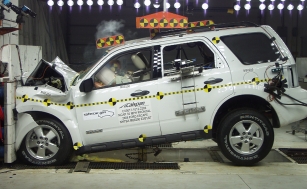
Frontal Crash Test
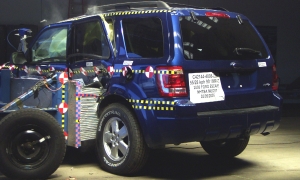
Side Crash Test
Overall Frontal Rating
Driver and Passenger Assessment
Driver Side
Passenger Side
Overall Side Rating
Side Barrier and Side Pole Tests
Driver Side
Passenger Side
Rollover Resistance
No rollover risk estimate available in this dataset
Safety Features
ESC: StandardForward Collision Warning: NoLane Departure Warning: No
Recall Notices
NHTSANHTSA ID: 15V606000September 29, 2015
POWER TRAIN:AUTOMATIC TRANSMISSION:LEVER AND LINKAGE:FLOOR SHIFT
Ford Motor Company (Ford) is recalling certain model year 2001-2008 Ford Escape and Mercury Mariner vehicles manufactured March 31, 2001, to September 1, 2009. The affected vehicles are equipped with either a 2.3L or 3.0L engine and have had their CD4E transmission replaced with remanufactured one that was rebuilt between June 11, 2015 through July 15, 2015. These service repair part transmissions have a shift lever bolt that may not be properly tightened. As a result, the shift control lever could disengage from the transmission without warning.
Remedy Status
Ford will notify owners, and dealers will inspect the transmissions and either tighten the manual shift lever bolt or replace the manual shift lever assembly. These repairs will be performed free of charge. The recall began on October 23, 2015. Owners may contact Ford customer service at 1-866-436-7332. Ford's number for this recall is 15S28.
NHTSA ID: 15E045000June 03, 2015
SUSPENSION:FRONT:WHEEL BEARING
The Timken Company (Timken) is recalling certain aftermarket front wheel bearings, part number 510072, sold from January 22, 2015, to May 21, 2015, to be used as service parts on 2001-2012 Ford Escape, 2001-2011 Mazda Tribute, and 2005-2011 Mercury Mariner vehicles. The affected wheel bearings have incorrect dimensions of a 42mm bore, 76mm outer dimension, and 39mm width, instead of a 42mm bore, 78mm outer dimension and a 45mm width.
Remedy Status
Timken has begun notifying distributors who will offer purchasers replacement wheel bearings, free of charge. The recall began on May 21, 2015. Owners may contact Timken customer service at 1-866-984-6536.
NHTSA ID: 14V526000September 03, 2014
HYBRID PROPULSION SYSTEM
Ford Motor Company (Ford) is recalling certain model year 2005-2008 Ford Escape hybrid electric vehicles manufactured October 13, 2003, to June 20, 2008, and 2006-2008 Mercury Mariner hybrid electric vehicles manufactured June 10, 2005, to June 20, 2008. The coolant pump for the hybrid system may fail resulting in the hybrid electronics overheating.
Remedy Status
Ford will notify owners, and dealers will inspect and replace the original Motor Electronics Coolant (MEC) Pump with an improved brushless pump, free of charge. The recall is expected to begin on October 27, 2014. Owners may contact Ford customer service at 1-866-436-7332. Ford's number for this recall is 14S19.
NHTSA ID: 14V284000May 29, 2014
STEERING:ELECTRIC POWER ASSIST SYSTEM
Ford Motor Company (Ford) is recalling certain model year 2008-2011 Ford Escape and Mercury Mariner vehicles manufactured August 18, 2006, through September 11, 2010. The affected vehicles have a steering torque sensor that may not be able to properly detect driver steering input. As a result, the system could remove the Electric Power Steering (EPS) assist.
Remedy Status
Ford will notify owners, and dealers will update the software for the power steering control module (PSCM) and the instrument cluster module, free of charge. If a vehicle shows a history of a loss of the torque sensor signal or fault codes relating to the PSCM when the vehicle is brought in for the recall remedy, the affected components will be replaced, free of charge. The recall began on July 18, 2014. Owners may contact Ford customer service at 1-800-392-3673. Ford's number for this recall is 14S05.
NHTSA ID: 10E043000September 03, 2010
EQUIPMENT
MARATHON IS RECALLING CERTAIN SEAT COVERS, BRAND SUPERHIDES WITH PART NUMBERS 593, 594, 578, 960, 228, 228-09, 267-08, 333, 625, AND 630, SOLD FOR USE AS AFTERMARKET EQUIPMENT FOR VARIOUS PASSENGER VEHICLES. THESE SEAT COVERS ARE MADE OF HEAVIER THREAD AND ARE NOT COMPATIBLE WITH SEATS CONTAINING SIDE AIRBAGS. THE HEAVIER SEAT COVER COULD INTERFERE WITH FULL DEPLOYMENT OF THE AIRBAG IN THE EVENT OF A CRASH.
Remedy Status
MARATHON WILL NOTIFY OWNERS OF RECORD AND REPLACE THE SEAT COVER FREE OF CHARGE. THE SAFETY RECALL BEGAN ON SEPTEMBER 14, 2010. OWNERS MAY CONTACT MARATHON AT 1-800-735-2769.
Investigations
3 totalOn May 27, 2014, amended June 2, 2014, Ford Motor Company (Ford) submitted a Defect Information Report (DIR) to NHTSA describing a safety defect that may result in a sudden loss of power steering assist while driving in approximately 746,067 model year (MY) 2008 through 2011 Ford Escape vehicles equipped with electric power assisted steering (NHTSA 14V-284, Ford 14S05). Ford's DIR described the defect condition as a poor signal to noise ratio [SNR] in the torque sensor within the Electric Power Assisted Steering (EPAS) system [which] does not allow the PSCM to determine the driver's steering input. When the system detects this fault condition, it transitions the EPAS system to the fail-safe/manual steering mode.Ford's DIR indicates that loss of power steering assist while driving would require higher steering effort at lower vehicle speeds, which may result in an increased risk of a crash.Ford's remedy instructs dealers to check the Power Steering Control Module (PSCM) for Diagnostic Trouble Codes (DTCs) to determine the proper repair procedure. If no DTCs are present, dealers are to update the PSCM and instrument cluster module software. The updated PSCM software changes the torque sensor fault strategy so that the SNR condition does not result in a loss of power steering assist while driving.In addition, audible and visual warnings are provided for torque sensor faults.If DTCs indicating faults in the torque sensor, PSCM or Power Steering Motor (motor) are present in the initial recall inspection, the dealer performs the following repairs: 1) replaces the torque sensor for torque sensor faults (DTC B2278); or 2) replaces the steering column for faults related to the PSCM (DTC B1342) or motor (DTC B2277).Continued in attachment pages
Component: STEERING:ELECTRIC POWER ASSIST SYSTEMOpened: Apr 1, 2015Closed: Jun 14, 2018
In a letter dated August 30, 2012, The North Carolina Consumers Council (NCCC) petitioned the National Highway Traffic Safety Administration (NHTSA) to initiate a defect investigation of alleged electronic throttle body failures resulting in engine stall or surge while driving in model year (MY) 2005 through 2012 Ford Escape vehicles. On October 2, 2012 the Office of Defects Investigation (ODI) opened a Defect Petition DP12-006 to evaluate whether to grant or deny the petition. The petition is hereby granted on certain model years. The NCCC letter cites two complaints of stall while driving in MY 2009 Ford Escape vehicles that were diagnosed as failed throttle bodies with diagnostic trouble codes (DTC) P2111, Throttle Body Stuck Open, and P2112, Throttle Body Stuck Closed. The petitioner indicates that the owners of both vehicles reported experiencing repeated incidents of stalling and engine surging. According to Ford, Escape non-hybrid vehicles are equipped with Electronic Throttle Body (ETB) assemblies beginning with MY 2009. Vehicles manufactured between June 22, 2009 and October 15, 2009 may contain contaminated printed circuit boards (PCB) with plating variations. Plating variations could lead to a lack of continuity in the throttle position sensor circuit where P2111 and/or other DTCs would be generated and stored. Ford and its electronic throttle body supplier, Delphi, modified the PCB manufacturing process and issued a technical service bulletin (TSB) 09-23-5. Vehicles produced after October 15, 2009 incorporated ETBs manufactured with a PCB process that resolved this condition. ODI's analysis identified a total of 123 unique reports indicating allegations of reduced motive power or vehicle stall. Depending on the condition of throttle control system malfunction, a driver may experience varying levels of reduced engine performance associated with three limp home modes. In two limp modes, reduced engine performance may maintain vehicle speeds above 20mph while the third is a limited limp home mode with engine speeds limited to approximately 900 RPM. Allegations of stall appear to be related to the limited limp home mode. Vehicles are not likely to unexpectedly stall as a result of this condition, but drivers may characterize the reduced functionality as a stall, even though their vehicle may still has motive capability. Allegations of vehicle surge appear to be related to limp home mode operation. Complaints alleging surge are most likely related to engine RPM fluctuations at low vehicle speeds or idle as the control system engages to prevent engine stall. In limited limp mode, rough-idle conditions may exist while the control system attempts to modulate engine RPMs once the vehicle reaches a reduced speed to maintain approximately 900 RPM. Separately, ODI received 59 complaints alleging incidents of engine stall while driving in model year (MY) 2010-2011 Ford Fusion vehicles. Approximately 60 percent (36) of the incidents occurred at speeds of 40 miles per hour or more. Eighty percent of complaints (47) were received beginning March 2012 and 14 complaints reported that the throttle body was replaced or DTCs associated with limp home modes. Additionally, Ford issued TSB 10-21-6 addressing DTCs associated with idle speed drops and limited limp home mode. The petition is granted on certain model years.Preliminary Evaluation PE13-003 has been opened to assess the scope, frequency and potential safety consequences associated with the alleged defect.See full copy of the closing resume for this defect petition for list of the VOQs associated with the defect petition analysis.
Component: ENGINEOpened: Oct 2, 2012Closed: Feb 21, 2013
PEClosed
ON OCTOBER 14, 2008, ODI OPENED PE08-060 TO INVESTIGATE ALLEGATIONS OF CRACKED AND LEAKING SNAP-IN TIRE VALVES IN MODEL YEAR (MY) 2007 VEHICLES MANUFACTURED BY FORD MOTOR COMPANY.THE VALVES WERE SUPPLIED TO FORD BY TOPSEAL AUTO-PARTS, A SUBSIDIARY OF THE SHANGHAI BAOLONG AUTOMOTIVE CORPORATION IN CHINA.VALVES MADE BY TOPSEAL FOR AFTERMARKET SALE WERE THE SUBJECT OF TWO RECENT SAFETY RECALLS BY TECH INTERNATIONAL (08T-018) AND DILL AIR CONTROLS (08T-028), THE LATTER OF WHICH WAS INVESTIGATED BY ODI IN PE08-036 AND EA08-022.THE DEFECT CONDITIONS ADDRESSED BY THE AFTERMARKET TIRE VALVE RECALLS BOTH INVOLVED INADEQUATE RESISTANCE TO OZONE CRACKING DUE TO ISSUES WITH THE SUPPLY OF ANTI-OZONANT CHEMICALS TO TOPSEAL FOR A PERIOD FROM JULY TO MID-NOVEMBER 2006.THE AFTERMARKET VALVES WERE COMPOUNDED WITH A BLEND OF EPDM AND NATURAL RUBBER, USING A RELATIVELY LOW PERCENTAGE OF EPDM (EPDM PROVIDES INHERENT RESISTANCE TO OZONE CRACKING).HENCE, THE NEED FOR ANTI-OZONANT CHEMICALS AND THE PROBLEMS WITH CRACKING WHEN THOSE CHEMICALS WERE MISSING OR OUT OF SPECIFICATION IN SOME LOTS OF VALVES.BOTH RECALL CAMPAIGNS INVOLVED INSPECTION PROGRAMS TO IDENTIFY AND REPLACE VALVES WITH VISIBLE SURFACE CRACKING.ALTHOUGH THE TOPSEAL VALVES SUPPLIED TO FORD ALSO APPEAR TO HAVE BEEN AFFECTED BY THE ANTI-OZONANT SUPPLY ISSUES IN MID TO LATE-2006, FORD INDICATED THAT ITS VALVES WERE MADE AT A DIFFERENT TOPSEAL PRODUCTION LINE AND WERE COMPOUNDED WITH A HIGHER PERCENTAGE OF EPDM RUBBER TO MEET MORE STRINGENT SPECIFICATIONS FROM FORD.ODI'S ANALYSIS OF COMPLAINT AND WARRANTY DATA PROVIDED BY FORD SHOWED THAT PROBLEMS WITH CRACKED TIRE VALVES WERE SIGNIFICANTLY HIGHER FOR MY 2007 VEHICLES PRODUCED FROM DECEMBER 2006 THROUGH MARCH 2007.FORD RESPONDED BY IMPLEMENTING CHANGES IN ITS MATERIAL SPECIFICATIONS FOR SNAP-IN RUBBER TIRE VALVES AND ALSO INCREASING THE QUALITY AND ACCEPTANCE STANDARDS FOR VALVES IMPORTED FOR USE IN ITS VEHICLES.WHILE THE COMPLAINT AND WARRANTY CLAIM RATES ARE ELEVATED FOR SUBJECT VEHICLES PRODUCED FROM DECEMBER 2006 THROUGH MARCH 2007, THE RATES OF LEAKING VALVES ARE WELL BELOW ONE PERCENT OF PRODUCTION FOR EACH OF THE PEAK MONTHS FOR ALL OF THE AFFECTED MODELS.A SUBSTANTIAL MAJORITY OF THE SUBJECT VEHICLES ARE EQUIPPED WITH TIRE PRESSURE MONITORING SYSTEMS (TPMS) WHICH WARN THE DRIVER WHEN ANY TIRE PRESSURES DROPS BELOW 25 PERCENT OF RECOMMENDED INFLATION PRESSURE. AS OUTLINED IN A LETTER TO ODI DATED APRIL 6, 2009, FORD HAS AGREED TO SEND LETTERS TO OWNERS OF CERTAIN MY 2007 AND 2008 FORD, LINCOLN AND MERCURY VEHICLES TO PROVIDE INFORMATION ABOUT THE CRACKING CONCERN. LETTERS WILL BE SENT TO OWNERS OF VEHICLES BUILT FROM NOVEMBER 2006 THROUGH MAY 2007.OWNERS CAN OPT FOR A FREE DEALER INSPECTION.VALVES EXHIBITING SURFACE CRACKS OR AIR LEAKAGE RELATED TO OZONE ATTACK WILL BE REPLACED BY FORD UNDER ITS NORMAL WARRANTY TERMS.FORD EXPECTS TO SEND THE LETTER BY APPROXIMATELY MID-MAY 2009. BASED ON THE USE OF TPMS IN THE MAJORITY OF SUBJECT VEHICLES AND THE RELATIVELY LOW RATES OF REPAIRS ASSOCIATED WITH LEAKING VALVES AND RESULTANT TIRE DAMAGE, ODI BELIEVES THAT THE ACTIONS FORD HAS AGREED TO TAKE WILL PROVIDE EFFECTIVE AND EXPEDITIOUS RESOLUTION FOR VEHICLES THAT WERE BUILT DURING THE PERIOD WHEN VALVES WITH INADEQUATE RESISTANCE TO OZONE CRACKING WERE MOST LIKELY TO HAVE BEEN USED IN VEHICLE PRODUCTION.FURTHER INVESTIGATION OF THIS MATTER WOULD NOT BE AN EFFICIENT ALLOCATION OF AGENCY RESOURCES.ACCORDINGLY, THIS INVESTIGATION IS CLOSED.THE CLOSING OF THIS INVESTIGATION DOES NOT CONSTITUTE A FINDING BY NHTSA THAT A SAFETY-RELATED DEFECT DOES NOT EXIST.THE AGENCY WILL CONTINUE TO
Component: TIRES:VALVEOpened: Oct 14, 2008Closed: Apr 9, 2009
Owner Complaints
2412 totalSERVICE BRAKES, HYDRAULIC,POWER TRAIN
Apr 13, 2026
The contact owns a 2008 Ford Escape. The contact stated that the powertrain malfunction warning light and the ABS warning light were illuminated. The driver was able to pull over, the battery was disconnected and reconnected, and the contact was able to continue driving. The brak...
Preview excerpt
STEERING
Mar 9, 2026
The contact owns a 2008 Ford Escape. The contact received notification of NHTSA Campaign Number: 14V284000 (Steering); however, the part to do the recall repair was not yet available. The contact stated that while driving at an undisclosed speed, the steering wheel became firm an...
Preview excerpt
ELECTRICAL SYSTEM,ENGINE,FUEL/PROPULSION SYSTEM
Mar 2, 2026
Check engine light keeps flashing, car vibration, bad head gasket, oil and fluid leak
STEERING
Mar 1, 2026
The power steering torque sensor went out. It was recalled, the repair was made, but the part is failing again. It is creating a safety issue. Ford won't re-repair. The part they put in is failing again. It has been less than 15 years since they put in the recalled part.
STEERING
Feb 11, 2026
The power steering started going out at low speeds and eventually just stopped working. The car keeps saying power steering assist fault. The power steering no longer works.
STEERING
Jan 26, 2026
The electronic power steering stopped working and it is almost impossible to move or turn the car. Dashboard shows fault. This is a Ford Escape Hybrid 2008 model with 142,000 miles. The car has not been repaired and I have yet to take it to a Ford dealership.
STEERING
Jan 24, 2026
Vehicle: 2008 Ford Escape VIN: [XXX] Component: Steering – Electric Power Steering Assist Recall Involved: 14S05 / NHTSA 14V-284000 Description of the Safety Problem: My vehicle is experiencing a recurrence of electric power steering assist failure after a prior safety recall re...
Preview excerpt
STEERING
Jan 16, 2026
Forscan showing torque sensor malfunction, the same issue that was recalled in 2014. Causing loss of power steering
STEERING
Dec 26, 2025
Manufacturer failed to respond to certified written request for recall coverage determination.
STEERING
Dec 1, 2025
The contact owns a 2008 Ford Escape. The contact stated that while stopped at a light and attempting to make a turn, the steering wheel became inoperable. The contact stated that the steering wheel seized and became difficult to turn, and a crescent wrench warning light was illum...
Preview excerpt
Showing 10 recent complaints from 2,412 total
View Full Complaint LogCompare Related Vehicles
Why Compare These Pages
The strongest comparison flow is usually: exact vehicle-year page, then nearby years of the same model, then other 2008 Ford models. That sequence helps separate one-off year spikes from broader make-wide patterns.
More Ford Escape Years
2009 Ford EscapeCompare this year against 2008 for complaint and recall shifts.3r3i1,687c2007 Ford EscapeCompare this year against 2008 for complaint and recall shifts.4r2i393c2010 Ford EscapeCompare this year against 2008 for complaint and recall shifts.5r4i2,122c2006 Ford EscapeCompare this year against 2008 for complaint and recall shifts.5r1i720c2011 Ford EscapeCompare this year against 2008 for complaint and recall shifts.3r4i1,310c2005 Ford EscapeCompare this year against 2008 for complaint and recall shifts.5r2i1,584c
More 2008 Ford Models
2008 Ford FusionAnother 2008 Ford option for same-year comparison.6r5i1,352c2008 Ford EdgeAnother 2008 Ford option for same-year comparison.7r2i1,115c2008 Ford F-150Another 2008 Ford option for same-year comparison.1r1i369c2008 Ford MustangAnother 2008 Ford option for same-year comparison.8r4i346c2008 Ford F-250Another 2008 Ford option for same-year comparison.8r1i336c2008 Ford RangerAnother 2008 Ford option for same-year comparison.6r1i324c
Frequently Asked Questions
How many recalls does the 2008 Ford Escape have?
The 2008 Ford Escape has 5 recalls recorded by NHTSA.
How many complaints have been filed for the 2008 Ford Escape?
NHTSA has received 2,412 owner-reported complaints for the 2008 Ford Escape.
What is the NHTSA safety rating for the 2008 Ford Escape?
An overall NHTSA safety rating is not available in our current dataset for the 2008 Ford Escape. Individual crash-test results may still be available.
What are the most common problems with the 2008 Ford Escape?
The most frequent complete stored component labels for the 2008 Ford Escape are steering (1087 reports), power train (247 reports), service brakes (204 reports). These are exact-label counts, not broader component-group totals or confirmed defects.
Does the 2008 Ford Escape have any recalls?
Yes. NHTSA has 5 recalls on record for the 2008 Ford Escape. Scroll up to review the published recall summaries, consequences, and remedies. To check for unrepaired recalls on your specific vehicle, use your VIN at nhtsa.gov/recalls.
Check Another Vehicle
Look up recalls and complaints for any year, make, and model.
This page summarizes publicly available data from the National Highway Traffic Safety Administration (NHTSA). Complaint counts reflect reports submitted to NHTSA by vehicle owners and do not by themselves prove defect severity or vehicle safety. Safety ratings may not be available for all vehicle-years. This site is not affiliated with NHTSA or any vehicle manufacturer. For official information, visit the official NHTSA page for this vehicle.