Ford · Escape · 2017
2017 Ford Escape
3
Recalls
2,533
Complaints
5/5
NCAP overall
The 2017 Ford Escape has 3 recalls and 2,533 owner-reported complaints on file with NHTSA. One stored NHTSA configuration has an overall rating of 5 out of 5 stars, not a rating for all versions. Most frequent stored component label: engine (1077 reports).
Stored NHTSA configuration: 2017 Ford Escape SUV AWD NCAP Vehicle ID: 11077
Ratings describe one stored NHTSA configuration, not every trim, body style or drivetrain for this model year. How this configuration is selected
Source: NHTSA Public Records
NHTSA source checks for this vehicle year
- Complaints
- Separate successful check not recorded.
- Recalls
- Separate successful check not recorded.
- Safety ratings
- Separate successful check not recorded.
- Investigations
- Separate successful check not recorded.
- Manufacturer communications
- Separate successful check not recorded.
Checks are recorded separately for each dataset, not for the whole page. Dates use UTC. A missing check date does not mean no records exist.
Vehicle import recorded: Apr 29, 2026. This is the stored import date, not confirmation that every source was successfully refreshed.
Research Context
The 2017 Ford Escape page works best as a research starting point. Complaint totals show how much owner-reported activity exists, while recalls and investigations help show whether any of that activity turned into formal safety action.
Because this is a newer-era vehicle page, it usually helps to compare this year against nearby model years before deciding whether a complaint pattern looks isolated or persistent. On this page, the most frequent complete stored component label is engine with 1077 reported complaints.
Best Research Moves
- Use the complaint log to see whether the 2017 Ford Escape reports cluster around one repeated symptom or spread across multiple systems.
- Review the recall section even if the total is smaller, because a limited number of recalls can still point to meaningful safety actions.
- This page is primarily a complaints-and-recalls research surface, so compare nearby model years before treating the complaint total as a standalone verdict.
Key Takeaways
- The 2017 Ford Escape currently shows 3 NHTSA recalls listed on this page and 2,533 owner-reported complaints.
- This page currently shows no linked NHTSA investigations.
- This page reflects complaint volume, recall history, and NHTSA test data, but it does not diagnose causes or rank reliability by itself.
- Safety data currently shows 5/5 overall NHTSA rating for one stored configuration, not all versions.
- The most frequent complete stored component labels on this page are engine (1077), engine and engine cooling (374), power train (208).
- Vehicle
- 2017 Ford Escape
- Recalls
- 3
- Complaints
- 2533
- Stored Configuration Overall Rating
- 5/5. Stored NHTSA configuration: 2017 Ford Escape SUV AWD. NCAP Vehicle ID: 11077.
How to Interpret This Page
This page combines three types of NHTSA data: recall campaigns (official manufacturer or government actions), owner complaints (unverified consumer reports), and crash test ratings (where available). A vehicle with many complaints is not necessarily less reliable — complaint volume correlates with sales volume and vehicle age. Recalls indicate identified defects, not overall quality. To compare this model year with others, use the year navigation in the sidebar or return to the model overview page.
If you are researching a used vehicle, start with the complaint categories, compare them against the recall list, and then check nearby model years to see whether the same issue profile repeats. That usually produces a better buying or research signal than treating the raw complaint total as a standalone safety ranking.
NHTSA Configuration Test Results
Stored NHTSA configuration: 2017 Ford Escape SUV AWD NCAP Vehicle ID: 11077
Ratings describe one stored NHTSA configuration, not every trim, body style or drivetrain for this model year. How this configuration is selected
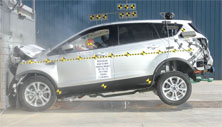
Frontal Crash Test
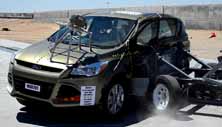
Side Crash Test
Overall Frontal Rating
Driver and Passenger Assessment
Driver Side
Passenger Side
Overall Side Rating
Side Barrier and Side Pole Tests
Driver Side
Passenger Side
Rollover Resistance
No rollover risk estimate available in this dataset
Safety Features
ESC: StandardForward Collision Warning: OptionalLane Departure Warning: Optional
Recall Notices
NHTSANHTSA ID: 26V011000January 15, 2026
EQUIPMENT:ELECTRICAL:ENGINE BLOCK HEATER
Ford Motor Company (Ford) is recalling certain 2013-2018 Focus, 2013-2019 Escape, and 2015-2016 MKC vehicles equipped with a 2.0L engine. The engine block heater may crack and develop a coolant leak, causing it to short circuit when the block heater is plugged in.
Remedy Status
Owners are advised not to plug in their block heater until the vehicle is remedied. Dealers will replace the block heater, free of charge. Owners will also have a alternative option to replace engine block heater element with a threaded plug, and remove the block heater electrical cord. Interim letters, notifying owners of the safety risk, were mailed March 6, 2026. Additional letters will be sent once the final remedy is available. Owners may contact Ford customer service at 1-866-436-7332. Ford's number for this recall is 26S01. Vehicle Identification Numbers (VINs) involved in this recall became searchable on NHTSA.gov on January 16, 2026.
NHTSA ID: 22V413000June 10, 2022
POWER TRAIN:AUTOMATIC TRANSMISSION:GEAR POSITION INDICATION (PRNDL)
Ford Motor Company (Ford) is recalling certain 2013-2019 Escape, 2013-2018 C-Max, 2013-2016 Fusion, 2013-2021 Transit Connect, and 2015-2018 Edge vehicles. The bushing that attaches the shifter cable to the transmission may degrade or detach.
Remedy Status
Dealers will replace the under hood shift bushing and add a protective cap over the shift cable bushing, free of charge. Interim owner notification letters, informing owners of the safety risk, were mailed July 1, 2022. Remedy parts are expected to be available in 4th Quarter 2022. Owner notification letters were mailed October 27, 2022. Owners may contact Ford customer service at 1-866-436-7332. Ford's number for this recall is 22S43.
NHTSA ID: 16V617000August 24, 2016
VISIBILITY:POWER WINDOW DEVICES AND CONTROLS
Ford Motor Company (Ford) is recalling certain model year 2017 Ford Escape Titanium and SE vehicles manufactured October 5, 2015, to May 12, 2016. The settings for the closing-force of the power-operated windows may allow the windows to close on an object such as a body part and injure it before the windows auto-reverse. As such, these vehicles fail to comply with the requirements of Federal Motor Vehicle Safety Standard (FMVSS) number 118, "Power-Operated Window Systems."
Remedy Status
Ford has notified owners, and dealers will update the power window operating system software, free of charge. The recall began on September 6, 2016. Owners may contact Ford customer service at 1-866-436-7332. Ford's number for this recall is 16C12.
Owner Complaints
2533 totalPOWER TRAIN,ENGINE
Apr 23, 2026
There is a known issue with coolant intrusion into the engine with this vehicle. The vehicle has less than 40,000 miles. The engine stalled three times over a two mile trip and completely shut off during a left hand turn with oncoming traffic putting my family and other drivers i...
Preview excerpt
UNKNOWN OR OTHER
Apr 23, 2026
My low beam headlights for the past year burn out every 4 to 6 weeks. In the past 3 months, they began to burn out every 2 to 3 weeks. Recently I went to have my headlight changed once again and they told me that the headlight assembly kits were actually burnt/melted and would ...
Preview excerpt
UNKNOWN OR OTHER,ENGINE
Apr 18, 2026
Engine fault light came on took to mechanic nothing popped up on the codes. Then check engine light came on took to another mechanic it showed it was misfiring along with other codes. Then check engine light went away. Then moved car out of driveway and engine overheating light c...
Preview excerpt
ELECTRICAL SYSTEM
Apr 15, 2026
The contact owns a 2017 Ford Escape. While driving at an undisclosed speed, the vehicle suddenly stopped on several occasions and lost automotive power. The Automatic START/STOP message was displayed. The contact manually turned off the feature, but the Automatic START/STOP featu...
Preview excerpt
ENGINE AND ENGINE COOLING
Apr 14, 2026
The contact owns a 2017 Ford Escape. The contact stated that the vehicle was losing coolant, and the coolant pipes were replaced; however, the failure persisted. The vehicle was inspected, and the contact was informed that coolant was leaking into the engine cylinders. Due to the...
Preview excerpt
ELECTRICAL SYSTEM,UNKNOWN OR OTHER,FUEL/PROPULSION SYSTEM
Apr 14, 2026
The failure appears to involve the vehicle’s auto start/stop system and related electrical control systems, including the battery management system and/or body control module. The vehicle shuts off unexpectedly while driving and fails to automatically restart, displaying “Auto St...
Preview excerpt
ENGINE
Apr 14, 2026
Mechanic looked at vehicle couldn’t find a coolant leak from anywhere, could be a cracked head.
ENGINE
Apr 12, 2026
DAILY COOLANT LOSS WITH NO LEAK. LARGE VOLUME OF WHITE SWEET-SMELLING SMOKE IN MORNING AT START UP AS WELL AS ENGINE STUMBLING AT STARTUP. UNKNOWN COOLANT LOSS CAUSED OVERHEATING
ENGINE
Apr 12, 2026
coolant intrusion
ENGINE
Apr 8, 2026
I am reporting a serious engine defect with my 2017 Ford Escape EcoBoost. Coolant has leaked into cylinder number 4, causing engine damage and failure. The dealership confirmed this diagnosis and stated that a full engine replacement is required, with an estimated cost of 9,000–1...
Preview excerpt
Showing 10 recent complaints from 2,533 total
View Full Complaint LogCompare Related Vehicles
Why Compare These Pages
The strongest comparison flow is usually: exact vehicle-year page, then nearby years of the same model, then other 2017 Ford models. That sequence helps separate one-off year spikes from broader make-wide patterns.
More Ford Escape Years
2018 Ford EscapeCompare this year against 2017 for complaint and recall shifts.4r1,627c2016 Ford EscapeCompare this year against 2017 for complaint and recall shifts.4r970c2019 Ford EscapeCompare this year against 2017 for complaint and recall shifts.3r517c2015 Ford EscapeCompare this year against 2017 for complaint and recall shifts.9r2i981c2020 Ford EscapeCompare this year against 2017 for complaint and recall shifts.23r2i1,487c2014 Ford EscapeCompare this year against 2017 for complaint and recall shifts.16r2i2,044c
More 2017 Ford Models
2017 Ford ExplorerAnother 2017 Ford option for same-year comparison.13r2i1,632c2017 Ford F-150Another 2017 Ford option for same-year comparison.17r3i1,287c2017 Ford EdgeAnother 2017 Ford option for same-year comparison.8r2i1,252c2017 Ford FusionAnother 2017 Ford option for same-year comparison.4r1i1,076c2017 Ford FocusAnother 2017 Ford option for same-year comparison.8r4i884c2017 Ford ExpeditionAnother 2017 Ford option for same-year comparison.4r344c
Frequently Asked Questions
How many recalls does the 2017 Ford Escape have?
The 2017 Ford Escape has 3 recalls recorded by NHTSA.
How many complaints have been filed for the 2017 Ford Escape?
NHTSA has received 2,533 owner-reported complaints for the 2017 Ford Escape.
What is the NHTSA safety rating for the 2017 Ford Escape?
Our stored NHTSA record for the 2017 Ford Escape has an overall rating of 5 out of 5 stars. Stored NHTSA configuration: 2017 Ford Escape SUV AWD. NCAP Vehicle ID: 11077. Ratings describe one stored NHTSA configuration, not every trim, body style or drivetrain for this model year.
What are the most common problems with the 2017 Ford Escape?
The most frequent complete stored component labels for the 2017 Ford Escape are engine (1077 reports), engine and engine cooling (374 reports), power train (208 reports). These are exact-label counts, not broader component-group totals or confirmed defects.
Does the 2017 Ford Escape have any recalls?
Yes. NHTSA has 3 recalls on record for the 2017 Ford Escape. Scroll up to review the published recall summaries, consequences, and remedies. To check for unrepaired recalls on your specific vehicle, use your VIN at nhtsa.gov/recalls.
Check Another Vehicle
Look up recalls and complaints for any year, make, and model.
This page summarizes publicly available data from the National Highway Traffic Safety Administration (NHTSA). Complaint counts reflect reports submitted to NHTSA by vehicle owners and do not by themselves prove defect severity or vehicle safety. Safety ratings may not be available for all vehicle-years. This site is not affiliated with NHTSA or any vehicle manufacturer. For official information, visit the official NHTSA page for this vehicle.