Ford · Explorer · 2017
2017 Ford Explorer
13
Recalls
1,632
Complaints
5/5
NCAP overall
The 2017 Ford Explorer has 13 recalls and 1,632 owner-reported complaints on file with NHTSA. One stored NHTSA configuration has an overall rating of 5 out of 5 stars, not a rating for all versions. Most frequent stored component label: structure (561 reports).
Stored NHTSA configuration: 2017 Ford Explorer 4 DR SUV FWD NCAP Vehicle ID: 11213
Ratings describe one stored NHTSA configuration, not every trim, body style or drivetrain for this model year. How this configuration is selected
Source: NHTSA Public Records
NHTSA source checks for this vehicle year
- Complaints
- Separate successful check not recorded.
- Recalls
- Separate successful check not recorded.
- Safety ratings
- Separate successful check not recorded.
- Investigations
- Separate successful check not recorded.
- Manufacturer communications
- Separate successful check not recorded.
Checks are recorded separately for each dataset, not for the whole page. Dates use UTC. A missing check date does not mean no records exist.
Vehicle import recorded: May 4, 2026. This is the stored import date, not confirmation that every source was successfully refreshed.
Research Context
The 2017 Ford Explorer page works best as a research starting point. Complaint totals show how much owner-reported activity exists, while recalls and investigations help show whether any of that activity turned into formal safety action.
Because this is a newer-era vehicle page, it usually helps to compare this year against nearby model years before deciding whether a complaint pattern looks isolated or persistent. On this page, the most frequent complete stored component label is structure with 561 reported complaints.
Best Research Moves
- Use the complaint log to see whether the 2017 Ford Explorer reports cluster around one repeated symptom or spread across multiple systems.
- Compare the recall list with the complaint mix to see whether the most reported issues overlap with formal NHTSA safety campaigns.
- Check the linked investigations for extra ODI context if you want to see whether owner complaints escalated into formal defect review.
Key Takeaways
- The 2017 Ford Explorer currently shows 13 NHTSA recalls listed on this page and 1,632 owner-reported complaints.
- This page currently shows 2 NHTSA investigations linked to this page.
- This page reflects complaint volume, recall history, and NHTSA test data, but it does not diagnose causes or rank reliability by itself.
- Safety data currently shows 5/5 overall NHTSA rating for one stored configuration, not all versions.
- The most frequent complete stored component labels on this page are structure (561), unknown or other (259), engine (131).
- Vehicle
- 2017 Ford Explorer
- Recalls
- 13
- Complaints
- 1632
- Stored Configuration Overall Rating
- 5/5. Stored NHTSA configuration: 2017 Ford Explorer 4 DR SUV FWD. NCAP Vehicle ID: 11213.
How to Interpret This Page
This page combines three types of NHTSA data: recall campaigns (official manufacturer or government actions), owner complaints (unverified consumer reports), and crash test ratings (where available). A vehicle with many complaints is not necessarily less reliable — complaint volume correlates with sales volume and vehicle age. Recalls indicate identified defects, not overall quality. To compare this model year with others, use the year navigation in the sidebar or return to the model overview page.
If you are researching a used vehicle, start with the complaint categories, compare them against the recall list, and then check nearby model years to see whether the same issue profile repeats. That usually produces a better buying or research signal than treating the raw complaint total as a standalone safety ranking.
NHTSA Configuration Test Results
Stored NHTSA configuration: 2017 Ford Explorer 4 DR SUV FWD NCAP Vehicle ID: 11213
Ratings describe one stored NHTSA configuration, not every trim, body style or drivetrain for this model year. How this configuration is selected
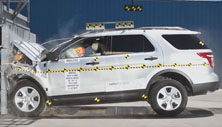
Frontal Crash Test
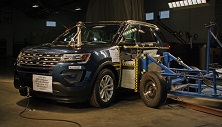
Side Crash Test
Overall Frontal Rating
Driver and Passenger Assessment
Driver Side
Passenger Side
Overall Side Rating
Side Barrier and Side Pole Tests
Driver Side
Passenger Side
Rollover Resistance
No rollover risk estimate available in this dataset
Safety Features
ESC: StandardForward Collision Warning: OptionalLane Departure Warning: Optional
Recall Notices
NHTSANHTSA ID: 26V101000February 20, 2026
SUSPENSION:REAR
Ford Motor Company (Ford) is recalling certain 2017-2019 Explorer vehicles. The rear suspension toe links may fracture.
Remedy Status
Dealers will replace the toe links, free of charge. Owner notification letters were mailed on March 16, 2026. Owners may contact Ford Customer Service at 1-866-436-7332. Ford's number for this recall is 26S08. This recall is an expansion of previous NHTSA recall number 21V537. Vehicle Identification Numbers (VINs) involved in this recall will be searchable on NHTSA.gov beginning February 25, 2026.
NHTSA ID: 25V685000October 10, 2025
EQUIPMENT:ELECTRICAL:ENGINE BLOCK HEATER
Ford Motor Company (Ford) is recalling certain 2016-2019 Lincoln MKC, 2016-2023 Explorer, 2019-2020 Fusion, 2019-2024 Ranger, 2020-2022 Lincoln Corsair, Escape, 2021-2024 Bronco, Bronco Sport, and 2022-2024 Maverick vehicles. The engine block heater may crack and develop a coolant leak, causing it to short circuit when the block heater is plugged in.
Remedy Status
Owners are advised not to plug in their block heater until the vehicle is remedied. Dealers will replace the block heater, free of charge. Interim letters, notifying owners of the safety risk, were mailed December 3, 2025. Additional letters will be sent once the final remedy is available, anticipated September 2026. Owners may contact Ford customer service at 1-866-436-7332. Ford's number for this recall is 25SA4. Vehicle Identification Numbers (VINs) involved in this recall became searchable on NHTSA.gov on October 15, 2025.
NHTSA ID: 25V347000May 23, 2025
STRUCTURE:BODY
Ford Motor Company (Ford) is recalling certain 2016-2017 Explorer vehicles. The driver and front passenger B-Pillar door trim may detach while driving.
Remedy Status
The remedy is currently under development. Interim letters, notifying owners of the safety risk, were mailed June 5, 2025. A second notice will be sent once the final remedy is available, anticipated November 2026. Owners may contact Ford customer service at 1-866-436-7332. Ford's number for this recall is 25S53.
NHTSA ID: 24V031000January 19, 2024
STRUCTURE:BODY:ROOF AND PILLARS
Ford Motor Company (Ford) is recalling certain 2011-2019 Explorer vehicles. The A-pillar trim retention clips may not be properly engaged, allowing the trim to detach.
Remedy Status
Dealers will inspect and replace the A-pillar trim as necessary, free of charge. Owner notification letters were mailed on July 18, 2024. Owners may contact Ford customer service at 1-866-436-7332. Ford's number for this recall is 24S02.
NHTSA ID: 21V537000July 15, 2021
SUSPENSION:REAR
Ford Motor Company (Ford) is recalling certain 2013-2017 Explorer vehicles originally sold, or ever registered, in Connecticut, Delaware, Illinois, Indiana, Iowa, Kentucky, Maine, Maryland, Massachusetts, Michigan, Minnesota, Missouri, New Hampshire, New Jersey, New York, Ohio, Pennsylvania, Rhode Island, Vermont, Virginia, West Virginia, Wisconsin, and the District of Columbia. Exposure to road salt can cause the cross-axis ball joint to corrode and seize, resulting in a fracture of the outboard section of the rear suspension toe link.
Remedy Status
Dealers will inspect and replace as necessary, the cross-axis ball joint (CABJ) knuckle, and replace the rear suspension toe links, free of charge. This recall is an expansion of previous NHTSA recall numbers 16V-245, 19V-435, and 20V-675. Certain vehicles previously repaired will need to return for the new remedy. An interim notification letter notifying owners of the safety risk were mailed on September 10, 2021. Owner notification letters were mailed on March 16, 2022. Owners may contact Ford's customer service at 1-866-436-7332. Ford's number for this recall is 21S32.
NHTSA ID: 21V316000May 05, 2021
STRUCTURE:BODY
Ford Motor Company (Ford) is recalling certain 2016-2019 Explorer vehicles. The retention pins could loosen and allow the roof rail covers to detach from the vehicle.
Remedy Status
Dealers will install push-pins and replace any damaged rail clips and roof rail covers, as necessary, free of charge. The interim owner notification letter was mailed on June 22, 2021. Owner notification letters (remedy available) were mailed on October 1, 2021. Owners may contact Ford customer service at 1-866-436-7332. Ford's number for this recall is 21S22.
NHTSA ID: 20V675000March 12, 2021
SUSPENSION:REAR
Ford Motor Company (Ford) is recalling certain 2013-2017 Explorer vehicles originally sold, or currently registered in Connecticut, Delaware, the District of Columbia, Illinois, Indiana, Iowa, Kentucky, Maine, Maryland, Massachusetts, Michigan, Minnesota, Missouri, New Hampshire, New Jersey, New York, Ohio, Pennsylvania, Rhode Island, Vermont, Virginia, West Virginia, and Wisconsin that were previously repaired under a prior recall numbers 16V-245 or 19V-435. The outboard section of a rear suspension toe link may fracture.
Remedy Status
Ford will notify owners, and dealers will inspect the cross-axis ball joint (CABJ) knuckle attached to the rear suspension toe link and replace it as necessary, free of charge. The recall began November 27, 2020. Owners may contact Ford customer service at 1-866-436-7332. Ford's number for this recall is 20S62.
NHTSA ID: 19V651000September 11, 2019
SEATS
Ford Motor Company (Ford) is recalling certain 2017 Ford Explorer vehicles equipped with power front seats. The seat frames may have sharp edges.
Remedy Status
Ford will notify owners, and dealers will install protective tape on the exposed inside edge and tab of the power seat frames, free of charge. The recall began November 8, 2019. Owners may contact Ford customer service at 1-866-436-7332. Ford's number for this recall is 19S29.
NHTSA ID: 19V435000June 10, 2019
SUSPENSION:REAR
Ford Motor Company (Ford) is recalling certain 2011-2017 Explorer vehicles. The rear suspension toe links may fracture due to stress on the rear suspension.
Remedy Status
Ford will notify owners, and dealers will replace the rear suspension toe links, and inspect both rear toe link ball joints, replacing the rear wheel knuckle(s), if necessary, free of charge. The recall began June 26, 2019. Owners may contact Ford customer service at 1-866-436-7332. Ford's number for this recall is 19S17.
NHTSA ID: 17V530000August 28, 2017
STEERING
Ford Motor Company (Ford) is recalling certain 2017 Explorer, Taurus and Police Interceptor Utility and Sedan vehicles. The steering gear heat shield fasteners may corrode, allowing the heat shield to detach.
Remedy Status
Ford will notify owners, and dealers to inspect and replace the heat shield fasteners as needed, free of charge. The recall began on September 13, 2017. Owners may contact Ford customer service at 1-866-436-7332. Ford's number for this recall is 17S23.
NHTSA ID: 17E048000August 28, 2017
WHEELS:HUB
Ford Motor Company (Ford) is recalling certain Wheel Hub Bearing assemblies, part number HB5Z-1104-C, incorrectly listed as being for installation on the rear axles of 2011-2017 Ford Explorer 4X2 vehicles. These bearings assemblies were manufactured without a self retention feature, possibly resulting in the separation of the wheel or wheel end.
Remedy Status
Ford will notify the distributors of the hubs specifying that they are to only be used on drive axles. It is believed that none of the hubs were purchased from Ford dealers for the incorrect application. Owners may contact Ford customer service at 1-866-436-7332.
NHTSA ID: 17V332000May 22, 2017
SEATS:FRONT ASSEMBLY:RECLINER
Ford Motor Company (Ford) is recalling certain 2017 Ford Explorer, F-150, F-250, F-350, F-450 and F-550 vehicles equipped with a manual driver's seat back recliner mechanism. In the event of a crash, the seat back frame may not restrain the occupant due to having inadequate welds. As such, these vehicles may not meet the requirements of Federal Motor Vehicle Safety Standard (FMVSS) numbers 202a, "Head Restraints" and 207, "Seating Systems."
Remedy Status
Ford will notify owners, and dealers will inspect and, if necessary, replace the seat back frame, free of charge. The recall began on June 7, 2017. Owners may contact Ford at 1-866-436-7332. Ford's number for this recall is 17C08.
NHTSA ID: 16V925000December 22, 2016
ENGINE AND ENGINE COOLING:ENGINE:GASOLINE:TURBO/SUPERCHARGER
Ford Motor Company (Ford) is recalling certain model year 2016 Ford Taurus, 2016-2017 Ford Flex, Lincoln MKT, 2017 Ford Explorer and Ford Explorer Police Interceptor Utility vehicles equipped with 3.5L GTDI engines. Improperly brazed turbocharger oil supply tubes may leak oil on engine components.
Remedy Status
Ford will notify owners, and dealers will inspect, and if necessary, replace the turbocharger oil supply tubes, free of charge. The recall began on January 31, 2017. Owners may contact Ford customer service at 1-866-436-7332. Ford's number for this recall is 16S46.
Investigations
2 totalOn January 27, 2023, the Office of Defects Investigation (ODI) opened PE23-001 to investigate allegations of A-pillar trim panel detachment on model year (MY) 2011-2019 Ford Explorer vehicles. At the time of opening, the office had received 164 Vehicle Owner Questionnaires (VOQs) reporting this failure. ODI has received 671 VOQs regarding this failure, including 1 alleged crash and 2 alleged injuries. Some consumers have reported that the failure occurred while they were driving at highway speeds, with the detached trim panel entering the path of travel of the vehicle behind them, requiring the driver of the following vehicle to take evasive action. It is noteworthy that motorists who experience this type of road hazard are less likely to accurately identify the subject vehicle the item detached from and report the event to the NHTSA. In its April 17, 2023 response to ODI’s information request, Ford provided 175 consumer complaints (including field reports) and 14,162 warranty claims related to A-pillar trim panel detachment. Ford relayed that the subject vehicles utilize a plastic A-pillar bracket, which is bolted to the vehicle structure during assembly. The A-pillar trim panel is attached to the bracket utilizing 7 plastic clips. Contributory factors which have been identified by Ford as leading to the subject defect include incomplete installation at the assembly plant, inadequate part stack up, damage to fasteners during installation, and failure to follow proper repair procedure during windshield replacements or other services. On January 19, 2024, Ford filed safety recall 24V-031 for MY 2011-2019 Ford Explorer vehicles to address the subject defect. In the Part 573 Safety Recall Report, Ford identified that a detached A-pillar trim panel can create a road hazard for other road users, increasing the risk of a crash. The recall remedy includes an inspection of the existing A-pillar trim panel and, if necessary, the replacement of the component. The remedy A-pillar trim panels will be installed with an additional adhesive for robustness and utilize an inspection procedure to ensure full engagement of all the retention clips during installation. In view of the recall action being taken by Ford, ODI is closing this Preliminary Evaluation. The agency reserves the right to take additional action if warranted by future circumstances. To review the reports cited in the Closing Resume ODI Report Identification Number document, go to NHTSA.gov.
Component: STRUCTURE:BODY:ROOF AND PILLARSOpened: Jan 27, 2023Closed: Feb 8, 2024Related recall: 24V031
During the EA17-002 investigation, the agency reviewed and analyzed reports of exhaust odors in the passenger cabins of Model Year 2011 to 2017 Ford Explorers. This investigation required an approach that incorporated knowledge and expertise from the automotive, medical, environmental health, and occupational safety fields. The agency conducted an in-depth investigation that encompassed the review of over 6,500 consumer complaints, conducting field inspections, and testing the relevant vehicles, both independently and in coordination with Ford and other entities. During the investigation, the evolution of Ford service bulletins intended to reduce the level of exhaust odors and carbon monoxide (CO) entering the occupant compartment was examined and independent tests to evaluate the effectiveness of the final Field Service Actions (FSA) for both consumer and police vehicles were conducted. As part of the investigation, the agency also examined the effects of cracked exhaust mani-cats on the measured CO levels in the vehicles and tested the FSA repairs to ensure they did not adversely impact occupant compartment CO levels due to cracked mani-cats.The investigation identified upfitting issues for Police Interceptor vehicles. Upfitting (sirens, lights, cages, auxiliary power, etc.) is typically performed by governmental fleet operations, independent repair facilities, or local Ford dealers after the sale of the new vehicle. Sealing issues caused by upfitting were responsible for the highest measured carbon monoxide levels in tested vehicles. The police FSA instructs how to inspect the quality of the vehicle upfits and how to properly seal any leaks caused by these upfits, at no cost to the police agency. Similarly, the highest CO levels measured in consumer vehicles were usually traced to sealing issues caused by rear crash damage where the repairs did not ensure sealing integrity. The most recent Ford FSA procedure for both the police (17B25) and consumer vehicles (17N03) includes an HVAC reprogramming operation. Tests by Ford and NHTSA have demonstrated a substantial reduction of CO levels due solely to the HVAC reprogramming. Other FSA repairs also demonstrated measurable contributions to CO level reductions during controlled tests.Throughout the investigation, vehicles accurately measured with higher levels of carbon monoxide were almost always affected by upfitter alterations, damage, or other causes compromising rear passenger cabin seals.NHTSA received thousands of reports alleging odors which triggered a variety of physiological responses, predominately nausea, headaches, and lightheadedness. NHTSA focused the investigation on accurately measuring vehicle CO levels, and accurately measuring carboxyhemoglobin (COHB) levels from properly administered blood tests. Using rigorous test methods to produce exhaust gas intrusion in vehicles with a properly performed FSA, occupant compartment CO levels remained below current environmental limits for CO in any environment (EPA ambient air quality standards). Furthermore, even without FSA repairs, no vehicles unaffected by upfitter issues or prior crash damage were identified with CO levels that exceed accepted occupational CO exposure levels. This investigation finds that the 2011-2017 Ford Explorer vehicles when accurately measured produce occupant compartment CO levels which fall below current accepted health standards, and could not identify COHB levels for vehicle drivers or other occupants, which exceeded thresholds for acute physiological effects. Therefore, the agency has not identified a defect that represents an unreasonable risk to motor vehicle safety.This inve
Component: ENGINE AND ENGINE COOLING:EXHAUST SYSTEM:MANIFOLD/HEADER/MUFFLER/TAIL PIPEOpened: Jul 27, 2017Closed: Jan 17, 2023
Owner Complaints
1632 totalSUSPENSION,STRUCTURE
Apr 27, 2026
The contact owns a 2017 Ford Explorer. The contact stated that while driving at an undisclosed speed, the A-pillar trim on both sides of the windshield started to detach. The contact received notifications of NHTSA Campaign Numbers: 24V031000 (Structure) and 26V101000 (Suspension...
Preview excerpt
STRUCTURE
Apr 22, 2026
A and b trim pillar pieces are loose and I just lost one going down the interstate. It is also causing my car to leak when it rains. Recall was issued over a year ago and still no parts available to fix it.
UNKNOWN OR OTHER
Apr 21, 2026
Filing a complaint as the nhtsa.gov website suggests: "If the manufacturer has failed or is unable to remedy this safety recall for your vehicle in a timely manner ... file an online complaint with NHTSA" It has been over 27 months and I have contacted my dealership numerous ti...
Preview excerpt
UNKNOWN OR OTHER
Apr 20, 2026
The trim on both A pillar and B pillar are coming off. When I spoke with Ford about a year ago they informed me of one recall with another coming. One of the trip pieces broke off in an automatic car wash. I was able to go back and get it, but have cut my hand on door multiple ti...
Preview excerpt
VISIBILITY/WIPER
Apr 12, 2026
No impact shattering of rear window. I entered the car and closed the driver’s side door when I heard the window shatter.
POWER TRAIN,ENGINE
Apr 12, 2026
My 2017 Ford Explorer suddenly started vibrating intensely whenever I am at a stop or start slowing down. Episodes of hesitation when attempting to take off from a start with significant rpm surges. I am told I need to have my torque converter replaced. My vehicle has 84,697 mile...
Preview excerpt
STEERING,STRUCTURE,ENGINE
Apr 9, 2026
I am reporting a serious safety concern with my 2017 Ford Explorer. The vehicle currently has approximately 93,752 miles and has become increasingly unreliable and unsafe to operate. On April 9, 2026, while my wife was driving home from work, the vehicle overheated, creating a da...
Preview excerpt
UNKNOWN OR OTHER
Apr 5, 2026
Part came off while on my way to church at some point and was unable to locate the piece that came off
STEERING
Apr 4, 2026
Difficulty in steering around corners
ELECTRICAL SYSTEM,EXTERIOR LIGHTING,UNKNOWN OR OTHER
Apr 2, 2026
Vehicle equipped with operation red and blue auxiliary emergency lights, prohibited and protected by law for law enforcement use only, facilitates impersonation of a police officer, false detention, harassment, legal scrutiny for police, seller has actual knowledge, strictly liab...
Preview excerpt
Showing 10 recent complaints from 1,632 total
View Full Complaint LogCompare Related Vehicles
Why Compare These Pages
The strongest comparison flow is usually: exact vehicle-year page, then nearby years of the same model, then other 2017 Ford models. That sequence helps separate one-off year spikes from broader make-wide patterns.
More Ford Explorer Years
2018 Ford ExplorerCompare this year against 2017 for complaint and recall shifts.6r2i688c2016 Ford ExplorerCompare this year against 2017 for complaint and recall shifts.14r2i2,398c2019 Ford ExplorerCompare this year against 2017 for complaint and recall shifts.5r1i277c2015 Ford ExplorerCompare this year against 2017 for complaint and recall shifts.9r5i1,720c2020 Ford ExplorerCompare this year against 2017 for complaint and recall shifts.31r3i1,116c2014 Ford ExplorerCompare this year against 2017 for complaint and recall shifts.7r4i1,657c
More 2017 Ford Models
2017 Ford EscapeAnother 2017 Ford option for same-year comparison.3r2,533c2017 Ford F-150Another 2017 Ford option for same-year comparison.17r3i1,287c2017 Ford EdgeAnother 2017 Ford option for same-year comparison.8r2i1,252c2017 Ford FusionAnother 2017 Ford option for same-year comparison.4r1i1,076c2017 Ford FocusAnother 2017 Ford option for same-year comparison.8r4i884c2017 Ford ExpeditionAnother 2017 Ford option for same-year comparison.4r344c
Frequently Asked Questions
How many recalls does the 2017 Ford Explorer have?
The 2017 Ford Explorer has 13 recalls recorded by NHTSA.
How many complaints have been filed for the 2017 Ford Explorer?
NHTSA has received 1,632 owner-reported complaints for the 2017 Ford Explorer.
What is the NHTSA safety rating for the 2017 Ford Explorer?
Our stored NHTSA record for the 2017 Ford Explorer has an overall rating of 5 out of 5 stars. Stored NHTSA configuration: 2017 Ford Explorer 4 DR SUV FWD. NCAP Vehicle ID: 11213. Ratings describe one stored NHTSA configuration, not every trim, body style or drivetrain for this model year.
What are the most common problems with the 2017 Ford Explorer?
The most frequent complete stored component labels for the 2017 Ford Explorer are structure (561 reports), unknown or other (259 reports), engine (131 reports). These are exact-label counts, not broader component-group totals or confirmed defects.
Does the 2017 Ford Explorer have any recalls?
Yes. NHTSA has 13 recalls on record for the 2017 Ford Explorer. Scroll up to review the published recall summaries, consequences, and remedies. To check for unrepaired recalls on your specific vehicle, use your VIN at nhtsa.gov/recalls.
Check Another Vehicle
Look up recalls and complaints for any year, make, and model.
This page summarizes publicly available data from the National Highway Traffic Safety Administration (NHTSA). Complaint counts reflect reports submitted to NHTSA by vehicle owners and do not by themselves prove defect severity or vehicle safety. Safety ratings may not be available for all vehicle-years. This site is not affiliated with NHTSA or any vehicle manufacturer. For official information, visit the official NHTSA page for this vehicle.