Ford · Edge · 2017
2017 Ford Edge
8
Recalls
1,252
Complaints
5/5
NCAP overall
The 2017 Ford Edge has 8 recalls and 1,252 owner-reported complaints on file with NHTSA. One stored NHTSA configuration has an overall rating of 5 out of 5 stars, not a rating for all versions. Most frequent stored component label: engine (471 reports).
Stored NHTSA configuration: 2017 Ford Edge SUV FWD NCAP Vehicle ID: 11211
Ratings describe one stored NHTSA configuration, not every trim, body style or drivetrain for this model year. How this configuration is selected
Source: NHTSA Public Records
NHTSA source checks for this vehicle year
- Complaints
- Separate successful check not recorded.
- Recalls
- Separate successful check not recorded.
- Safety ratings
- Separate successful check not recorded.
- Investigations
- Separate successful check not recorded.
- Manufacturer communications
- Separate successful check not recorded.
Checks are recorded separately for each dataset, not for the whole page. Dates use UTC. A missing check date does not mean no records exist.
Vehicle import recorded: Apr 29, 2026. This is the stored import date, not confirmation that every source was successfully refreshed.
Research Context
The 2017 Ford Edge page works best as a research starting point. Complaint totals show how much owner-reported activity exists, while recalls and investigations help show whether any of that activity turned into formal safety action.
Because this is a newer-era vehicle page, it usually helps to compare this year against nearby model years before deciding whether a complaint pattern looks isolated or persistent. On this page, the most frequent complete stored component label is engine with 471 reported complaints.
Best Research Moves
- Use the complaint log to see whether the 2017 Ford Edge reports cluster around one repeated symptom or spread across multiple systems.
- Compare the recall list with the complaint mix to see whether the most reported issues overlap with formal NHTSA safety campaigns.
- Check the linked investigations for extra ODI context if you want to see whether owner complaints escalated into formal defect review.
Key Takeaways
- The 2017 Ford Edge currently shows 8 NHTSA recalls listed on this page and 1,252 owner-reported complaints.
- This page currently shows 2 NHTSA investigations linked to this page.
- This page reflects complaint volume, recall history, and NHTSA test data, but it does not diagnose causes or rank reliability by itself.
- Safety data currently shows 5/5 overall NHTSA rating for one stored configuration, not all versions.
- The most frequent complete stored component labels on this page are engine (471), engine and engine cooling (189), power train (82).
- Vehicle
- 2017 Ford Edge
- Recalls
- 8
- Complaints
- 1252
- Stored Configuration Overall Rating
- 5/5. Stored NHTSA configuration: 2017 Ford Edge SUV FWD. NCAP Vehicle ID: 11211.
How to Interpret This Page
This page combines three types of NHTSA data: recall campaigns (official manufacturer or government actions), owner complaints (unverified consumer reports), and crash test ratings (where available). A vehicle with many complaints is not necessarily less reliable — complaint volume correlates with sales volume and vehicle age. Recalls indicate identified defects, not overall quality. To compare this model year with others, use the year navigation in the sidebar or return to the model overview page.
If you are researching a used vehicle, start with the complaint categories, compare them against the recall list, and then check nearby model years to see whether the same issue profile repeats. That usually produces a better buying or research signal than treating the raw complaint total as a standalone safety ranking.
NHTSA Configuration Test Results
Stored NHTSA configuration: 2017 Ford Edge SUV FWD NCAP Vehicle ID: 11211
Ratings describe one stored NHTSA configuration, not every trim, body style or drivetrain for this model year. How this configuration is selected
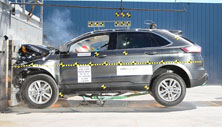
Frontal Crash Test
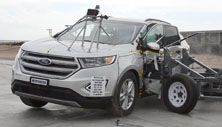
Side Crash Test
Overall Frontal Rating
Driver and Passenger Assessment
Driver Side
Passenger Side
Overall Side Rating
Side Barrier and Side Pole Tests
Driver Side
Passenger Side
Rollover Resistance
No rollover risk estimate available in this dataset
Safety Features
ESC: StandardForward Collision Warning: OptionalLane Departure Warning: Optional
Recall Notices
NHTSANHTSA ID: 25V572000September 04, 2025
BACK OVER PREVENTION: SENSING SYSTEM: CAMERA
Ford Motor Company (Ford) is recalling certain 2015-2019 Lincoln MKC, Mustang, F-350 SD, F-250 SD, F-450 SD, 2015-2017 Lincoln Navigator, Expedition, 2015-2018 Edge, Transit Connect, 2016-2019 F-550 SD, Transit, 2017-2019 Econoline, and 2019 Ranger vehicles. The rearview camera may display a distorted, inverted, or blank image when the vehicle is in reverse.
Remedy Status
Dealers will inspect and replace the rearview camera as necessary, free of charge. Owner notification letters were mailed January 13, 2026. Ford owners will receive letters in phases, beginning January 2026 and May 2026. Owners may contact Ford customer service at 1-866-436-7332. Ford's number for this recall is 25S89. This recall expands previous NHTSA recall number 25V270. Vehicle Identification Numbers (VINs) involved in this recall will be searchable on NHTSA.gov beginning September 8, 2025.
NHTSA ID: 25V544000August 22, 2025
SERVICE BRAKES, HYDRAULIC:FOUNDATION COMPONENTS:HOSES, LINES/PIPING, AND FITTINGS
Ford Motor Company (Ford) is recalling certain 2016-2018 Lincoln MKX and 2015-2018 Edge vehicles. The rear brake jounce hose may rupture and leak brake fluid.
Remedy Status
Dealers will inspect and replace the brake jounce hoses and adjust brake jounce hoses with no damage present, free of charge. Interim owner letters notifying owners of the safety risk were mailed September 8, 2025. Additional letters will be sent once the remedy is available, anticipated April 2026. Owners may contact Ford customer service at 1-866-436-7332. Ford's number for this recall is 25S87.
NHTSA ID: 22V413000June 10, 2022
POWER TRAIN:AUTOMATIC TRANSMISSION:GEAR POSITION INDICATION (PRNDL)
Ford Motor Company (Ford) is recalling certain 2013-2019 Escape, 2013-2018 C-Max, 2013-2016 Fusion, 2013-2021 Transit Connect, and 2015-2018 Edge vehicles. The bushing that attaches the shifter cable to the transmission may degrade or detach.
Remedy Status
Dealers will replace the under hood shift bushing and add a protective cap over the shift cable bushing, free of charge. Interim owner notification letters, informing owners of the safety risk, were mailed July 1, 2022. Remedy parts are expected to be available in 4th Quarter 2022. Owner notification letters were mailed October 27, 2022. Owners may contact Ford customer service at 1-866-436-7332. Ford's number for this recall is 22S43.
NHTSA ID: 20V469000August 10, 2020
SERVICE BRAKES
Ford Motor Company (Ford) is recalling certain 2015-2018 Ford Edge and 2016-2018 Lincoln MKX vehicles. The front brake hoses may rupture prematurely.
Remedy Status
Ford will notify owners, and dealers will replace the front brake hoses with the new hoses that have a revised braid material, free of charge. Owner notification letters were mailed on May 13, 2021. Owners may contact Ford customer service at 1-866-436-7332. Ford's number for this recall is 20S42.
NHTSA ID: 18V390000June 11, 2018
POWER TRAIN:AUTOMATIC TRANSMISSION:TORQUE CONVERTER
Ford Motor Company (Ford) is recalling certain 2017-2018 Ford Edge and 2017 Lincoln MKZ vehicles. On vehicles with 2.0L gas engines and six-speed automatic transmissions, the torque converter weld studs may have been inadequately welded.
Remedy Status
Ford will notify owners, and dealers will replace the torque converters, free of charge. The recall began on July 5, 2018. Owners may contact Ford customer service at 1-866-436-7332. Ford's number for this recall is 17S16 (S2). Note: This recall is an expansion of recall 17V-427.
NHTSA ID: 17V427000July 06, 2017
POWER TRAIN:AUTOMATIC TRANSMISSION:TORQUE CONVERTER
Ford Motor Company (Ford) is recalling certain 2017 Lincoln MKZ and Ford Edge and Fusion vehicles. On vehicles with 2.0L gas engines and six-speed automatic transmissions, the torque converter weld studs may have been inadequately welded.
Remedy Status
Ford or Lincoln will notify owners, and dealers will replace the torque converters, free of charge. The recall began August 25, 2017. Owners may contact Ford customer service at 1-866-436-7332. Ford's number for this recall is 17S16.
NHTSA ID: 17V205000March 27, 2017
STRUCTURE:BODY:ROOF AND PILLARS
Ford Motor Company (Ford) is recalling certain 2017 Edge vehicles equipped with the optional Panoramic Vista Roof. These vehicles may have an improperly welded windshield header, reducing the vehicle's lateral structural integrity. As such, these vehicles fail to comply with the requirements of Federal Motor Vehicle Safety Standard (FMVSS) number 214, "Side Impact Protection."
Remedy Status
Ford will notify owners, and dealers will repair the windshield header, free of charge. The recall began May 18, 2017. Owners may contact Ford customer service at 1-866-436-7332. Ford's number for the recall is 17C05.
NHTSA ID: 17V123000February 27, 2017
AIR BAGS:FRONTAL:DRIVER SIDE:INFLATOR MODULE
Ford Motor Company (Ford) is recalling certain 2016-2017 Ford Edge and Lincoln MKX vehicles and 2017 Lincoln Continental vehicles. In the event of a crash, the driver's frontal air bag may not fully inflate or the air bag cushion may detach from the air bag module. As such, these vehicles fail to comply with the requirements of Federal Motor Vehicle Safety Standard (FMVSS) number 208, "Occupant Crash Protection."
Remedy Status
Ford will notify owners, and dealers will replace the driver frontal air bag module, free of charge. The recall began June 16, 2017. Owners may contact Ford customer service at 1-866-436-7332. Ford's number for this recall is 17C02.
Investigations
2 totalOn October 3, 2024, NHTSA’s Office of Defects Investigation (ODI) opened this Preliminary Evaluation to investigate instances of rear brake hose ruptures causing a sudden and unexpected loss of braking in model year (MY) 2015-2017 Ford Edge vehicles manufactured by Ford Motor Company. The complaints allege that, without warning, the vehicle lost its ability to brake causing an unanticipated increase in the vehicle’s stopping distance. The complaints also allege that, prior to the rear brake hose rupture event, the vehicle had been serviced under recall 20V-469. Recall 20V469 involved MY 2015-2018 Ford Edge and MY 2016-2018 Lincoln MKX vehicles which may experience front brake hose ruptures causing increased brake pedal travel and a reduction in the rate of deceleration. Ford identified the cause of this safety defect as a consistent localized failure of the internal reinforcement braid of the brake hose due to cyclic fatigue via tensile/bending and torsional inputs during suspension and steering articulations. Ford also identified that only 88% of suspension articulation was utilized on the front brake hose test rig during life cycle testing. These findings, along with ODI’s identification of an emerging trend involving rear brake hose ruptures, prompted the opening of this investigation. ODI identified 64 Vehicle Owners Questionnaires related to this investigation, 2 involving a crash. These consumers were interviewed and reported experiencing sudden loss of braking ability while traveling at low and highway speeds without any prior warning such as a “low brake fluid” warning indicator. Consumers reported that, as they tried to stop their vehicle, the brake pedal traveling to the floorboard and the vehicle required more stopping distance than anticipated or considered normal. Consumers also observed brake fluid present on the rear tires and roadway near the rear tires immediately after the incident. Some consumers provided photographs of the rear brake hose ruptures which depicted a similar rupture pattern and location (near the crimp on the dynamic section of the brake hose). 1 photograph showed an installation alignment mark pulled out near the crimp suggesting exposure to unanticipated tensile forces pulling the hose away from the crimp. During this investigation, Ford responded to Information Request Letters detailing information such as warranty claim data, brake hose specifications and engineering drawings, production part changes logs, and Ford’s assessments of potential root cause. Ford reported that the front and rear brake jounce hoses equipped on the subject vehicle population utilized the same construction and material. Therefore, Ford’s analysis consisted of a comparison between the front and rear hoses demonstrating that the rear hose bend radii in full jounce and full rebound were larger than the front hose. Ford also described that the two hoses are exposed to different loading environments as the rear brake hose is exposed to suspension inputs only, while the front hose is exposed to both suspension and steering inputs; thus, the rear hose is subjected to lower tension and fatigue loads. However, it is important to point out that larger bend radii alone do not necessarily mean a brake hose can withstand the dynamic loading requirements of a brake hose (as discussed earlier, the defect identified in the front brake hoses were attributed to the hose material). Rear brake hose failures were identified through exemplar vehicle and parts inspections conducted by NHTSA’s Vehicle Research and Testing Center. Ford stated that its investigation did not identify any specific or common root cause for this safety defect, and that brake hoses can fail for many reasons including contact with road debris, improper vehicle servicing, and fatigue, as well as vehicle age and miles in service. Based on its assessment of failure rates and warranty claims, Ford concluded that the rear brake hose ruptures did not present an unreasonable risk to motor vehicle safety because consumers would experience a progressive leak accompanied by a red brake warning indicator within the instrument panel and would not experience a total loss of braking due to the diagonally split brake system. Note that these assessments are contrary to the consumer experiences described above. As previously described, consumers described a sudden, unexpected loss of braking ability with no prior warning in their instrument cluster (not a progressive leak) and an increase in anticipated vehicle stopping distance (presenting an unreasonable risk to motor vehicle safety). ODI conveyed these perspectives and investigative findings to Ford during a technical discussion on July 23, 2025. On August 22, 2025, Ford submittedrecall 25V-544 which included MY 2015-2018 Ford Edge and MY 2016-2018 Lincoln MKX vehicles, for a total recall population of 499,129 vehicles. As described in the Part 573, in September 2024, Ford concluded that this concern did not present an unreasonable risk to motor vehicle safety and closed its investigation into allegations involving rear brake jounce hose ruptures within this vehicle population. Ford reopened this investigation in July 2025 following the technical discussion with ODI referenced above. Ford identified the safety defect as a rupture of the rear brake jounce hose resulting in an increase in pedal travel and increase in vehicle stopping distance elevating the risk of a crash. To date, Ford has not fully determined the root cause of this safety defect and is currently working to develop a remedy program. In view of the recall action taken by Ford, ODI is closing this Preliminary Evaluation. The agency reserves the right to take additional action if warranted by future circumstances. To review the reports cited in the Closing Resume ODI Report Identification Number document, go to NHTSA.gov.
Component: SERVICE BRAKESOpened: Oct 3, 2024Closed: Oct 30, 2025
From 2000 through 2017, Takata produced millions of air bag inflators using two types of phase-stabilized ammonium nitrate ("PSAN") propellant -- propellant 2004 and propellant 2004L. After prolonged exposure to high temperature cycles and humidity, inflators using propellant 2004 can degrade, causing the propellant to burn too quickly when ignited. The rapid burning can cause the inflator to rupture during deployment, potentially causing serious or even fatal injury to vehicle occupants. See 2016 Blomquist Report at www.nhtsa.gov/sites/nhtsa.gov/files/documents/expert_report-hrblomquist.pdf.Consequently, all frontal inflators using propellant 2004 that do not contain a "desiccant" (a substance that traps and holds moisture) in US vehicles are under recall. These "non-desiccated" inflators either have been or are required to be replaced.In some cases, the remedy part for these recalled inflators was, or will be, an inflator using either propellant 2004 or 2004L that does contain a desiccant. None of these "desiccated" remedy parts (which were installed in older model year vehicles) are currently under recall for a degradation concern. Certain subsets of desiccated PSAN inflators using propellant 2004 for use as original equipment, however, have been recalled for a degradation concern. All Takata inflators produced with propellant 2004L contain desiccant, and none of these desiccated inflators using propellant 2004L are under recall for a degradation concern. There have been no reported field ruptures in any non-recalled desiccated PSAN inflators.It is understood that desiccants fully saturate at some threshold, at which point any additional moisture will not be captured. This means the degradation process observed in non-desiccated inflators using propellant 2004 may also occur in non-recalled desiccated inflators using propellant 2004, assuming additional moisture enters the inflator and high temperature cycling occurs. Based on available information, desiccant saturation can occur within the first five years in the worst environments, and the time required for full saturation is affected by multiple factors. While no present safety risk has been identified, further work is needed to evaluate the future risk of non-recalled desiccated inflators using propellant 2004.Three entities -- Takata (now known as TK Global), the Independent Testing Coalition, and Exponent -- have been studying the long-term behavior of Takata desiccated PSAN inflators using propellant 2004L (as well as 2004) in the presence of moisture and temperature cycling. The research efforts, which include development of predictive modeling techniques and field sample analysis, are ongoing. To date, none of the researchers have identified field evidence showing that propellant 2004L is undergoing a degradation process that leads to aggressive deployment and potential rupture. However, the time in service of such inflators remains short compared to that of the inflators using propellant 2004. Further study is needed to assess the long-term safety of desiccated inflators using propellant 2004L.The Office of Defects Investigation is opening this investigation to examine whether a safety defect related to propellant degradation exists in non-recalled desiccated PSAN frontal inflators manufactured by Takata. This investigation will require extensive information on Takata production processes and surveys of inflators in the field. Lists of recall actions that may have used desiccated PSAN inflators as remedy parts, as well as the makes and models originally manufactured with them, is available with the downloadable version of this document (see nhtsa.gov/recalls?nhtsaId=EA21002 -- note this information is subject to change/revision as the investigation proceeds). This investigation does not supersede EA15-001, which remains open.
Component: AIR BAGS:FRONTAL:DRIVER SIDE:INFLATOR MODULEOpened: Sep 17, 2021
Owner Complaints
1252 totalSERVICE BRAKES, HYDRAULIC
Apr 25, 2026
The contact owns a 2017 Ford Edge. The contact received notification of NHTSA Campaign Number: 25V544000 (Service Brakes, Hydraulic); however, the part to do the recall repair was not yet available. The contact stated that while driving at various speeds, the vehicle hesitated wh...
Preview excerpt
SERVICE BRAKES, HYDRAULIC,BACK OVER PREVENTION
Apr 22, 2026
The contact owns a 2017 Ford Edge. The contact received notifications of NHTSA Campaign Numbers: 25V572000 (Back Over Prevention) and 25V544000 (Service Brakes, Hydraulic); however, the parts to do the recall repairs were not yet available. The dealer was not contacted. The vehic...
Preview excerpt
SERVICE BRAKES
Apr 22, 2026
There has been no accident as of yet. However Ford has sat on a recall for potential bad break lines on the 2017 Ford edge for 8 Months. Loss of breaks could easily result in multiple DEATHS. I would consider this as an egregious time to get flexible break line. A search of ford ...
Preview excerpt
POWER TRAIN,ENGINE
Apr 14, 2026
My 2017 Ford Edge SE has been diagnosed with having a coolant intrusion into cylinders. I was not made aware of this defect neither by the dealer I purchased or by Ford. It seems like I might have to replace the engine which an inconvience given that I have own the car for less t...
Preview excerpt
SERVICE BRAKES, HYDRAULIC
Apr 12, 2026
The contact owns a 2017 Ford Edge. The contact received notification of NHTSA Campaign Number: 25V544000 (Service Brakes, Hydraulic); however, the part to do the recall repair was not yet available. The local dealer was contacted, but the vehicle was not repaired. The contact sta...
Preview excerpt
SERVICE BRAKES
Apr 6, 2026
Consumer Complaint Summary Nature of Dispute: Refusal to reimburse for safety-related recall repair (Recall 25S87). Summary: On April 6, 2026, my 2017 Ford Edge (VIN: [XXX] ) became undrivable due to a failure of the rear brake jounce hoses. This specific defect is the subject o...
Preview excerpt
SERVICE BRAKES, HYDRAULIC
Apr 5, 2026
The contact owns a 2017 Ford Edge. The contact stated that while starting the vehicle and depressing the brake pedal, the brake pedal went to the floorboard. The contact heard a popping sound coming from outside the vehicle and discovered that the brake hose had ruptured and was ...
Preview excerpt
SERVICE BRAKES
Apr 2, 2026
While stopped at closed train tracks, my brake petal depressed about 2 inches further. After this I was having trouble breaking, I quickly pulled into a parking lot and had my car towed a nearby dealership. There is a recall out for the break line of my car, 25v544. The dealershi...
Preview excerpt
ENGINE
Mar 30, 2026
What component or system failed or malfunctioned, and is it available for inspection upon request? Yes, the engine (long block) is leaking coolant into the cylinder. How was your safety or the safety of others put at risk? This is a known problem with these vehicles. Some vehic...
Preview excerpt
SERVICE BRAKES, HYDRAULIC
Mar 28, 2026
The contact owns a 2017 Ford Edge. The contact stated that while driving approximately 30 MPH, the brake pedal was depressed while slowing for traffic, and the brake pedal went to the floorboard. There was no warning light illuminated. The vehicle was taken to a local dealer, whe...
Preview excerpt
Showing 10 recent complaints from 1,252 total
View Full Complaint LogCompare Related Vehicles
Why Compare These Pages
The strongest comparison flow is usually: exact vehicle-year page, then nearby years of the same model, then other 2017 Ford models. That sequence helps separate one-off year spikes from broader make-wide patterns.
More Ford Edge Years
2018 Ford EdgeCompare this year against 2017 for complaint and recall shifts.7r738c2016 Ford EdgeCompare this year against 2017 for complaint and recall shifts.7r2i856c2019 Ford EdgeCompare this year against 2017 for complaint and recall shifts.3r686c2015 Ford EdgeCompare this year against 2017 for complaint and recall shifts.7r2i702c2020 Ford EdgeCompare this year against 2017 for complaint and recall shifts.4r1i269c2014 Ford EdgeCompare this year against 2017 for complaint and recall shifts.3r1i376c
More 2017 Ford Models
2017 Ford EscapeAnother 2017 Ford option for same-year comparison.3r2,533c2017 Ford ExplorerAnother 2017 Ford option for same-year comparison.13r2i1,632c2017 Ford F-150Another 2017 Ford option for same-year comparison.17r3i1,287c2017 Ford FusionAnother 2017 Ford option for same-year comparison.4r1i1,076c2017 Ford FocusAnother 2017 Ford option for same-year comparison.8r4i884c2017 Ford ExpeditionAnother 2017 Ford option for same-year comparison.4r344c
Frequently Asked Questions
How many recalls does the 2017 Ford Edge have?
The 2017 Ford Edge has 8 recalls recorded by NHTSA.
How many complaints have been filed for the 2017 Ford Edge?
NHTSA has received 1,252 owner-reported complaints for the 2017 Ford Edge.
What is the NHTSA safety rating for the 2017 Ford Edge?
Our stored NHTSA record for the 2017 Ford Edge has an overall rating of 5 out of 5 stars. Stored NHTSA configuration: 2017 Ford Edge SUV FWD. NCAP Vehicle ID: 11211. Ratings describe one stored NHTSA configuration, not every trim, body style or drivetrain for this model year.
What are the most common problems with the 2017 Ford Edge?
The most frequent complete stored component labels for the 2017 Ford Edge are engine (471 reports), engine and engine cooling (189 reports), power train (82 reports). These are exact-label counts, not broader component-group totals or confirmed defects.
Does the 2017 Ford Edge have any recalls?
Yes. NHTSA has 8 recalls on record for the 2017 Ford Edge. Scroll up to review the published recall summaries, consequences, and remedies. To check for unrepaired recalls on your specific vehicle, use your VIN at nhtsa.gov/recalls.
Check Another Vehicle
Look up recalls and complaints for any year, make, and model.
This page summarizes publicly available data from the National Highway Traffic Safety Administration (NHTSA). Complaint counts reflect reports submitted to NHTSA by vehicle owners and do not by themselves prove defect severity or vehicle safety. Safety ratings may not be available for all vehicle-years. This site is not affiliated with NHTSA or any vehicle manufacturer. For official information, visit the official NHTSA page for this vehicle.