Ford · Mustang · 2016
2016 Ford Mustang
5
Recalls
363
Complaints
5/5
NCAP overall
The 2016 Ford Mustang has 5 recalls and 363 owner-reported complaints on file with NHTSA. One stored NHTSA configuration has an overall rating of 5 out of 5 stars, not a rating for all versions. Most frequent stored component label: engine (51 reports).
Stored NHTSA configuration: 2016 Ford Mustang 2 DR RWD NCAP Vehicle ID: 10220
Ratings describe one stored NHTSA configuration, not every trim, body style or drivetrain for this model year. How this configuration is selected
Source: NHTSA Public Records
NHTSA source checks for this vehicle year
- Complaints
- Separate successful check not recorded.
- Recalls
- Separate successful check not recorded.
- Safety ratings
- Separate successful check not recorded.
- Investigations
- Separate successful check not recorded.
- Manufacturer communications
- Separate successful check not recorded.
Checks are recorded separately for each dataset, not for the whole page. Dates use UTC. A missing check date does not mean no records exist.
Vehicle import recorded: Apr 29, 2026. This is the stored import date, not confirmation that every source was successfully refreshed.
Research Context
The 2016 Ford Mustang page works best as a research starting point. Complaint totals show how much owner-reported activity exists, while recalls and investigations help show whether any of that activity turned into formal safety action.
Because this is a newer-era vehicle page, it usually helps to compare this year against nearby model years before deciding whether a complaint pattern looks isolated or persistent. On this page, the most frequent complete stored component label is engine with 51 reported complaints.
Best Research Moves
- Use the complaint log to see whether the 2016 Ford Mustang reports cluster around one repeated symptom or spread across multiple systems.
- Compare the recall list with the complaint mix to see whether the most reported issues overlap with formal NHTSA safety campaigns.
- Check the linked investigations for extra ODI context if you want to see whether owner complaints escalated into formal defect review.
Key Takeaways
- The 2016 Ford Mustang currently shows 5 NHTSA recalls listed on this page and 363 owner-reported complaints.
- This page currently shows 1 NHTSA investigation linked to this page.
- This page reflects complaint volume, recall history, and NHTSA test data, but it does not diagnose causes or rank reliability by itself.
- Safety data currently shows 5/5 overall NHTSA rating for one stored configuration, not all versions.
- The most frequent complete stored component labels on this page are engine (51), unknown or other (40), back over prevention (36).
- Vehicle
- 2016 Ford Mustang
- Recalls
- 5
- Complaints
- 363
- Stored Configuration Overall Rating
- 5/5. Stored NHTSA configuration: 2016 Ford Mustang 2 DR RWD. NCAP Vehicle ID: 10220.
How to Interpret This Page
This page combines three types of NHTSA data: recall campaigns (official manufacturer or government actions), owner complaints (unverified consumer reports), and crash test ratings (where available). A vehicle with many complaints is not necessarily less reliable — complaint volume correlates with sales volume and vehicle age. Recalls indicate identified defects, not overall quality. To compare this model year with others, use the year navigation in the sidebar or return to the model overview page.
If you are researching a used vehicle, start with the complaint categories, compare them against the recall list, and then check nearby model years to see whether the same issue profile repeats. That usually produces a better buying or research signal than treating the raw complaint total as a standalone safety ranking.
NHTSA Configuration Test Results
Stored NHTSA configuration: 2016 Ford Mustang 2 DR RWD NCAP Vehicle ID: 10220
Ratings describe one stored NHTSA configuration, not every trim, body style or drivetrain for this model year. How this configuration is selected
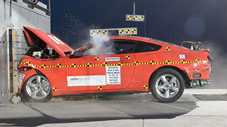
Frontal Crash Test
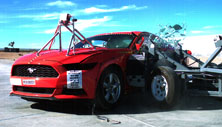
Side Crash Test
Overall Frontal Rating
Driver and Passenger Assessment
Driver Side
Passenger Side
Overall Side Rating
Side Barrier and Side Pole Tests
Driver Side
Passenger Side
Rollover Resistance
No rollover risk estimate available in this dataset
Safety Features
ESC: StandardForward Collision Warning: OptionalLane Departure Warning: No
Recall Notices
NHTSANHTSA ID: 25V614000September 12, 2025
SEAT BELTS:PRETENSIONER
Ford Motor Company (Ford) is recalling certain 2015-2017 Mustang vehicles. Water and road salt may corrode the front seat belt anchor pretensioner cables.
Remedy Status
Dealers will inspect and replace both front seat belt anchor pretensioner assemblies, as necessary. In addition, dealers will remove sections of the carpet and underlayment that contact the cables. Dealers will also inspect the A-pillar sealing patches, and as necessary, install A-pillar body plugs, and/or inspect and replace the front outboard seat bolts. Repairs will be performed free of charge. Interim letters, notifying owners of the safety risk, were mailed October 20, 2025. Additional letters will be sent once the final remedy is available, anticipated January 2026. Owners may contact Ford customer service at 1-866-436-7332. Ford's number for this recall is 25S92. Vehicle Identification Numbers (VINs) involved in this recall became searchable on NHTSA.gov September 17, 2025.
NHTSA ID: 25V572000September 04, 2025
BACK OVER PREVENTION: SENSING SYSTEM: CAMERA
Ford Motor Company (Ford) is recalling certain 2015-2019 Lincoln MKC, Mustang, F-350 SD, F-250 SD, F-450 SD, 2015-2017 Lincoln Navigator, Expedition, 2015-2018 Edge, Transit Connect, 2016-2019 F-550 SD, Transit, 2017-2019 Econoline, and 2019 Ranger vehicles. The rearview camera may display a distorted, inverted, or blank image when the vehicle is in reverse.
Remedy Status
Dealers will inspect and replace the rearview camera as necessary, free of charge. Owner notification letters were mailed January 13, 2026. Ford owners will receive letters in phases, beginning January 2026 and May 2026. Owners may contact Ford customer service at 1-866-436-7332. Ford's number for this recall is 25S89. This recall expands previous NHTSA recall number 25V270. Vehicle Identification Numbers (VINs) involved in this recall will be searchable on NHTSA.gov beginning September 8, 2025.
NHTSA ID: 22V082000February 16, 2022
BACK OVER PREVENTION: SENSING SYSTEM: CAMERA
Ford Motor Company (Ford) is recalling certain 2015-2017 Mustang vehicles. The rearview camera wiring may be loose or damaged, which can result in a blank or distorted image.
Remedy Status
Dealers will inspect and repair the decklid wiring harness and/or replace the rearview camera, as necessary, free of charge. Owner notification letters were mailed December 23, 2022 and June 26, 2023. Remedy parts are expected to become available in the 4th Quarter of 2022. Owners may contact Ford customer service at 1-866-436-7332. Ford's number for this recall is 22S06.
NHTSA ID: 16V779000October 26, 2016
ENGINE AND ENGINE COOLING:COOLING SYSTEM:HOSES/LINES/PIPING/FITTINGS
Ford Motor Company (Ford) is recalling certain model year 2015-2017 Mustang vehicles manufactured February 24, 2015, to August 30, 2016. A hose may separate from the engine oil cooler tube assembly causing an oil leak.
Remedy Status
Ford will notify owners, and dealers will replace the engine oil cooler tube assembly, free of charge. The recall began on March 23, 2017. Owners may contact Ford customer service at 1-866-436-7332. Ford's number for this recall is 16S40.
NHTSA ID: 15V707000October 26, 2015
SEAT BELTS
Ford Motor Company (Ford) is recalling certain model year 2016 Ford Mustang vehicles manufactured September 26, 2015, to October 1, 2015. The front and rear seat belts and child seat tether anchors may have been damaged in shipping from the supplier to the vehicle assembly plant and may not adequately restrain the occupant in a crash. As such, these vehicles fail to comply with the requirements of Federal Motor Vehicle Safety Standard numbers 208, "Occupant Crash Protection," and 225, "Child restraint anchorage systems."
Remedy Status
Ford will notify owners, and dealers will replace the front and rear seat belt assemblies and the child seat tether anchors, free of charge. The recall began on December 18, 2015. Owners may contact Ford customer service at 1-866-436-7332. Ford's number for this recall is 15C13.
Investigations
1 totalFrom 2000 through 2017, Takata produced millions of air bag inflators using two types of phase-stabilized ammonium nitrate ("PSAN") propellant -- propellant 2004 and propellant 2004L. After prolonged exposure to high temperature cycles and humidity, inflators using propellant 2004 can degrade, causing the propellant to burn too quickly when ignited. The rapid burning can cause the inflator to rupture during deployment, potentially causing serious or even fatal injury to vehicle occupants. See 2016 Blomquist Report at www.nhtsa.gov/sites/nhtsa.gov/files/documents/expert_report-hrblomquist.pdf.Consequently, all frontal inflators using propellant 2004 that do not contain a "desiccant" (a substance that traps and holds moisture) in US vehicles are under recall. These "non-desiccated" inflators either have been or are required to be replaced.In some cases, the remedy part for these recalled inflators was, or will be, an inflator using either propellant 2004 or 2004L that does contain a desiccant. None of these "desiccated" remedy parts (which were installed in older model year vehicles) are currently under recall for a degradation concern. Certain subsets of desiccated PSAN inflators using propellant 2004 for use as original equipment, however, have been recalled for a degradation concern. All Takata inflators produced with propellant 2004L contain desiccant, and none of these desiccated inflators using propellant 2004L are under recall for a degradation concern. There have been no reported field ruptures in any non-recalled desiccated PSAN inflators.It is understood that desiccants fully saturate at some threshold, at which point any additional moisture will not be captured. This means the degradation process observed in non-desiccated inflators using propellant 2004 may also occur in non-recalled desiccated inflators using propellant 2004, assuming additional moisture enters the inflator and high temperature cycling occurs. Based on available information, desiccant saturation can occur within the first five years in the worst environments, and the time required for full saturation is affected by multiple factors. While no present safety risk has been identified, further work is needed to evaluate the future risk of non-recalled desiccated inflators using propellant 2004.Three entities -- Takata (now known as TK Global), the Independent Testing Coalition, and Exponent -- have been studying the long-term behavior of Takata desiccated PSAN inflators using propellant 2004L (as well as 2004) in the presence of moisture and temperature cycling. The research efforts, which include development of predictive modeling techniques and field sample analysis, are ongoing. To date, none of the researchers have identified field evidence showing that propellant 2004L is undergoing a degradation process that leads to aggressive deployment and potential rupture. However, the time in service of such inflators remains short compared to that of the inflators using propellant 2004. Further study is needed to assess the long-term safety of desiccated inflators using propellant 2004L.The Office of Defects Investigation is opening this investigation to examine whether a safety defect related to propellant degradation exists in non-recalled desiccated PSAN frontal inflators manufactured by Takata. This investigation will require extensive information on Takata production processes and surveys of inflators in the field. Lists of recall actions that may have used desiccated PSAN inflators as remedy parts, as well as the makes and models originally manufactured with them, is available with the downloadable version of this document (see nhtsa.gov/recalls?nhtsaId=EA21002 -- note this information is subject to change/revision as the investigation proceeds). This investigation does not supersede EA15-001, which remains open.
Component: AIR BAGS:FRONTAL:DRIVER SIDE:INFLATOR MODULEOpened: Sep 17, 2021
Owner Complaints
363 totalSEAT BELTS
Mar 17, 2026
Manufacturer has failed or is unable to remedy this safety recall for your vehicle IN A TIMELY MANNER. The Recall was from September 16, 2025. It has now been OVER half a year with NO remedy. I live in a salty air state and the last thing I want to happen is to drive with a seat ...
Preview excerpt
SEAT BELTS
Mar 1, 2026
They have a recall for the seatbelt so I got my car inspected and tested and my seatbelts are fine. I use this as a rental car and my business is stopped and I’m losing money every day that I cannot rent this out.
ELECTRICAL SYSTEM,UNKNOWN OR OTHER
Jan 31, 2026
There have been 3 instances within the last year and a half where the rear window of my vehicle (Ford mustang) and the rear window of family member ford mustang both have shattered during the extreme cold possibly due to the heating coils on the window over heating and burning. Y...
Preview excerpt
UNKNOWN OR OTHER
Jan 15, 2026
The driver And passengers door opens while driving
SEAT BELTS
Jan 2, 2026
The contact owns a 2016 Ford Mustang. The contact received notification of NHTSA Campaign Number: 25V614000 (Seat Belts). The contact stated that the driver’s side front seat belt had detached from the frame. There were no warning lights illuminated. The local dealer was contact...
Preview excerpt
ENGINE
Dec 22, 2025
My cars head gasket blew at only 45,000 miles. Replaced my a local well known mechanic for around $3500.00. Now my car at 96,000 miles has blown the head gasket again. I believe the car needs a whole new block. I have seen several lawsuits regarding this and just would love my ca...
Preview excerpt
ENGINE
Dec 18, 2025
The head gasket in my 2016 mustang eco boost failed. I have 126k miles and coolant is leaking into cylinder 2. I’ve always taken care of the maintenance on a timely matter and no modifications have been done.
STEERING
Dec 10, 2025
The steering wheel over time is very loose and in my case i need to be very careful with it because I feel I am losing control on my car while driving. You can feel the steering wheel moving up and down without little to know force also while driving. I don't even drive that fast...
Preview excerpt
FUEL/PROPULSION SYSTEM
Dec 6, 2025
On 12/06/2025 I filled the vehicle with gasoline. As I was driving home I noticd a strong odor of gasoline. When I arrived home I parked the car in my carport. A short time later I went outside and noticed that I could still smell gasoline and I looked under the car, which was...
Preview excerpt
ENGINE
Nov 29, 2025
2016 Ford Mustang 2.3L Ecoboost Engine. Coolant intrusion into the cylinder. It's a known issue, an engine block design flaw. Ford was replacing the whole engine when those cars were under warranty. There is extensive content online about it and dozens of class actions.
Showing 10 recent complaints from 363 total
View Full Complaint LogCompare Related Vehicles
Why Compare These Pages
The strongest comparison flow is usually: exact vehicle-year page, then nearby years of the same model, then other 2016 Ford models. That sequence helps separate one-off year spikes from broader make-wide patterns.
More Ford Mustang Years
2017 Ford MustangCompare this year against 2016 for complaint and recall shifts.6r1i250c2015 Ford MustangCompare this year against 2016 for complaint and recall shifts.11r3i432c2018 Ford MustangCompare this year against 2016 for complaint and recall shifts.4r180c2014 Ford MustangCompare this year against 2016 for complaint and recall shifts.4r356c2019 Ford MustangCompare this year against 2016 for complaint and recall shifts.5r134c2013 Ford MustangCompare this year against 2016 for complaint and recall shifts.6r270c
More 2016 Ford Models
2016 Ford ExplorerAnother 2016 Ford option for same-year comparison.14r2i2,398c2016 Ford F-150Another 2016 Ford option for same-year comparison.14r4i1,896c2016 Ford FusionAnother 2016 Ford option for same-year comparison.12r4i1,611c2016 Ford FocusAnother 2016 Ford option for same-year comparison.8r3i1,176c2016 Ford EscapeAnother 2016 Ford option for same-year comparison.4r970c2016 Ford EdgeAnother 2016 Ford option for same-year comparison.7r2i856c
Frequently Asked Questions
How many recalls does the 2016 Ford Mustang have?
The 2016 Ford Mustang has 5 recalls recorded by NHTSA.
How many complaints have been filed for the 2016 Ford Mustang?
NHTSA has received 363 owner-reported complaints for the 2016 Ford Mustang.
What is the NHTSA safety rating for the 2016 Ford Mustang?
Our stored NHTSA record for the 2016 Ford Mustang has an overall rating of 5 out of 5 stars. Stored NHTSA configuration: 2016 Ford Mustang 2 DR RWD. NCAP Vehicle ID: 10220. Ratings describe one stored NHTSA configuration, not every trim, body style or drivetrain for this model year.
What are the most common problems with the 2016 Ford Mustang?
The most frequent complete stored component labels for the 2016 Ford Mustang are engine (51 reports), unknown or other (40 reports), back over prevention (36 reports). These are exact-label counts, not broader component-group totals or confirmed defects.
Does the 2016 Ford Mustang have any recalls?
Yes. NHTSA has 5 recalls on record for the 2016 Ford Mustang. Scroll up to review the published recall summaries, consequences, and remedies. To check for unrepaired recalls on your specific vehicle, use your VIN at nhtsa.gov/recalls.
Check Another Vehicle
Look up recalls and complaints for any year, make, and model.
This page summarizes publicly available data from the National Highway Traffic Safety Administration (NHTSA). Complaint counts reflect reports submitted to NHTSA by vehicle owners and do not by themselves prove defect severity or vehicle safety. Safety ratings may not be available for all vehicle-years. This site is not affiliated with NHTSA or any vehicle manufacturer. For official information, visit the official NHTSA page for this vehicle.