Ford · Mustang · 2015
2015 Ford Mustang
11
Recalls
432
Complaints
5/5
NCAP overall
The 2015 Ford Mustang has 11 recalls and 432 owner-reported complaints on file with NHTSA. One stored NHTSA configuration has an overall rating of 5 out of 5 stars, not a rating for all versions. Most frequent stored component label: unknown or other (43 reports).
Stored NHTSA configuration: 2015 Ford Mustang 2 DR RWD NCAP Vehicle ID: 9555
Ratings describe one stored NHTSA configuration, not every trim, body style or drivetrain for this model year. How this configuration is selected
Source: NHTSA Public Records
NHTSA source checks for this vehicle year
- Complaints
- Separate successful check not recorded.
- Recalls
- Separate successful check not recorded.
- Safety ratings
- Separate successful check not recorded.
- Investigations
- Separate successful check not recorded.
- Manufacturer communications
- Separate successful check not recorded.
Checks are recorded separately for each dataset, not for the whole page. Dates use UTC. A missing check date does not mean no records exist.
Vehicle import recorded: Apr 29, 2026. This is the stored import date, not confirmation that every source was successfully refreshed.
Research Context
The 2015 Ford Mustang page works best as a research starting point. Complaint totals show how much owner-reported activity exists, while recalls and investigations help show whether any of that activity turned into formal safety action.
Because this is a newer-era vehicle page, it usually helps to compare this year against nearby model years before deciding whether a complaint pattern looks isolated or persistent. On this page, the most frequent complete stored component label is unknown or other with 43 reported complaints.
Best Research Moves
- Use the complaint log to see whether the 2015 Ford Mustang reports cluster around one repeated symptom or spread across multiple systems.
- Compare the recall list with the complaint mix to see whether the most reported issues overlap with formal NHTSA safety campaigns.
- Check the linked investigations for extra ODI context if you want to see whether owner complaints escalated into formal defect review.
Key Takeaways
- The 2015 Ford Mustang currently shows 11 NHTSA recalls listed on this page and 432 owner-reported complaints.
- This page currently shows 3 NHTSA investigations linked to this page.
- This page reflects complaint volume, recall history, and NHTSA test data, but it does not diagnose causes or rank reliability by itself.
- Safety data currently shows 5/5 overall NHTSA rating for one stored configuration, not all versions.
- The most frequent complete stored component labels on this page are unknown or other (43), exterior lighting (36), structure (28).
- Vehicle
- 2015 Ford Mustang
- Recalls
- 11
- Complaints
- 432
- Stored Configuration Overall Rating
- 5/5. Stored NHTSA configuration: 2015 Ford Mustang 2 DR RWD. NCAP Vehicle ID: 9555.
How to Interpret This Page
This page combines three types of NHTSA data: recall campaigns (official manufacturer or government actions), owner complaints (unverified consumer reports), and crash test ratings (where available). A vehicle with many complaints is not necessarily less reliable — complaint volume correlates with sales volume and vehicle age. Recalls indicate identified defects, not overall quality. To compare this model year with others, use the year navigation in the sidebar or return to the model overview page.
If you are researching a used vehicle, start with the complaint categories, compare them against the recall list, and then check nearby model years to see whether the same issue profile repeats. That usually produces a better buying or research signal than treating the raw complaint total as a standalone safety ranking.
NHTSA Configuration Test Results
Stored NHTSA configuration: 2015 Ford Mustang 2 DR RWD NCAP Vehicle ID: 9555
Ratings describe one stored NHTSA configuration, not every trim, body style or drivetrain for this model year. How this configuration is selected
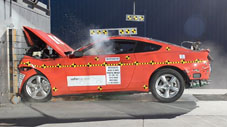
Frontal Crash Test
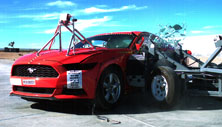
Side Crash Test
Overall Frontal Rating
Driver and Passenger Assessment
Driver Side
Passenger Side
Overall Side Rating
Side Barrier and Side Pole Tests
Driver Side
Passenger Side
Rollover Resistance
No rollover risk estimate available in this dataset
Safety Features
ESC: StandardForward Collision Warning: OptionalLane Departure Warning: No
Recall Notices
NHTSANHTSA ID: 25V614000September 12, 2025
SEAT BELTS:PRETENSIONER
Ford Motor Company (Ford) is recalling certain 2015-2017 Mustang vehicles. Water and road salt may corrode the front seat belt anchor pretensioner cables.
Remedy Status
Dealers will inspect and replace both front seat belt anchor pretensioner assemblies, as necessary. In addition, dealers will remove sections of the carpet and underlayment that contact the cables. Dealers will also inspect the A-pillar sealing patches, and as necessary, install A-pillar body plugs, and/or inspect and replace the front outboard seat bolts. Repairs will be performed free of charge. Interim letters, notifying owners of the safety risk, were mailed October 20, 2025. Additional letters will be sent once the final remedy is available, anticipated January 2026. Owners may contact Ford customer service at 1-866-436-7332. Ford's number for this recall is 25S92. Vehicle Identification Numbers (VINs) involved in this recall became searchable on NHTSA.gov September 17, 2025.
NHTSA ID: 25V572000September 04, 2025
BACK OVER PREVENTION: SENSING SYSTEM: CAMERA
Ford Motor Company (Ford) is recalling certain 2015-2019 Lincoln MKC, Mustang, F-350 SD, F-250 SD, F-450 SD, 2015-2017 Lincoln Navigator, Expedition, 2015-2018 Edge, Transit Connect, 2016-2019 F-550 SD, Transit, 2017-2019 Econoline, and 2019 Ranger vehicles. The rearview camera may display a distorted, inverted, or blank image when the vehicle is in reverse.
Remedy Status
Dealers will inspect and replace the rearview camera as necessary, free of charge. Owner notification letters were mailed January 13, 2026. Ford owners will receive letters in phases, beginning January 2026 and May 2026. Owners may contact Ford customer service at 1-866-436-7332. Ford's number for this recall is 25S89. This recall expands previous NHTSA recall number 25V270. Vehicle Identification Numbers (VINs) involved in this recall will be searchable on NHTSA.gov beginning September 8, 2025.
NHTSA ID: 22V082000February 16, 2022
BACK OVER PREVENTION: SENSING SYSTEM: CAMERA
Ford Motor Company (Ford) is recalling certain 2015-2017 Mustang vehicles. The rearview camera wiring may be loose or damaged, which can result in a blank or distorted image.
Remedy Status
Dealers will inspect and repair the decklid wiring harness and/or replace the rearview camera, as necessary, free of charge. Owner notification letters were mailed December 23, 2022 and June 26, 2023. Remedy parts are expected to become available in the 4th Quarter of 2022. Owners may contact Ford customer service at 1-866-436-7332. Ford's number for this recall is 22S06.
NHTSA ID: 22V011000January 13, 2022
SERVICE BRAKES, HYDRAULIC:PEDALS AND LINKAGES
Ford Motor Company (Ford) is recalling certain 2014-2015 Fusion, Lincoln MKZ, and 2015 Mustang vehicles originally sold or ever registered, in Texas, Louisiana, Mississippi, Alabama, Florida, Georgia, South Carolina, North Carolina, Virginia and Hawaii. Exposure to certain environmental conditions, such as high temperatures, high humidity, and salt air can cause the brake pedal bumper to corrode and separate from the brake pedal.
Remedy Status
Dealers will replace the brake pedal bumpers and clutch pedal bumpers, free of charge. Interim owner notification letters notifying owners of the safety risk were mailed on March 4, 2022. Owner notification letters were mailed on June 13, 2022. Owners may contact Ford customer service at 1-866-436-7332. Ford's number for this recall is 22S02.
NHTSA ID: 20V331000June 08, 2020
LATCHES/LOCKS/LINKAGES:DOORS:LATCH
Ford Motor Company (Ford) is recalling certain 2011-2014 Fiesta, 2013-2014 Fusion, 2015 Mustang, 2013-2015 Escape and C-Max, 2012-2015 Focus, 2014-2016 Transit Connect, 2013-2014 Lincoln MKZ, and 2015 MKC vehicles. These vehicles were previously recalled and repaired under recalls 15V-246, 16V-643 or 17V-210, however the repair may not have been completed properly. A component within the door latches may break making the doors difficult to latch and/or leading the driver or a passenger to believe a door is securely closed when, in fact, it is not.
Remedy Status
Ford will notify owners, and dealers will inspect the latch date codes to confirm if the repair was done correctly, and replace the side door latches if necessary, free of charge. Owners will also have the option to inspect their own vehicle's door latches and enter the date codes into a website to determine if the latches are correct. Owner notification letters were mailed on July 27, 2020. Owners may contact Ford customer service at 1-866-436-7332. Ford's number for this recall is 20S30.
NHTSA ID: 16V779000October 26, 2016
ENGINE AND ENGINE COOLING:COOLING SYSTEM:HOSES/LINES/PIPING/FITTINGS
Ford Motor Company (Ford) is recalling certain model year 2015-2017 Mustang vehicles manufactured February 24, 2015, to August 30, 2016. A hose may separate from the engine oil cooler tube assembly causing an oil leak.
Remedy Status
Ford will notify owners, and dealers will replace the engine oil cooler tube assembly, free of charge. The recall began on March 23, 2017. Owners may contact Ford customer service at 1-866-436-7332. Ford's number for this recall is 16S40.
NHTSA ID: 16V643000September 06, 2016
LATCHES/LOCKS/LINKAGES:DOORS:LATCH
Ford Motor Company (Ford) is recalling certain model year 2012-2015 Ford Focus, 2013-2015 Ford Escape and Ford C-MAX, 2015 Lincoln MKC and Ford Mustang, and 2014-2016 Ford Transit Connect vehicles. A component within the door latches may break, preventing the doors from latching and/or leading the driver or a passenger to believe a door is securely closed when, in fact, it is not.
Remedy Status
Ford will notify owners, and dealers will replace the door latches with an improved part, free of charge. The recall began on January 27, 2017. Owners may contact Ford customer service at 1-866-436-7332. Ford's number for this recall is 16S30.
NHTSA ID: 15V832000December 10, 2015
SERVICE BRAKES, HYDRAULIC:FOUNDATION COMPONENTS:DISC:CALIPER
Roush Performance Products, Inc. (Roush) is recalling certain model year 2015 Ford Mustang GT Roush Stage 3 vehicles manufactured April 1, 2015, to October 31, 2015, and equipped with Roush Extreme Duty Half Shafts. The affected vehicles have a brake caliper guide pin that may not have been sufficiently tightened during installation of the half shafts. As a result, the caliper guide pin may loosen while driving, reducing the vehicle's rear braking ability.
Remedy Status
Roush will notify owners, and Roush-authorized Ford dealers will tighten the caliper guide pin to the proper specification, free of charge. The recall began in February 2016. Owners may contact Roush customer service at 1-800-597-6874.
NHTSA ID: 15V339000June 02, 2015
FUEL SYSTEM, GASOLINE:STORAGE:TANK ASSEMBLY
Ford Motor Company (Ford) is recalling certain model year 2015 Ford Mustang vehicles manufactured February 14, 2014, to February 10, 2015, and equipped with 2.3L engines. Prolonged exposure to elevated underbody temperatures can cause degradation of the fuel tank and/or fuel vapor lines, which may eventually result in a fuel leak. In addition, this condition could cause seals in the parking brake cable to degrade, potentially affecting parking brake function.
Remedy Status
Ford will notify owners, and dealers will replace the fuel tank shield, add thermal patches to the fuel tank and parking brake cable, and add thermal wraps to the fuel vapor lines. The repairs will be performed free of charge. The recall began on July 9, 2015. Owners may contact Ford customer service at 1-866-436-7332. Ford's number for this recall is 15S19.
NHTSA ID: 14V774000December 05, 2014
FUEL SYSTEM, GASOLINE
Ford Motor Company (Ford) is recalling certain model year 2015 Ford Mustang vehicles manufactured September 25, 2014, to October 9, 2014. The fuel pressure sensor may not have been seated properly to the fuel jumper line, which may cause a fuel leak.
Remedy Status
Ford will notify owners, and dealers will replace the fuel jumper line, free of charge. The recall began on December 17, 2014. Owners may contact Ford customer service at 1-866-436-7332. Ford's number for this recall is 14S27.
NHTSA ID: 14V649000October 17, 2014
SEAT BELTS
Ford Motor Company (Ford) is recalling certain model year 2015 Ford Mustang vehicles manufactured August 18, 2014, to October 2, 2014. In the affected vehicles, the passenger safety belt tension sensor may misclassify the size of the front passenger seat occupant. This could cause a child size occupant to be classified as an adult and an adult passenger to be classified as a child passenger. As such, these vehicles fail to comply with the requirements of Federal Motor Vehicle Safety Standard No. 208, "Occupant Crash Protection."
Remedy Status
Ford has notified owners, and dealers will replace the passenger safety belt buckle, free of charge. The recall began on October 28, 2014. Owners may contact Ford customer service at 1-866-436-7332. Ford's number for this recall is 14C08.
Investigations
3 totalFrom 2000 through 2017, Takata produced millions of air bag inflators using two types of phase-stabilized ammonium nitrate ("PSAN") propellant -- propellant 2004 and propellant 2004L. After prolonged exposure to high temperature cycles and humidity, inflators using propellant 2004 can degrade, causing the propellant to burn too quickly when ignited. The rapid burning can cause the inflator to rupture during deployment, potentially causing serious or even fatal injury to vehicle occupants. See 2016 Blomquist Report at www.nhtsa.gov/sites/nhtsa.gov/files/documents/expert_report-hrblomquist.pdf.Consequently, all frontal inflators using propellant 2004 that do not contain a "desiccant" (a substance that traps and holds moisture) in US vehicles are under recall. These "non-desiccated" inflators either have been or are required to be replaced.In some cases, the remedy part for these recalled inflators was, or will be, an inflator using either propellant 2004 or 2004L that does contain a desiccant. None of these "desiccated" remedy parts (which were installed in older model year vehicles) are currently under recall for a degradation concern. Certain subsets of desiccated PSAN inflators using propellant 2004 for use as original equipment, however, have been recalled for a degradation concern. All Takata inflators produced with propellant 2004L contain desiccant, and none of these desiccated inflators using propellant 2004L are under recall for a degradation concern. There have been no reported field ruptures in any non-recalled desiccated PSAN inflators.It is understood that desiccants fully saturate at some threshold, at which point any additional moisture will not be captured. This means the degradation process observed in non-desiccated inflators using propellant 2004 may also occur in non-recalled desiccated inflators using propellant 2004, assuming additional moisture enters the inflator and high temperature cycling occurs. Based on available information, desiccant saturation can occur within the first five years in the worst environments, and the time required for full saturation is affected by multiple factors. While no present safety risk has been identified, further work is needed to evaluate the future risk of non-recalled desiccated inflators using propellant 2004.Three entities -- Takata (now known as TK Global), the Independent Testing Coalition, and Exponent -- have been studying the long-term behavior of Takata desiccated PSAN inflators using propellant 2004L (as well as 2004) in the presence of moisture and temperature cycling. The research efforts, which include development of predictive modeling techniques and field sample analysis, are ongoing. To date, none of the researchers have identified field evidence showing that propellant 2004L is undergoing a degradation process that leads to aggressive deployment and potential rupture. However, the time in service of such inflators remains short compared to that of the inflators using propellant 2004. Further study is needed to assess the long-term safety of desiccated inflators using propellant 2004L.The Office of Defects Investigation is opening this investigation to examine whether a safety defect related to propellant degradation exists in non-recalled desiccated PSAN frontal inflators manufactured by Takata. This investigation will require extensive information on Takata production processes and surveys of inflators in the field. Lists of recall actions that may have used desiccated PSAN inflators as remedy parts, as well as the makes and models originally manufactured with them, is available with the downloadable version of this document (see nhtsa.gov/recalls?nhtsaId=EA21002 -- note this information is subject to change/revision as the investigation proceeds). This investigation does not supersede EA15-001, which remains open.
Component: AIR BAGS:FRONTAL:DRIVER SIDE:INFLATOR MODULEOpened: Sep 17, 2021
RQClosed
In December 2019, the Office of Defects Investigation (ODI) opened this investigation based on 235 Vehicle Owner Questionnaires (VOQs) alleging doors failed to latch when closed, and/or inadvertently opened while driving, on model year (MY) 2012-2014 Ford Fiesta, and 2013-2014 Fusion and Lincoln MKZ. Some VOQs reported the failure occurred after the latch had been remedied under a prior recall which involved fracture of the latch pawl spring tab due to thermally induced cyclic fatigue. Other VOQs alleged a similar failure in vehicles not previously recalled. A latch with a fractured pawl spring tab typically results in a ?door will not close? condition, however in certain somewhat rare circumstances, may result in the door coming open while driving. In response to ODI?s investigation, Ford has announced three field actions, as discussed below.On March 23, 2020, Ford submitted Safety Recall 20V-177 (Ford 20S15), a regional recall campaign to address door latch failures in vehicles not previously recalled under Safety Recalls 15V-246, 16V-643 and 17V-210. The recall affects vehicles currently or ever registered in certain high ambient temperature states (see 20V-177 for affected states). As a remedy, Ford will replace all four door latches free of charge.On August 24, 2020, Ford issued a non-safety regional field action (Ford 20R01) to address door latch failures on the same model/MY vehicles not covered under 20V-177 (i.e., not currently/ever registered in affected states). According to Ford, spring tab failure rates for vehicles covered by this action are about half that of the 20V-177 vehicles. Under this action, dealers will replace all door latches, free of charge, if either; a) the vehicle exhibits a related latch concern, or b) if the vehicle owner expresses a concern about the latches in their vehicles. Details can be found under NHTSA TSB No. 10190990, a copy of which is available in this investigative file available at NHTSA.gov.On June 8, 2020, Ford submitted Safety Recall 20V-331 (Ford 20S30) addressing vehicles previously remedied under NHTSA Recalls 15V-246, 16V-643 and 17V-210, where the repair may not have been properly completed, specifically not all of the door latches were replaced, or replaced correctly. This recall involves an inspection of the latches, with the option for a consumer self-inspection; owners could view the date codes on their latches (and confirm child safety locks are present on the rear doors) and then submit the information to Ford?s mobile app or website. A dealership inspection option was also available. Any vehicle found to have unreplaced defective latches requires the replacement of all door latches as directed by Ford.Regarding the 4,494 reports cited above, 1,485 involve scope-related failures (with 13% alleging door opening), and the remaining 3,009 reports involving remedy concerns (with 18% alleging door opening - note ODI was unable to verify the allegations of door opening). The three ODI injuries were all relatively minor. Ford?s reported injury incidences include one (unconfirmed) report of an ejection, three minor injuries with the others involving undisclosed injuries. Ford?s crashes involved two (unconfirmed) crashes alleging the incident door contacted another vehicle and three involving doors striking other property.The recalled vehicles include MY 2011-2015 Ford Fiesta, 2013-2016 Ford Fusion and Lincoln MKZ, 2015 Ford Mustang and Lincoln MKC, 2013-2015 Ford Escape and Ford C-MAX, 2012-2015 Ford Focus and 2014-2016 Ford Transit Connect.Ford's actions address ODI's concerns at this time. ODI will take further action if warranted by new information. The reference (OD
Component: LATCHES/LOCKS/LINKAGES:DOORS:LATCHOpened: Dec 19, 2019Closed: Feb 7, 2022Related recall: 20V177000
PEClosed
In January, the Office of Defects Investigation (ODI) opened this Preliminary Evaluation based on consumers' allegations of doors failing to latch and/or inadvertently opening on model year (MY) 2012-2013 Ford Focus vehicles (subject vehicles).ODI has received 464 unique reports related to the alleged problem, with over 200 claiming that the door(s) opened inadvertently while the vehicle was in motion.One consumer alleged an injury that occurred while driving when a door inadvertently opened and then closed on a child's arm.Another alleged that a door that inadvertently opened struck a parked vehicle.In response to ODI's information request, Ford Motor Company (Ford) provided 500 unique reports related to the alleged problem on the subject vehicles.Ford reported no injury or accident claims.Ford also submitted 1,513 warranty claims related to door latch failures.Many customers indicated that the affected door could not be latched at all and some of them decided to restrain the door by other means in order to operate the vehicle.Some customers also reported door latch failures occurring on multiple doors and at different times.Additionally, Ford stated that MY 2014-2015 Ford Focus, 2013-2015 Ford Escape, 2013-2015 Ford C-Max, 2014-2016 Ford Transit Connect, 2015 Ford Mustang, and 2015 Lincoln MKC, all use the same door latch as the 2012-2013 Ford Focus.On September 6, 2016, Ford notified ODI that it would conduct a safety recall (16V-643) to remedy the door latches in the MY 2012-2015 Ford Focus and other Ford models mentioned above (total of approximately 2 million vehicles).According to Ford, a component within the door latch may break preventing the door from latching.Ford dealers will replace all four door latches in the recalled vehicles with a new more robust latch design that is currently in production.The recall action initiated by the manufacturer appears to address the safety risks.Accordingly, this investigation is closed.The ODI reports cited above can be reviewed at www-odi.nhtsa.dot.gov/owners/SearchNHTSAID under the identification (ODI) numbers found in the attached list.
Component: LATCHES/LOCKS/LINKAGES:DOORS:LATCHOpened: Jan 16, 2016Closed: Oct 29, 2016Related recall: 16V643000
Owner Complaints
432 totalSTRUCTURE,UNKNOWN OR OTHER
Mar 22, 2026
My passenger door latch pops open nearly every time I drive on the highway. The latches were previously the subject of Safety Recall 16S30. I had my vehicle inspected by a Ford Dealership. No repairs or work was deemed necessary at that time. In the years since, my door now comes...
Preview excerpt
UNKNOWN OR OTHER,ENGINE,FUEL/PROPULSION SYSTEM
FIREMar 12, 2026
I was driving down the highway with heater on and defrost. All of a sudden I hear a pop and my car started bogging down. I exited the highway to get out of danger, it then had a wrench light ( transmission) pop up and when I parked the car on the access road it started smoking a ...
Preview excerpt
UNKNOWN OR OTHER,SERVICE BRAKES
Mar 5, 2026
While driving, I attempted to depress my clutch pedal in order to bring my vehicle to a stop. My clutch pedal only went halfway to the floor. I was able to force it down to the floor using a higher than usual amount of force. After bringing my vehicle to a stop I inspected my clu...
Preview excerpt
ENGINE
FIREDec 7, 2025
“Charge system service now” came on the dash, battery lost power after about 10 seconds, screen went black, dash went black, car locked up, opened the hood and the engine was on fire, called 911 who came quickly and put the fire out without the entire car burning, insurance later...
Preview excerpt
ELECTRICAL SYSTEM
Nov 30, 2025
When putting the vehicle into reverse the backup camera displayed an unusable red fuzzy screen. Backup camera was unable to assist in safely reversing and mirrors and parking sensors had to be used
FUEL/PROPULSION SYSTEM
Nov 7, 2025
With only 32,885 miles, engine light came on due to (P0456) EVAP small leak. Went to an auto shop and Ford dealer for diagnostic scan. Both technicians found that there is a bit of smoke coming out from the top of the fuel tank due to a small stress crack at the port near the can...
Preview excerpt
SEAT BELTS,BACK OVER PREVENTION
Oct 23, 2025
The contact owns a 2015 Ford Mustang. The contact received notifications of NHTSA Campaign Numbers: 25V614000 (Seat Belts) and 25V572000 (Back Over Prevention); however, the part to do the recall repair was not yet available. The dealer was contacted and confirmed that parts were...
Preview excerpt
SEAT BELTS
Oct 15, 2025
The contact owns a 2015 Ford Mustang. The contact received notification of NHTSA Campaign Number: 25V614000 (SEAT BELTS); however, the part to do the recall repair was unavailable. The contact stated that the manufacturer had exceeded a reasonable amount of time for the recall re...
Preview excerpt
SERVICE BRAKES, HYDRAULIC,POWER TRAIN
Oct 14, 2025
The contact owns a 2015 Ford Mustang. The contact stated that while driving 35 MPH and attempting to depress the brake pedal, the clutch pedal detached from the brake pedal assembly. Neither an independent mechanic nor a dealer was contacted. The vehicle was not taken to a dealer...
Preview excerpt
LATCHES/LOCKS/LINKAGES
Oct 8, 2025
The contact owns a 2015 Ford Mustang. The contact recently purchased the vehicle. The contact became aware that the VIN was included in NHTSA Campaign Number: 20V331000 (LATCHES/LOCKS/LINKAGES). The vehicle was taken to the dealer, who refused to inspect the door latch codes. The...
Preview excerpt
Showing 10 recent complaints from 432 total
View Full Complaint LogCompare Related Vehicles
Why Compare These Pages
The strongest comparison flow is usually: exact vehicle-year page, then nearby years of the same model, then other 2015 Ford models. That sequence helps separate one-off year spikes from broader make-wide patterns.
More Ford Mustang Years
2016 Ford MustangCompare this year against 2015 for complaint and recall shifts.5r1i363c2014 Ford MustangCompare this year against 2015 for complaint and recall shifts.4r356c2017 Ford MustangCompare this year against 2015 for complaint and recall shifts.6r1i250c2013 Ford MustangCompare this year against 2015 for complaint and recall shifts.6r270c2018 Ford MustangCompare this year against 2015 for complaint and recall shifts.4r180c2012 Ford MustangCompare this year against 2015 for complaint and recall shifts.7r1i468c
More 2015 Ford Models
2015 Ford ExplorerAnother 2015 Ford option for same-year comparison.9r5i1,720c2015 Ford F-150Another 2015 Ford option for same-year comparison.14r5i1,573c2015 Ford FusionAnother 2015 Ford option for same-year comparison.12r4i1,039c2015 Ford FocusAnother 2015 Ford option for same-year comparison.7r4i1,007c2015 Ford EscapeAnother 2015 Ford option for same-year comparison.9r2i981c2015 Ford EdgeAnother 2015 Ford option for same-year comparison.7r2i702c
Frequently Asked Questions
How many recalls does the 2015 Ford Mustang have?
The 2015 Ford Mustang has 11 recalls recorded by NHTSA.
How many complaints have been filed for the 2015 Ford Mustang?
NHTSA has received 432 owner-reported complaints for the 2015 Ford Mustang.
What is the NHTSA safety rating for the 2015 Ford Mustang?
Our stored NHTSA record for the 2015 Ford Mustang has an overall rating of 5 out of 5 stars. Stored NHTSA configuration: 2015 Ford Mustang 2 DR RWD. NCAP Vehicle ID: 9555. Ratings describe one stored NHTSA configuration, not every trim, body style or drivetrain for this model year.
What are the most common problems with the 2015 Ford Mustang?
The most frequent complete stored component labels for the 2015 Ford Mustang are unknown or other (43 reports), exterior lighting (36 reports), structure (28 reports). These are exact-label counts, not broader component-group totals or confirmed defects.
Does the 2015 Ford Mustang have any recalls?
Yes. NHTSA has 11 recalls on record for the 2015 Ford Mustang. Scroll up to review the published recall summaries, consequences, and remedies. To check for unrepaired recalls on your specific vehicle, use your VIN at nhtsa.gov/recalls.
Check Another Vehicle
Look up recalls and complaints for any year, make, and model.
This page summarizes publicly available data from the National Highway Traffic Safety Administration (NHTSA). Complaint counts reflect reports submitted to NHTSA by vehicle owners and do not by themselves prove defect severity or vehicle safety. Safety ratings may not be available for all vehicle-years. This site is not affiliated with NHTSA or any vehicle manufacturer. For official information, visit the official NHTSA page for this vehicle.