Honda · Accord · 2002
2002 Honda Accord
16
Recalls
1,050
Complaints
N/A
NCAP overall
The 2002 Honda Accord has 16 recalls and 1,050 owner-reported complaints on file with NHTSA. Most frequent stored component label: power train (419 reports).
Stored NHTSA configuration: 2002 Honda Accord 4-DR. NCAP Vehicle ID: 4444
Ratings describe one stored NHTSA configuration, not every trim, body style or drivetrain for this model year. How this configuration is selected
Source: NHTSA Public Records
NHTSA source checks for this vehicle year
- Complaints
- Separate successful check not recorded.
- Recalls
- Separate successful check not recorded.
- Safety ratings
- Separate successful check not recorded.
- Investigations
- Separate successful check not recorded.
- Manufacturer communications
- Separate successful check not recorded.
Checks are recorded separately for each dataset, not for the whole page. Dates use UTC. A missing check date does not mean no records exist.
Vehicle import recorded: May 4, 2026. This is the stored import date, not confirmation that every source was successfully refreshed.
Research Context
The 2002 Honda Accord page works best as a research starting point. Complaint totals show how much owner-reported activity exists, while recalls and investigations help show whether any of that activity turned into formal safety action.
Because this is a newer-era vehicle page, it usually helps to compare this year against nearby model years before deciding whether a complaint pattern looks isolated or persistent. On this page, the most frequent complete stored component label is power train with 419 reported complaints.
Best Research Moves
- Use the complaint log to see whether the 2002 Honda Accord reports cluster around one repeated symptom or spread across multiple systems.
- Compare the recall list with the complaint mix to see whether the most reported issues overlap with formal NHTSA safety campaigns.
- Check the linked investigations for extra ODI context if you want to see whether owner complaints escalated into formal defect review.
Key Takeaways
- The 2002 Honda Accord currently shows 16 NHTSA recalls listed on this page and 1,050 owner-reported complaints.
- This page currently shows 7 NHTSA investigations linked to this page.
- This page reflects complaint volume, recall history, and NHTSA test data, but it does not diagnose causes or rank reliability by itself.
- Safety data currently shows no overall NHTSA safety rating in our current dataset.
- The most frequent complete stored component labels on this page are power train (419), air bags (219), structure (44).
- Vehicle
- 2002 Honda Accord
- Recalls
- 16
- Complaints
- 1050
- Stored Configuration Overall Rating
- Not available in this dataset
How to Interpret This Page
This page combines three types of NHTSA data: recall campaigns (official manufacturer or government actions), owner complaints (unverified consumer reports), and crash test ratings (where available). A vehicle with many complaints is not necessarily less reliable — complaint volume correlates with sales volume and vehicle age. Recalls indicate identified defects, not overall quality. To compare this model year with others, use the year navigation in the sidebar or return to the model overview page.
If you are researching a used vehicle, start with the complaint categories, compare them against the recall list, and then check nearby model years to see whether the same issue profile repeats. That usually produces a better buying or research signal than treating the raw complaint total as a standalone safety ranking.
NHTSA Configuration Test Results
Stored NHTSA configuration: 2002 Honda Accord 4-DR. NCAP Vehicle ID: 4444
Ratings describe one stored NHTSA configuration, not every trim, body style or drivetrain for this model year. How this configuration is selected
No overall score is available in our current dataset. The individual results below are not a combined safety rating; compare vehicles within the same test program and model year.
Frontal Crash Test
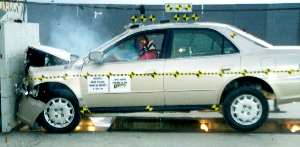
Overall Frontal Rating
Driver and Passenger Assessment
Driver Side
Passenger Side
Overall Side Rating
Side Barrier and Side Pole Tests
Driver Side
Passenger Side
Rollover Resistance
No rollover risk estimate available in this dataset
Safety Features
ESC: NoForward Collision Warning: NoLane Departure Warning: No
Recall Notices
NHTSANHTSA ID: 19V499000June 27, 2019
AIR BAGS:FRONTAL:DRIVER SIDE:INFLATOR MODULE
Honda (American Honda Motor Co.) is recalling certain 2003 Acura 3.2CL, 2002-2003 3.2TL, 2003-2006 MDX, 2001-2007 Honda Accord, 2001-2005 Civic, 2003-2005 Civic Hybrid, 2001-2005 Civic GX NGV, 2002-2006 CR-V, 2003-2011 Element, 2002-2004 Odyssey, 2003-2008 Pilot and 2006 Ridgeline vehicles. These vehicles are equipped with driver frontal air bag inflators assembled as a recall remedy part or replacement service part, that may explode due to propellant degradation occurring after long-term exposure to high absolute humidity, temperature and temperature cycling.
Remedy Status
Honda will notify owners, and dealers will replace the driver frontal air bag inflator, free of charge. The recall began August 12, 2019. Owners may contact Honda customer service at 1-888-234-2138. Honda's numbers for this recall are Q5A and Y58.
NHTSA ID: 19V182000March 06, 2019
AIR BAGS:FRONTAL:DRIVER SIDE:INFLATOR MODULE
Honda (American Honda Motor Co.) is recalling specific 2003 Acura 3.2CL, 2013-2016 ILX, 2013-2014 ILX Hybrid, 2003-2006 MDX, 2007-2016 RDX, 2002-2003 3.2TL, 2004-2006, and 2009-2014 TL, 2010-2013 ZDX and 2001-2007 and 2009 Honda Accord, 2001-2005 Civic, 2003-2005 Civic Hybrid, 2001-2005 Civic GX NGV, 2002-2007 and 2010-2011 CR-V, 2003-2011 Element, 2007 Fit, 2002-2004 Odyssey, 2003-2008 Pilot, and 2006-2014 Ridgeline vehicles. The affected vehicles received a replacement driver air bag inflator as part of a previous Takata inflator recall remedy or a replacement driver air bag module containing the same inflator type as a service part. Due to a manufacturing error, in the event of a crash necessitating deployment of the driver frontal air bag, these inflators may explode.
Remedy Status
Honda will notify owners, and dealers will replace the driver's air bag inflator with an alternate inflator, free of charge. The recall began April 10, 2019. Honda owners may contact customer service at 1-888-234-2138. Honda's number for this recall is O41. Acura owners may contact customer service at 1-888-234-2138. Acura's number for this recall is U40.
NHTSA ID: 15V320000May 28, 2015
AIR BAGS:FRONTAL:DRIVER SIDE:INFLATOR MODULE
Honda (American Honda Motor Co.) is recalling certain model year 2001-2007 Accord, 2001-2005 Civic, 2001-2004 Honda Civic GX, 2003-2005 Honda Civic Hybrid, 2002-2006 CR-V, 2003-2011 Element, 2002-2004 Odyssey, 2003-2008 Pilot, 2006 Ridgeline, 2003 Acura 3.2CL, 2003-2006 Acura MDX, and 2002-2003 Acura 3.2TL vehicles. The affected vehicles are equipped with a dual-stage driver frontal air bag that may be susceptible to moisture intrusion and other factors, including manufacturing variability that, over time, could cause the inflator to rupture.
Remedy Status
Honda will notify owners, and dealers will replace the driver frontal air bag inflator, free of charge. The recall began on July 1, 2015. Owners may contact Honda customer service at 1-888-234-2138. Owners may contact Acura customer service at 1-800-382-2238, select option 4. Note: Vehicles that have had their driver frontal air bag replaced previously as part of a recall remedy prior to September 12, 2014 need to have their air bag replaced under this recall as well. Vehicles that, on or after September 12, 2014, received a remedy for a prior driver frontal air bag inflator recall already received an inflator of a different design, and therefore are not included in this recall and do not require additional servicing. Note: This recall fully supersedes recalls 08V-593, 09V-259, 10V-041, 11V-260, 14V-351 and 15V-153. Honda's numbers for this recall are JQ9, JR0, JR1, JR2, JR3, JR4, JR5, JR6, JR7, and JR8.
NHTSA ID: 09E025000May 11, 2009
EXTERIOR LIGHTING:HEADLIGHTS
DOPE, INC. IS RECALLING 42,540 COMBINATION CORNER AND BUMPER LAMP ASSEMBLIES OF VARIOUS PART NUMBERS SOLD FOR USE AS AFTERMARKET EQUIPMENT FOR VARIOUS PASSENGER VEHICLES. THESE HEADLAMPS FAIL TO CONFORM TO THE REQUIREMENTS OF FEDERAL MOTOR VEHICLE SAFETY STANDARD NO. 108, "LAMPS, REFLECTIVE DEVICES, AND ASSOCIATED EQUIPMENT." THESE LAMPS DO NOT CONTAIN THE REQUIRED AMBER SIDE REFLECTORS.
Remedy Status
DOPE, INC. WILL NOTIFY OWNERS AND OFFER A FULL REFUND FOR THE NONCOMPLIANT COMBINATION LAMPS. THE SAFETY RECALL BEGAN ON JULY 28, 2009. OWNERS MAY CONTACT DOPE, INC. AT 1-626-272-1798.
NHTSA ID: 09E012000April 07, 2009
EXTERIOR LIGHTING
SABERSPORT IS RECALLING 16,270 COMBINATION CORNER AND BUMPER LAMP ASSEMBLIES OF VARIOUS PART NUMBERS SOLD FOR USE AS AFTERMARKET EQUIPMENT FOR VARIOUS PASSENGER VEHICLES. THESE HEADLAMPS FAIL TO CONFORM TO THE REQUIREMENTS OF FEDERAL MOTOR VEHICLE SAFETY STANDARD NO. 108, "LAMPS, REFLECTIVE DEVICES, AND ASSOCIATED EQUIPMENT." THESE LAMPS DO NOT CONTAIN THE REQUIRED AMBER SIDE REFLECTORS.
Remedy Status
SABERSPORT WILL NOTIFY OWNERS AND OFFER A FULL REFUND FOR THE NONCOMPLIANT COMBINATION LAMPS. THE SAFETY RECALL BEGAN ON MAY 11, 2009. OWNERS MAY CONTACT SABERSPORT AT 1-909-598-7589.
NHTSA ID: 08E050000August 11, 2008
EXTERIOR LIGHTING:HEADLIGHTS
K2 MOTOR IS RECALLING 1,921 AFTERMARKET HEADLAMPS OF VARIOUS MODELS SOLD FOR USE ON THE ABOVE LISTED VEHICLES. THESE HEADLAMPS ARE MISSING THE AMBER SIDE REFLEX REFLECTOR WHICH FAILS TO CONFORM WITH THE REQUIREMENTS OF FEDERAL MOTOR VEHICLE SAFETY STANDARD NO. 108, "LAMPS, REFLECTIVE DEVICES, AND ASSOCIATED EQUIPMENT."
Remedy Status
K2 MOTOR WILL NOTIFY OWNERS AND OFFER A FULL REFUND. THE RECALL BEGAN ON DECEMEBER 17, 2008. OWNERS MAY CONTACT K2 MOTOR AT 1-909-839-2992.
NHTSA ID: 06E064000July 17, 2006
EXTERIOR LIGHTING
CERTAIN TRADESONIC COMBINATION LAMPS SOLD AS REPLACEMENT LAMPS FOR USE ON THE ABOVE LISTED PASSENGER VEHICLES. COMBINATION LAMPS NOT EQUIPPED WITH AMBER SIDE REFLECTORS FAIL TO CONFORM WITH THE REQUIREMENTS OF FEDERAL MOTOR VEHICLE SAFETY STANDARD NO. 108, LAMPS, REFLECTIVE DEVICES, AND ASSOCIATED EQUIPMENT.
Remedy Status
TRADESONIC WILL NOTIFY OWNERS AND REPLACE THE LAMPS FREE OF CHARGE. THE RECALL IS EXPECTED TO BEGIN DURING JULY 2006. OWNERS MAY CONTACT TRADESONIC AT 626-934-8884.
NHTSA ID: 06E060000June 29, 2006
EXTERIOR LIGHTING
CERTAIN AAI MOTORSPORTS COMBINATION LAMPS SOLD AS REPLACEMENT LAMPS FOR USE ON THE ABOVE LIST PASSENGER VEHICLES. COMBINATION LAMPS NOT EQUIPPED WITH AMBER SIDE REFLECTORS FAIL TO CONFORM WITH THE REQUIREMENTS OF FEDERAL MOTOR VEHICLE SAFETY STANDARD NO. 108, "LAMPS, REFLECTIVE DEVICES, AND ASSOCIATED EQUIPMENT."
Remedy Status
AAI MOTORSPORTS WILL NOTIFY OWNERS AND REPLACE THE LAMPS FREE OF CHARGE. THE RECALL BEGAN ON AUGUST 1, 2006. OWNERS MAY CONTACT AAI MOTORSPORTS AT 909-923-9188.
NHTSA ID: 06E044000May 22, 2006
EXTERIOR LIGHTING
CERTAIN J & A AUTO ACCESSORIES COMBINATION HEADLAMPS SOLD AS REPLACEMENT LAMPS FOR USE ON THE ABOVE LISTED PASSENGER VEHICLES. SOME COMBINATION LAMPS THAT ARE NOT EQUIPPED WITH AMBER SIDE REFLECTORS FAIL TO CONFORM TO FEDERAL MOTOR VEHICLE SAFETY STANDARD NO. 108, LAMPS, REFLECTIVE DEVICES, AND ASSOCIATED EQUIPMENT.
Remedy Status
J & A AUTO ACCESSORIES WILL NOTIFY OWNERS AND OFFER TO REPURCHASE THE HEADLAMPS. THE RECALL BEGAN ON JULY 10, 2006. OWNERS MAY CONTACT J & A AUTO ACCESSORIES AT 310-327-4981.
NHTSA ID: 06E038000May 08, 2006
EXTERIOR LIGHTING
CERTAIN ALFAOTTO COMBINATION HEADLAMPS SOLD AS REPLACEMENT LAMPS FOR USE ON THE ABOVE LISTED PASSENGER VEHICLES. SOME COMBINATION LAMPS THAT ARE NOT EQUIPPED WITH AMBER SIDE REFLECTORS FAIL TO CONFORM TO FEDERAL MOTOR VEHICLE SAFETY STANDARD NO. 108, LAMPS, REFLECTIVE DEVICES, AND ASSOCIATED EQUIPMENT.
Remedy Status
ALFAOTTO WILL NOTIFY OWNERS AND REPLACE THE HEADLAMPS FREE OF CHARGE. THE RECALL BEGAN ON MAY 10, 2006. OWNERS MAY CONTACT ALFAOTTO AT 626-656-2992 OR VISIT THEIR WEBSITE AT WWW.ALFAOTTO.COM.
NHTSA ID: 06E032000April 18, 2006
EXTERIOR LIGHTING
CERTAIN EAGLE EYES AND SONAR HEADLIGHTS AND CORNER LIGHTS SOLD AS AFTERMARKET FOR USE ON 1988-2005 HONDA CIVIC, 1990-2005 HONDA ACCORD, AND 1990-2001 ACURA INTEGRA PASSENGER VEHICLES LISTED ABOVE. HEADLIGHTS AND CORNER LIGHTS THAT ARE NOT EQUIPPED WITH AMBER SIDE REFLECTORS FAIL TO CONFORM TO FEDERAL MOTOR VEHICLE SAFETY STANDARD NO. 108, LAMPS, REFLECTIVE DEVICES, AND ASSOCIATED EQUIPMENT.
Remedy Status
TOM MOTORSPORT WILL NOTIFY OWNERS AND OFFER REIMBURSEMENT FOR THE PURCHASE OF NONCOMPLIANT LIGHTS. THE RECALL BEGAN APRIL 17, 2006. OWNERS MAY CONTACT TOM MOTORSPORT AT 626-968-4007.
NHTSA ID: 06E026000March 23, 2006
EXTERIOR LIGHTING
CERTAIN PRO-A MOTORS CORNER LAMPS, TURN SIGNALS, AND HEADLIGHTS SOLD AS REPLACEMENT LAMPS FOR USE ON CERTAIN PASSENGER VEHICLES LISTED ABOVE. SOME COMBINATION LAMPS THAT ARE NOT EQUIPPED WITH AMBER SIDE REFLECTORS FAIL TO CONFORM TO FEDERAL MOTOR VEHICLE SAFETY STANDARD NO. 108, LAMPS, REFLECTIVE DEVICES, AND ASSOCIATED EQUIPMENT.
Remedy Status
PRO-A MOTORS WILL NOTIFY OWNERS AND OFFER TO REPURCHASE THE LAMPS. THE RECALL BEGAN ON APRIL 3, 2006. OWNERS MAY CONTACT PRO-A MOTORS AT 323-838-2988.
NHTSA ID: 06E025000March 21, 2006
EXTERIOR LIGHTING:HEADLIGHTS
CERTAIN POLI-AUTO COMBINATION HEADLAMP ASSEMBLIES, P/NOS. 11-728, 11-728D, 11-710, 11-419, 11-713, 11-703, 11-704, 11-708P, 11-735, 11-725, 11-726, 11-716 (P&C), 11-721-1, 11-733, 11-729, 11-730, AND 11-732, SOLD AS REPLACEMENT LAMPS FOR USE ON CERTAIN PASSENGER VEHICLES. SOME COMBINATION LAMPS THAT ARE NOT EQUIPPED WITH AMBER SIDE REFLECTORS FAIL TO CONFORM TO FEDERAL MOTOR VEHICLE SAFETY STANDARD NO. 108, "LAMPS, REFLECTIVE DEVICES, AND ASSOCIATED EQUIPMENT."
Remedy Status
POLI-AUTO WILL NOTIFY OWNERS AND OFFER TO REPURCHASE THE HEADLAMPS AT ITS ORIGINAL PURCHASE PRICE. THE RECALL IS EXPECTED TO BEGIN DURING APRIL 2006. OWNERS MAY CONTACT POLI-AUTO AT 305-477-1356.
NHTSA ID: 06E023000March 13, 2006
EXTERIOR LIGHTING:HEADLIGHTS
CERTAIN ANZO COMBINATION HEADLAMP ASSEMBLIES SOLD AS REPLACEMENT LAMPS FOR USE ON CERTAIN PASSENGER VEHICLES. SOME COMBINATION LAMPS ARE NOT EQUIPPED WITH AMBER SIDE REFLECTORS WHICH FAIL TO CONFORM TO FEDERAL MOTOR VEHICLE SAFETY STANDARD NO. 108, "LAMPS, REFLECTIVE DEVICES, AND ASSOCIATED EQUIPMENT."
Remedy Status
ANZO WILL NOTIFY OWNERS AND REPLACE THE HEADLAMPS FREE OF CHARGE. THE RECALL BEGAN MAY 9, 2006. OWNERS MAY CONTACT ANZO USA AT 909-468-3688.
NHTSA ID: 05V025000January 28, 2005
ELECTRICAL SYSTEM:IGNITION:SWITCH
ON CERTAIN PASSENGER VEHICLES, THE INTERLOCK OPERATION OF THE IGNITION SWITCH MAY NOT FUNCTION PROPERLY, MAKING IT POSSIBLE TO TURN THE IGNITION KEY TO THE "OFF" POSITION AND REMOVE THE KEY WITHOUT SHIFTING THE TRANSMISSION TO PARK.
Remedy Status
DEALERS WILL PERFORM AN INSPECTION PROCEDURE THAT CONFIRMS INTERLOCK FUNCTION. VEHICLES WILL BE UPDATED WITH A REDESIGNED INTERLOCK LEVER FREE OF CHARGE. THE RECALL BEGAN ON MARCH 7, 2005. OWNERS MAY CONTACT HONDA AT 1-800-999-1009 OR ACURA AT 1-800-382-2238.
NHTSA ID: 02V226000August 28, 2002
ENGINE AND ENGINE COOLING:ENGINE
ON CERTAIN MINIVANS, SEDANS, COUPES, AND SPORT UTILITY VEHICLES EQUIPPED WITH V6 ENGINES, A TIMING BELT TENSIONER PULLEY ON THE WATER PUMP IS MISALIGNED AND COULD CAUSE THE TIMING BELT TO CONTACT A BOLT ON THE CYLINDER HEAD. EVENTUALLY THE BELT COULD BE DAMAGED AND FAIL.
Remedy Status
DEALERS WILL INSPECT THE WATER PUMP AND IF IT IS ONE OF THE DEFECTIVE PUMPS, THE WATER PUMP AND TIMING BELT WILL BE REPLACED. OWNER NOTIFICATION BEGAN AUGUST 30, 2002. OWNERS WHO TAKE THEIR VEHICLES TO AN AUTHORIZED DEALER ON AN AGREED UPON SERVICE DATE AND DO NOT RECEIVE THE FREE REMEDY WITHIN A REASONABLE TIME SHOULD CONTACT HONDA AT 1-800-999-1009 OR ACURA AT 1-800-382-2238.
Investigations
7 totalFrom 2000 through 2017, Takata produced millions of air bag inflators using two types of phase-stabilized ammonium nitrate ("PSAN") propellant -- propellant 2004 and propellant 2004L. After prolonged exposure to high temperature cycles and humidity, inflators using propellant 2004 can degrade, causing the propellant to burn too quickly when ignited. The rapid burning can cause the inflator to rupture during deployment, potentially causing serious or even fatal injury to vehicle occupants. See 2016 Blomquist Report at www.nhtsa.gov/sites/nhtsa.gov/files/documents/expert_report-hrblomquist.pdf.Consequently, all frontal inflators using propellant 2004 that do not contain a "desiccant" (a substance that traps and holds moisture) in US vehicles are under recall. These "non-desiccated" inflators either have been or are required to be replaced.In some cases, the remedy part for these recalled inflators was, or will be, an inflator using either propellant 2004 or 2004L that does contain a desiccant. None of these "desiccated" remedy parts (which were installed in older model year vehicles) are currently under recall for a degradation concern. Certain subsets of desiccated PSAN inflators using propellant 2004 for use as original equipment, however, have been recalled for a degradation concern. All Takata inflators produced with propellant 2004L contain desiccant, and none of these desiccated inflators using propellant 2004L are under recall for a degradation concern. There have been no reported field ruptures in any non-recalled desiccated PSAN inflators.It is understood that desiccants fully saturate at some threshold, at which point any additional moisture will not be captured. This means the degradation process observed in non-desiccated inflators using propellant 2004 may also occur in non-recalled desiccated inflators using propellant 2004, assuming additional moisture enters the inflator and high temperature cycling occurs. Based on available information, desiccant saturation can occur within the first five years in the worst environments, and the time required for full saturation is affected by multiple factors. While no present safety risk has been identified, further work is needed to evaluate the future risk of non-recalled desiccated inflators using propellant 2004.Three entities -- Takata (now known as TK Global), the Independent Testing Coalition, and Exponent -- have been studying the long-term behavior of Takata desiccated PSAN inflators using propellant 2004L (as well as 2004) in the presence of moisture and temperature cycling. The research efforts, which include development of predictive modeling techniques and field sample analysis, are ongoing. To date, none of the researchers have identified field evidence showing that propellant 2004L is undergoing a degradation process that leads to aggressive deployment and potential rupture. However, the time in service of such inflators remains short compared to that of the inflators using propellant 2004. Further study is needed to assess the long-term safety of desiccated inflators using propellant 2004L.The Office of Defects Investigation is opening this investigation to examine whether a safety defect related to propellant degradation exists in non-recalled desiccated PSAN frontal inflators manufactured by Takata. This investigation will require extensive information on Takata production processes and surveys of inflators in the field. Lists of recall actions that may have used desiccated PSAN inflators as remedy parts, as well as the makes and models originally manufactured with them, is available with the downloadable version of this document (see nhtsa.gov/recalls?nhtsaId=EA21002 -- note this information is subject to change/revision as the investigation proceeds). This investigation does not supersede EA15-001, which remains open.
Component: AIR BAGS:FRONTAL:DRIVER SIDE:INFLATOR MODULEOpened: Sep 17, 2021
The Office of Defects Investigation (ODI) opened PE14-016 in June 2014 based on six inflator rupture incidents involving consumer owned vehicles produced by five vehicle manufacturers.All six vehicles were operated in Florida or Puerto Rico at the time of the rupture and for the majority of their service life, and were equipped with inflators produced by Takata, a tier-one supplier of automotive air bag systems.During the course of PE14-016, ODI determined that five additional vehicle manufacturers used inflators of a similar design and vintage also supplied by Takata. No evidence of field failures was found in vehicles produced by these five additional manufacturers.Nonetheless, at ODI's insistence, all 10 vehicle manufacturers initiated a regional recall within approximately two weeks of the opening of the investigation.The regions recalled initially included Florida, Puerto Rico, Hawaii, and the U.S. Virgin Islands, areas with high absolute humidity and climatic conditions believed to be a significant factor in the inflator ruptures.As part of the recall actions, inflators removed from remedied vehicles are to be returned to Takata for testing.Takata's initial test results on passenger inflators from remedied vehicles indicated a much higher than anticipated rupture frequency for inflators returned from Florida.Accordingly ODI requested all 10 manufacturers expand the regional recalls for passenger inflators to include other geographic areas where high absolute humidity conditions exist, including the Gulf States and other coastal areas.Takata's testing of the passenger inflators to date continues to indicate this geographic area as having the highest risk, with no ruptures occurring from inflators returned from outside the expanded recall regions.During PE14-016 four additional passenger inflator field events occurred, all in vehicles from the same expanded geographic region.Also during PE14-016 four additional driver inflator field events occurred including two in vehicles from regions not known for high absolute humidity, specifically California and North Carolina.Accordingly, ODI requested all five of the affected vehicle manufacturers currently using the subject Takata driver inflators expand to nationwide recalls.Significantly, neither of the affected vehicle manufacturers or Takata provided any explanation to account for these two driver air bag inflator ruptures outside the area of high absolute humidity.Takata testing of returned driver inflators indicates a lower rupture frequency as compared to passenger inflator testing.All test ruptures reported by Takata to date have occurred on inflators returned from high absolute humidity areas.The investigation now includes all manufacturers and vehicles known to be affected at this time.ODI's investigation will focus on, among other things, root cause analysis, other potential defect consequences, identification of affected vehicles scope, and adequacy of the remedy.The five ODI reports cited above can be reviewed online at http://www-odi.nhtsa.dot.gov/owners/SearchNHTSAID under the following identification numbers: 10537899, 10568848, 10585224, 10605877, 10651492
PEClosed
The Office of Defects Investigation (ODI) opened PE14-016 in June 2014 based on six inflator rupture incidents involving consumer owned vehicles produced by five vehicle manufacturers.All six vehicles were operated in Florida or Puerto Rico at the time of the rupture and for the majority of their service life, and were equipped with inflators produced by Takata, a tier-one supplier of automotive air bag systems.During the course of PE14-016, ODI determined that five additional vehicle manufacturers used inflators of a similar design and vintage also supplied by Takata. No evidence of field failures was found in vehicles produced by these five additional manufacturers.Nonetheless, at ODI's insistence, all 10 vehicle manufacturers initiated a regional recall within approximately two weeks of the opening of the investigation.The regions recalled initially included Florida, Puerto Rico, Hawaii, and the U.S. Virgin Islands, areas with consistently high absolute humidity and climatic conditions believed to be a significant factor in the inflator ruptures.As part of the recall actions, inflators removed from remedied vehicles are to be returned to Takata for testing.Takata's initial test results on passenger inflators from remedied vehicles indicated a much higher than anticipated rupture frequency for inflators returned from Florida.Accordingly, ODI requested all 10 manufacturers expand the regional recalls for passenger inflators to include other geographic areas where high absolute humidity conditions exist, including the Gulf States and other coastal areas.Takata's testing of the passenger inflators to date continues to indicate this geographic area as having the highest risk, with no ruptures occurring from inflators returned from outside the expanded recall regions.During PE14-016, four additional passenger inflator field events occurred, all in vehicles from the same expanded geographic region.Also during PE14-016, four additional driver inflator field events occurred including two in vehicles from regions not known for high absolute humidity, specifically California and North Carolina.Accordingly, ODI requested all five of the affected vehicle manufacturers currently using the subject Takata driver inflators expand to nationwide recalls.Significantly, neither of the affected vehicle manufacturers or Takata provided any explanation to account for these two driver air bag inflator ruptures outside the area of high absolute humidity.Takata testing of returned driver inflators indicates a lower rupture frequency as compared to passenger inflator testing.All test ruptures reported by Takata to date have occurred on inflators returned from high absolute humidity areas.The PE is now closed/upgraded to an Engineering Evaluation (EA15-001) to include all manufacturersand vehicles known to be affected at this time.ODI's EA investigation will focus on, among other things, root cause analysis, other potential defect consequences, identification of affected vehicles scope, and adequacy of the remedy.The recalls related to this PE are: 14V343, 14V344, 14V348, 14V351, 14V353, 14V655, 14V700, 14V701, 14V752, 14V763, 14V770, 14V773, 14V787, 14V802 and 14V817.The number of vehicles affected are an estimate since some vehicles may have both the driver and passenger side inflators recalled. The five ODI reports cited above can be reviewed online at http://www-odi.nhtsa.dot.gov/owners/SearchNHTSAID under the following identification numbers: 10537899, 10568848, 10585224, 10605877, 10651492
Owner Complaints
1050 totalENGINE AND ENGINE COOLING
Oct 2, 2025
See attached document for complaint.
STRUCTURE
Nov 19, 2024
I am writing to express my concern regarding a significant safety issue with my 2002 Honda Accord's subframe. The subframe is rusting severely in the area where the air conditioning drain line drips directly onto it. This design flaw has caused concentrated corrosion over time, s...
Preview excerpt
STEERING,AIR BAGS
Sep 16, 2024
SRS bag light has been on for unknown reason(s). Steering is not good and it got checked they said they fixed issue on it but it does not feel fixed
STEERING,SUSPENSION
Aug 7, 2024
The right side of the main front subframe of the car broke. The subframe on the right side was completely rusted out and corroded away. However, the left side of the subframe was perfectly intact with no damage and only minor surface rust. The car has only 50,000 miles on it. W...
Preview excerpt
SEATS
Apr 26, 2024
I complained to Joe Morgan Honda that my driver's seat broke from the frame causing it to be a rocking chair and Joe Morgan Honda confirmed that the car needs an entirely new seat because the frame had snapped. Joe Morgan Honda said they don't make the seat anymore and it was imp...
Preview excerpt
AIR BAGS
Mar 29, 2024
The contact owns a 2002 Honda Accord. The contact stated that while operating the vehicle, the driver's side air bag warning light remained illuminated. The cause of the failure was not yet determined. The manufacturer and local dealer were notified of the failure, but no assista...
Preview excerpt
ELECTRICAL SYSTEM
FIREJan 31, 2024
Car exploded spontaneously. Fire department thinks it started in the steering wheel/ignition area. Vehicle is still parked on the street and is available for inspection. No one was in or around the vehicle, but it seems if someone had been in the car they would certainly have be...
Preview excerpt
AIR BAGS
CRASH1 injurySep 28, 2023
On Sept. 28, 2023 I was driving this car and it was on a very rough highway and it went into a skid and flipped over and was totaled. It was towed to Willow Creek, CA for one week. I was badly injured and had no way to get to Willow Creek, CA so I had to pay $500 for it to be s...
Preview excerpt
STEERING,SUSPENSION,STRUCTURE
Aug 16, 2023
-The front subframe on the passenger side completely rusted through and broke. The driver side is perfectly fine and still has factory paint on it, but the passenger side is completely rusted out. Yes the vehicle and issue are available for inspection. -The front subframe is the...
Preview excerpt
POWER TRAIN,ELECTRICAL SYSTEM
1 injuryJun 28, 2023
The contact owns a 2002 Honda Accord. The contact stated that while parking the vehicle, the vehicle independently accelerated without warning. The contact stated that the vehicle went over a concrete island with the engine revving and the vehicle accelerating. The contact turned...
Preview excerpt
Showing 10 recent complaints from 1,050 total
View Full Complaint LogCompare Related Vehicles
Why Compare These Pages
The strongest comparison flow is usually: exact vehicle-year page, then nearby years of the same model, then other 2002 Honda models. That sequence helps separate one-off year spikes from broader make-wide patterns.
More Honda Accord Years
2003 Honda AccordCompare this year against 2002 for complaint and recall shifts.24r5i1,985c2001 Honda AccordCompare this year against 2002 for complaint and recall shifts.19r10i920c2004 Honda AccordCompare this year against 2002 for complaint and recall shifts.22r4i1,016c2000 Honda AccordCompare this year against 2002 for complaint and recall shifts.21r5i1,183c2005 Honda AccordCompare this year against 2002 for complaint and recall shifts.24r4i686c1999 Honda AccordCompare this year against 2002 for complaint and recall shifts.17r5i1,144c
More 2002 Honda Models
2002 Honda OdysseyAnother 2002 Honda option for same-year comparison.10r3i959c2002 Honda CivicAnother 2002 Honda option for same-year comparison.24r4i714c2002 Honda CR-VAnother 2002 Honda option for same-year comparison.16r8i515c2002 Honda PassportAnother 2002 Honda option for same-year comparison.2r3i23c2002 Honda InsightAnother 2002 Honda option for same-year comparison.1r1i12c2002 Honda S2000Another 2002 Honda option for same-year comparison.10c
Frequently Asked Questions
How many recalls does the 2002 Honda Accord have?
The 2002 Honda Accord has 16 recalls recorded by NHTSA.
How many complaints have been filed for the 2002 Honda Accord?
NHTSA has received 1,050 owner-reported complaints for the 2002 Honda Accord.
What is the NHTSA safety rating for the 2002 Honda Accord?
An overall NHTSA safety rating is not available in our current dataset for the 2002 Honda Accord. Individual crash-test results may still be available.
What are the most common problems with the 2002 Honda Accord?
The most frequent complete stored component labels for the 2002 Honda Accord are power train (419 reports), air bags (219 reports), structure (44 reports). These are exact-label counts, not broader component-group totals or confirmed defects.
Does the 2002 Honda Accord have any recalls?
Yes. NHTSA has 16 recalls on record for the 2002 Honda Accord. Scroll up to review the published recall summaries, consequences, and remedies. To check for unrepaired recalls on your specific vehicle, use your VIN at nhtsa.gov/recalls.
Check Another Vehicle
Look up recalls and complaints for any year, make, and model.
This page summarizes publicly available data from the National Highway Traffic Safety Administration (NHTSA). Complaint counts reflect reports submitted to NHTSA by vehicle owners and do not by themselves prove defect severity or vehicle safety. Safety ratings may not be available for all vehicle-years. This site is not affiliated with NHTSA or any vehicle manufacturer. For official information, visit the official NHTSA page for this vehicle.