Toyota · RAV4 · 2017
2017 Toyota RAV4
3
Recalls
300
Complaints
5/5
NCAP overall
The 2017 Toyota RAV4 has 3 recalls and 300 owner-reported complaints on file with NHTSA. One stored NHTSA configuration has an overall rating of 5 out of 5 stars, not a rating for all versions. Most frequent stored component label: electrical system (73 reports).
Stored NHTSA configuration: 2017 Toyota Rav4 SUV AWD NCAP Vehicle ID: 11147
Ratings describe one stored NHTSA configuration, not every trim, body style or drivetrain for this model year. How this configuration is selected
Source: NHTSA Public Records
NHTSA source checks for this vehicle year
- Complaints
- Separate successful check not recorded.
- Recalls
- Separate successful check not recorded.
- Safety ratings
- Separate successful check not recorded.
- Investigations
- Separate successful check not recorded.
- Manufacturer communications
- Separate successful check not recorded.
Checks are recorded separately for each dataset, not for the whole page. Dates use UTC. A missing check date does not mean no records exist.
Vehicle import recorded: May 4, 2026. This is the stored import date, not confirmation that every source was successfully refreshed.
Research Context
The 2017 Toyota RAV4 page works best as a research starting point. Complaint totals show how much owner-reported activity exists, while recalls and investigations help show whether any of that activity turned into formal safety action.
Because this is a newer-era vehicle page, it usually helps to compare this year against nearby model years before deciding whether a complaint pattern looks isolated or persistent. On this page, the most frequent complete stored component label is electrical system with 73 reported complaints.
Best Research Moves
- Use the complaint log to see whether the 2017 Toyota RAV4 reports cluster around one repeated symptom or spread across multiple systems.
- Review the recall section even if the total is smaller, because a limited number of recalls can still point to meaningful safety actions.
- Check the linked investigations for extra ODI context if you want to see whether owner complaints escalated into formal defect review.
Key Takeaways
- The 2017 Toyota RAV4 currently shows 3 NHTSA recalls listed on this page and 300 owner-reported complaints.
- This page currently shows 1 NHTSA investigation linked to this page.
- This page reflects complaint volume, recall history, and NHTSA test data, but it does not diagnose causes or rank reliability by itself.
- Safety data currently shows 5/5 overall NHTSA rating for one stored configuration, not all versions.
- The most frequent complete stored component labels on this page are electrical system (73), unknown or other (37), service brakes (24).
- Vehicle
- 2017 Toyota RAV4
- Recalls
- 3
- Complaints
- 300
- Stored Configuration Overall Rating
- 5/5. Stored NHTSA configuration: 2017 Toyota Rav4 SUV AWD. NCAP Vehicle ID: 11147.
How to Interpret This Page
This page combines three types of NHTSA data: recall campaigns (official manufacturer or government actions), owner complaints (unverified consumer reports), and crash test ratings (where available). A vehicle with many complaints is not necessarily less reliable — complaint volume correlates with sales volume and vehicle age. Recalls indicate identified defects, not overall quality. To compare this model year with others, use the year navigation in the sidebar or return to the model overview page.
If you are researching a used vehicle, start with the complaint categories, compare them against the recall list, and then check nearby model years to see whether the same issue profile repeats. That usually produces a better buying or research signal than treating the raw complaint total as a standalone safety ranking.
NHTSA Configuration Test Results
Stored NHTSA configuration: 2017 Toyota Rav4 SUV AWD NCAP Vehicle ID: 11147
Ratings describe one stored NHTSA configuration, not every trim, body style or drivetrain for this model year. How this configuration is selected
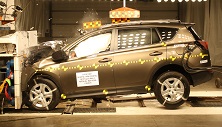
Frontal Crash Test
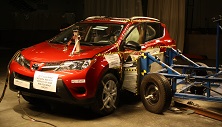
Side Crash Test
Overall Frontal Rating
Driver and Passenger Assessment
Driver Side
Passenger Side
Overall Side Rating
Side Barrier and Side Pole Tests
Driver Side
Passenger Side
Rollover Resistance
No rollover risk estimate available in this dataset
Safety Features
ESC: StandardForward Collision Warning: OptionalLane Departure Warning: Optional
Recall Notices
NHTSANHTSA ID: 23V734000November 01, 2023
ELECTRICAL SYSTEM:12V/24V/48V BATTERY
Toyota Motor Engineering & Manufacturing (Toyota) is recalling certain 2013-2018 RAV4 vehicles. Certain replacement 12-volt batteries may not fit properly in the battery tray, allowing the battery to move and contact the hold-down bracket, possibly causing a short circuit.
Remedy Status
Dealers will replace the battery clamp sub-assembly, battery tray, and positive terminal cover, free of charge. Owner letters were mailed December 27, 2024, to 2013-2014 RAV4 owners. Additional owner notification letters will be mailed in phases, phase 2 will begin on May 14, 2025, and phase 3 in late July 2025. Owners may contact Toyota's customer service at 1-800-331-4331. Toyota's numbers for this recall are 23TB13 and 23TA13.
NHTSA ID: 19V503000June 28, 2019
EQUIPMENT:OTHER:LABELS
Southeast Toyota Distributors, LLC (SET) is recalling certain 2017-2019 Toyota Camry, Corolla, Rav4, Sienna, and Yaris iA vehicles equipped with factory-installed floor mats. The load carrying capacity modification label may be incorrect. As such, these vehicles fail to comply with the requirements of Federal Motor Vehicle Safety Standard (FMVSS) number 110, "Tire Selection and Rims."
Remedy Status
SET will notify owners and provide a corrected label for placement over the inaccurate label, free of charge. The recall began August 23, 2019. Owners may contact Toyota customer service at 1-888-270-9371. SET's number for this recall is SET19A.
NHTSA ID: 17V295000May 02, 2017
TIRES:TEMPORARY/EMERGENCY SPARE TIRE
Gulf States Toyota, Inc. (Gulf States) is recalling certain 2017 4Runner , 86, Avalon, Camry, Camry Hybrid, Corolla, Corolla iM, Highlander, Highlander Hybrid, Prius, Prius C, RAV4, RAV4 Hybrid, Sienna and Yaris vehicles. The spare tire air pressure was not adjusted to the proper pressure as stated on the Tire Pressure Label.
Remedy Status
Gulf States will notify owners, and dealers will inspect the spare tires, adjusting their pressure as necessary, free of charge. The recall began June 15, 2017. Owners may contact Gulf States customer service at 1-800-444-1074. Toyota's number for this recall is 17R2.
Investigations
1 totalThe Office of Defects Investigation (ODI) opened a Preliminary Evaluation (PE) to understand the contributing factors and frequency of vehicle fires originating from the battery region of the engine compartment in Model Year (MY) 2013-2018 Toyota RAV4 vehicles on 25 February 2021. At the time of opening, ODI attributed eleven allegations and additional EWR events to this PE. PE21005 focused on replacement batteries installed in the subject vehicles. No reported fire event identified in PE21005 involved the originally supplied 12V battery. The reported fires took place in vehicles known to contain aftermarket batteries or whose age exceeded the expected life of the original equipment battery. ODI identified battery dimensioning as it relates to the battery retention system (hold down bracket, radiator support bolt, J-hook, and battery tray) as the main factor set in the contact between the battery hold down bracket contacting the positive terminal of the 12V battery. The subject vehicles carried over the same battery tray and retention system from the prior generation (MY2006 – MY2012) of RAV4 vehicles. However, the subject vehicles were equipped with a dimensionally smaller battery (Group 35) than the prior generation (Group 24F). The smaller- length measurement in the Group 35 battery size in a battery tray originally designed to fit a Group 24F battery contributed to increased potential for battery movement which was exacerbated by the diversity in aftermarket battery configuration and irregularities intrinsic to battery replacement procedures. Battery movement coupled with the proximity of the B+ terminal on the battery and the grounded electrically conductive hold down bracket set the stage for a short to ground leading to an engine stall (if in operation) followed by a vehicle fire. This investigation was not able to classify the installation status, battery size, or cause of every allegation due to the fire event causing damage to the area, inaccessible vehicle, modification to the battery retention system after the event, and/or inconclusive photographic evidence. Toyota's investigation of the issue identified aftermarket battery catalogs that listed an improper battery replacement size (Group 26R) that would nevertheless fit into the subject vehicles whose battery retention system is incapable of reliably restraining a Group 26R battery. On 18 November 2021, Toyota initiated a consumer advisory campaign (21TG01) to the subject vehicle owners, notifying them of the correct size battery and offering a free inspection of the battery and retention hardware, a caution label to affix to the hold down bracket, and a discounted replacement 12V battery. This investigation with Toyota established three broad categories to characterize the battery retention system state of a given vehicle: "correct", "minor mis-installation", and "major mis-installation". - The "correct" terminology references the front bolt, bracket, and J-hook installed in a position not in contact with the positive battery terminal and the front bolt torqued to 17 Nm and the J-hook engaged with the tray hole and torqued to 4.9 Nm. - A "minor mis-installation" would describe the three retention components installed in the prescribed location, however not to the correct torque values. - The "major mis-installation" condition would constitute a retention component missing or disconnected from the system. Toyota's own testing used five exemplar batteries installed on a subject vehicle in each battery categorization resulted in: - Contact between the B+ terminal and hold down bracket in "major mis-installations" - Movement of the battery in "minor mis-installations" - No observable motion in "correct" installations. ODI conducted its own evaluation of the Toyota- specified replacement battery and 5 aftermarket Group 35 batteries. The six batteries tested conformed to the Group 35 Battery Council International (BCI) standard on overall dimensional tolerance and terminal location. That standard does not define the edge shape or material of battery casing. Physical interaction between the hold down bracket and the battery case and the friction between the casing material and the battery tray resulted in a large variability in movement forces required to incite movement when the battery was installed in the "correct" condition. Resulting in movement at an induced lateral load between 0.6 G and 1.91 G equivalent force across each battery. This force is higher than a typical vehicle could exert in a steady state turn and would only experience loads through brief shock or impulses. Multiple shock or impulse loads across time would contribute to a delay between the replacement battery installation and the fire event. Likelihood of a fire event increases as the installation method degraded from the "correct", to "minor mis-installation", and then to "major mis-installation". Protruding vent caps atop some of the batteries tested aided in restricting battery movement relative to the hold down. An absence of vent caps permitted additional movement. Following several discussions and vehicle inspections with ODI during this investigation, on 01 November 2023, Toyota filed a safety recall (NHTSA 23V-734) of 1,853,568 MY 2013 through MY 2018 Toyota RAV4 vehicles to reduce the risk of a vehicle fire with redesigned battery retention components. To review the ODI reports cited in the Closing Resume ODI Report Identification Number document, go to NHTSA.gov.
Component: ELECTRICAL SYSTEM:12V/24V/48V BATTERYOpened: Feb 25, 2021Closed: Aug 12, 2024Related recall: 23V734
Owner Complaints
300 totalUNKNOWN OR OTHER
Apr 6, 2026
Rust on roof by the windshield
STRUCTURE,UNKNOWN OR OTHER,ENGINE
FIREMar 25, 2026
Yesterday March 25th 2026 I went to work and parked my 2017 Toyota RAV4 and about 30minutes later it was on fire in the parking lot. The fire happened around the battery area
FORWARD COLLISION AVOIDANCE
CRASH1 injuryFeb 12, 2026
PCS brake has enormously engaged twice. 1. small branch fell off tree on a dirt road. brakes engaged and should not have and almost caused vehicle to slide off a 1000 foot cliff. 2. auto braked with my dog was in car and broke dogs' leg and cost a 2,000 dollar vet bill. bra...
Preview excerpt
Insert, Padding
Feb 3, 2026
While my child was sitting in his carseat, the foam head support detached from the plastic casing where it is glued together. This is not the result of any action on our part and the seat has not been in car accident. The glue just gave out.
VEHICLE SPEED CONTROL
CRASH1 injuryDec 28, 2025
I am the driver's husband and the driver was the only one in the car. I assist her to file this report The accident happened around 6 pm on 12.28.2025 My wife was involved in a single car accident in a parking lot. She made a left turn at the intersection of 192nd ave and 3...
Preview excerpt
UNKNOWN OR OTHER
Dec 4, 2025
My 2017 Toyota RAV4 suddenly caught fire while it was parked in front of my home. The vehicle was turned off and had been parked for several minutes. Without any warning, flames started in the battery area and rapidly spread, resulting in a total loss of the vehicle. The Wylie, T...
Preview excerpt
ELECTRICAL SYSTEM,VEHICLE SPEED CONTROL,FORWARD COLLISION AVOIDANCE
Nov 27, 2025
While driving the vehicle on an uphill stretch of highway with cruise control set at approximately 65 mph, the vehicle suddenly slowed down without warning. A distinct clunk was heard at the same moment. The cruise control system attempted to restore speed, and the engine became ...
Preview excerpt
FORWARD COLLISION AVOIDANCE
Nov 4, 2025
My 2017 Toyota RAV4 XLE is experiencing unsafe behavior with the Adaptive Cruise Control (ACC). When driving around modest or slight turns, the ACC frequently loses tracking of the vehicle ahead and suddenly accelerates, then harshly brakes once it reacquires the vehicle. This cr...
Preview excerpt
UNKNOWN OR OTHER
Oct 27, 2025
The rear lift hatch on my 2017 Toyota RAV4 is not working properly. It can be raised without a problem most of the time but not lowered without a lot of effort and time. It might go down several inches and stop before going back up again causing me to have to start the process ...
Preview excerpt
SERVICE BRAKES
Sep 15, 2025
The brake system on my 2017 Toyota RAV4 LE has repeatedly failed to provide normal stopping power, even after the replacement of pads and rotors in July 2025. This poses a serious safety hazard and may indicate a defect in the braking system.
Showing 10 recent complaints from 300 total
View Full Complaint LogCompare Related Vehicles
Why Compare These Pages
The strongest comparison flow is usually: exact vehicle-year page, then nearby years of the same model, then other 2017 Toyota models. That sequence helps separate one-off year spikes from broader make-wide patterns.
More Toyota RAV4 Years
2018 Toyota RAV4Compare this year against 2017 for complaint and recall shifts.3r1i322c2016 Toyota RAV4Compare this year against 2017 for complaint and recall shifts.3r1i232c2019 Toyota RAV4Compare this year against 2017 for complaint and recall shifts.7r855c2015 Toyota RAV4Compare this year against 2017 for complaint and recall shifts.4r1i299c2020 Toyota RAV4Compare this year against 2017 for complaint and recall shifts.6r611c2014 Toyota RAV4Compare this year against 2017 for complaint and recall shifts.4r1i192c
More 2017 Toyota Models
2017 Toyota HighlanderAnother 2017 Toyota option for same-year comparison.4r252c2017 Toyota TacomaAnother 2017 Toyota option for same-year comparison.5r1i229c2017 Toyota CorollaAnother 2017 Toyota option for same-year comparison.3r2i186c2017 Toyota CamryAnother 2017 Toyota option for same-year comparison.3r145c2017 Toyota SiennaAnother 2017 Toyota option for same-year comparison.10r143c2017 Toyota PriusAnother 2017 Toyota option for same-year comparison.3r1i100c
Frequently Asked Questions
How many recalls does the 2017 Toyota RAV4 have?
The 2017 Toyota RAV4 has 3 recalls recorded by NHTSA.
How many complaints have been filed for the 2017 Toyota RAV4?
NHTSA has received 300 owner-reported complaints for the 2017 Toyota RAV4.
What is the NHTSA safety rating for the 2017 Toyota RAV4?
Our stored NHTSA record for the 2017 Toyota RAV4 has an overall rating of 5 out of 5 stars. Stored NHTSA configuration: 2017 Toyota Rav4 SUV AWD. NCAP Vehicle ID: 11147. Ratings describe one stored NHTSA configuration, not every trim, body style or drivetrain for this model year.
What are the most common problems with the 2017 Toyota RAV4?
The most frequent complete stored component labels for the 2017 Toyota RAV4 are electrical system (73 reports), unknown or other (37 reports), service brakes (24 reports). These are exact-label counts, not broader component-group totals or confirmed defects.
Does the 2017 Toyota RAV4 have any recalls?
Yes. NHTSA has 3 recalls on record for the 2017 Toyota RAV4. Scroll up to review the published recall summaries, consequences, and remedies. To check for unrepaired recalls on your specific vehicle, use your VIN at nhtsa.gov/recalls.
Check Another Vehicle
Look up recalls and complaints for any year, make, and model.
This page summarizes publicly available data from the National Highway Traffic Safety Administration (NHTSA). Complaint counts reflect reports submitted to NHTSA by vehicle owners and do not by themselves prove defect severity or vehicle safety. Safety ratings may not be available for all vehicle-years. This site is not affiliated with NHTSA or any vehicle manufacturer. For official information, visit the official NHTSA page for this vehicle.