Chrysler · Pacifica · 2017
2017 Chrysler Pacifica
10
Recalls
1,445
Complaints
5/5
NCAP overall
The 2017 Chrysler Pacifica has 10 recalls and 1,445 owner-reported complaints on file with NHTSA. One stored NHTSA configuration has an overall rating of 5 out of 5 stars, not a rating for all versions. Most frequent stored component label: engine (212 reports).
Stored NHTSA configuration: 2017 Chrysler Pacifica VAN FWD NCAP Vehicle ID: 11422
Ratings describe one stored NHTSA configuration, not every trim, body style or drivetrain for this model year. How this configuration is selected
Source: NHTSA Public Records
NHTSA source checks for this vehicle year
- Complaints
- Separate successful check not recorded.
- Recalls
- Separate successful check not recorded.
- Safety ratings
- Separate successful check not recorded.
- Investigations
- Separate successful check not recorded.
- Manufacturer communications
- Separate successful check not recorded.
Checks are recorded separately for each dataset, not for the whole page. Dates use UTC. A missing check date does not mean no records exist.
Vehicle import recorded: Apr 28, 2026. This is the stored import date, not confirmation that every source was successfully refreshed.
Research Context
The 2017 Chrysler Pacifica page works best as a research starting point. Complaint totals show how much owner-reported activity exists, while recalls and investigations help show whether any of that activity turned into formal safety action.
Because this is a newer-era vehicle page, it usually helps to compare this year against nearby model years before deciding whether a complaint pattern looks isolated or persistent. On this page, the most frequent complete stored component label is engine with 212 reported complaints.
Best Research Moves
- Use the complaint log to see whether the 2017 Chrysler Pacifica reports cluster around one repeated symptom or spread across multiple systems.
- Compare the recall list with the complaint mix to see whether the most reported issues overlap with formal NHTSA safety campaigns.
- This page is primarily a complaints-and-recalls research surface, so compare nearby model years before treating the complaint total as a standalone verdict.
Key Takeaways
- The 2017 Chrysler Pacifica currently shows 10 NHTSA recalls listed on this page and 1,445 owner-reported complaints.
- This page currently shows no linked NHTSA investigations.
- This page reflects complaint volume, recall history, and NHTSA test data, but it does not diagnose causes or rank reliability by itself.
- Safety data currently shows 5/5 overall NHTSA rating for one stored configuration, not all versions.
- The most frequent complete stored component labels on this page are engine (212), power train (204), steering (123).
- Vehicle
- 2017 Chrysler Pacifica
- Recalls
- 10
- Complaints
- 1445
- Stored Configuration Overall Rating
- 5/5. Stored NHTSA configuration: 2017 Chrysler Pacifica VAN FWD. NCAP Vehicle ID: 11422.
How to Interpret This Page
This page combines three types of NHTSA data: recall campaigns (official manufacturer or government actions), owner complaints (unverified consumer reports), and crash test ratings (where available). A vehicle with many complaints is not necessarily less reliable — complaint volume correlates with sales volume and vehicle age. Recalls indicate identified defects, not overall quality. To compare this model year with others, use the year navigation in the sidebar or return to the model overview page.
If you are researching a used vehicle, start with the complaint categories, compare them against the recall list, and then check nearby model years to see whether the same issue profile repeats. That usually produces a better buying or research signal than treating the raw complaint total as a standalone safety ranking.
NHTSA Configuration Test Results
Stored NHTSA configuration: 2017 Chrysler Pacifica VAN FWD NCAP Vehicle ID: 11422
Ratings describe one stored NHTSA configuration, not every trim, body style or drivetrain for this model year. How this configuration is selected
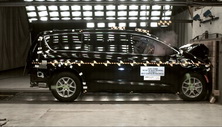
Frontal Crash Test
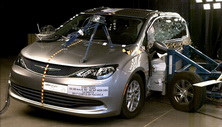
Side Crash Test
Overall Frontal Rating
Driver and Passenger Assessment
Driver Side
Passenger Side
Overall Side Rating
Side Barrier and Side Pole Tests
Driver Side
Passenger Side
Rollover Resistance
No rollover risk estimate available in this dataset
Safety Features
ESC: StandardForward Collision Warning: OptionalLane Departure Warning: Optional
Recall Notices
NHTSANHTSA ID: 25V876000December 17, 2025
EQUIPMENT ADAPTIVE/MOBILITY:WHEELCHAIR RESTRAINTS/SECUREMENT:LATCH/ANCHOR:
Rollx Vans (Rollx) is recalling certain GMC Yukon, Sierra, Chevrolet Express 2500, Ford Transit, E-250, Toyota Sienna, Sienna Hybrid, Honda Odyssey, Chrysler Town and Country, Voyager, Pacifica, Dodge Grand Caravan, and Ram Promaster vehicles equipped with QRT-Deluxe and QRT-Max wheelchair restraints. Please refer to Rollx's recall report for specific model year information. The retractors may not lock, preventing the wheelchair from being properly secured.
Remedy Status
Rollx will work with Q'Straint to inspect and replace the retractors as necessary, free of charge. Owner notification letters were mailed February 5, 2026. Owners may contact Rollx's customer service at 1-800-956-6668.
NHTSA ID: 23V010000January 17, 2023
ELECTRICAL SYSTEM:WIRING:CONNECTORS/PLUGS/RECEPTACLES
Chrysler (FCA US, LLC) is recalling certain 2017-2023 Pacifica Plug-In Hybrid Electric vehicles (PHEVs). An internal transmission wiring connector may short circuit, resulting in an unexpected engine shutdown.
Remedy Status
Dealers will update the Power Inverter Module (PIM) software and, if necessary, update the instrument panel cluster (IPC) and the electronic control module (ECM) software, free of charge. FCA US will notify dealers and begin notifying owners on or about: 03/21/2023 for 2021 model year vehicles, 05/02/2023 for 2019-2020 model year vehicles, and 06/15/2023 for 2017-2018 model year vehicles. FCA began notifying owners on February 23, 2023. Owners may contact FCA US, LLC customer service at 1-800-853-1403. FCA US, LLC's number for this recall is 03A.
NHTSA ID: 19V348000May 09, 2019
ELECTRICAL SYSTEM:12V/24V/48V BATTERY
Chrysler (FCA US LLC) is recalling certain 2017-2019 Pacifica vehicles equipped with engine stop/start systems. A loose battery ground connection may result in an intermittent loss of power steering assist and/or a stall.
Remedy Status
Chrysler will notify owners, and dealers will inspect the battery ground surfaces, clean the contact surfaces as needed, and properly reassemble the ground connection, free of charge. The recall began May 24, 2019. Owners may contact Chrysler customer service at 1-800-853-1403. FCA US' number for this recall is V53.
NHTSA ID: 18V395000June 14, 2018
ELECTRICAL SYSTEM:IGNITION:ANTI-THEFT:CONTROL MODULE
Chrysler (FCA US LLC) is recalling certain 2017-2018 Chrysler Pacifica vehicles. The Manual Park Release (MPR) plug may be removed without a tool. As such, these vehicles fail to comply with the requirements of Federal Motor Vehicle Safety Standard (FMVSS) number 114, "Theft Protection."
Remedy Status
Chrysler will notify owners, and dealers will replace the MPR plug, free of charge. The recall began July 9, 2018. Owners may contact Chrysler customer service at 1-800-853-1403. Chrysler's number for this recall is U50.
NHTSA ID: 18V332000May 17, 2018
ELECTRICAL SYSTEM:WIRING
Chrysler (FCA US LLC) is recalling certain 2014-2018 Dodge Journey, Charger and Durango, RAM 2500, 3500, 3500 Cab Chassis (more than 10,000lb), 4500 Cab Chassis and 5500 Cab Chassis, Jeep Cherokee and Grand Cherokee and Chrysler 300, 2014-2019 RAM 1500, 2015-2018 Dodge Challenger, 2015-2017 Chrysler 200, 2016-2018 RAM 3500 Cab Chassis (less than 10,000 lb), 2017-2018 Chrysler Pacifica and 2018 Jeep Wrangler vehicles. These vehicles are being recalled to address a defect that could prevent the cruise control system from disengaging. If, when using cruise control, there is a short circuit within the vehicle's wiring, the driver may not be able to shut off the cruise control either by depressing the brake pedal or manually turning the system off once it has been engaged, resulting in either the vehicle maintaining its current speed or possibly accelerating.
Remedy Status
Chrysler will notify owners, and dealers will inspect the software, and perform a software flash on the engine or powertrain control module, free of charge. The recall began June 4, 2018. Owners may contact Chrysler customer service at 1-800-853-1403. Note: Owners are advised to stop using cruise control until the software update has been performed. In the event that cruise control cannot be disengaged while driving, owners should firmly and steadily apply the brakes and shift the transmission to neutral, placing the vehicle in park once it has stopped.
NHTSA ID: 18V049000January 11, 2018
ELECTRICAL SYSTEM:SOFTWARE
Chrysler (FCA US LLC) is recalling certain 2017 Chrysler Pacifica vehicles equipped with a 3.6l engine. The engine control software may become out of sync with the crankshaft position sensor, possibly resulting in an engine stall.
Remedy Status
Chrysler will notify owners, and dealers will update the engine control software, free of charge. The recall began March 7, 2018. Owners may contact Chrysler customer service at 1-800-853-1403. Chrysler's number for this recall is U01.
NHTSA ID: 17V542000August 31, 2017
SEAT BELTS:REAR/OTHER
Chrysler (FCA US LLC) is recalling certain 2017-2018 Chrysler Pacifica vehicles equipped with the 8-passenger seating option. In certain passenger seating and vehicle situations, the second-row center seating position seat belt buckle could cause the left outboard seat belt to become unlatched.
Remedy Status
Chrysler will notify owners, and dealers will install a shorter second-row seat belt buckle, free of charge. The recall began October 26, 2017. Owners may contact Chrysler customer service at 1-800-853-1403. Chrysler's number for this recall is T54.
NHTSA ID: 17V482000July 28, 2017
POWER TRAIN:DRIVELINE:DIFFERENTIAL UNIT
Vantage Mobility International, LLC (VMI) is recalling certain 2017 Chrysler Pacifica lowered floor vehicles modified by VMI. The rear pinion bracket on both sides of the vehicle may crack, causing the axle not to be centered and the wheel to wobble.
Remedy Status
VMI will notify owners, and dealers will replace the pinion brackets, free of charge. The recall began on August 14, 2017. Owners may contact VMI customer service at 1-800-488-9082. VMI's number for this recall is PAC20170728.
NHTSA ID: 17V342000May 25, 2017
SERVICE BRAKES, HYDRAULIC:FOUNDATION COMPONENTS:HOSES, LINES/PIPING, AND FITTINGS
Vantage Mobility International, LLC (Vantage Mobility) is recalling certain 2017 Chrysler Pacifica lowered floor vans modified by Vantage Mobility for wheelchair accessibility. The affected vans have rear brake lines that might have been crossed during the modification. As such, these vehicles fail to comply with the requirements of Federal Motor Vehicle Safety Standard number 135, "Light Vehicle Brake Systems."
Remedy Status
Vantage Mobility will notify owners, and dealers will correct the rear brake line attachments, free of charge. The recall began on July 3, 2017. Owners may contact Vantage Mobility customer service at 1-800-488-9082. Vantage Mobility's number for this recall is Pac-20170525.
NHTSA ID: 16V490000June 30, 2016
SEAT BELTS:REAR/OTHER
Chrysler (FCA US LLC) is recalling certain model year 2017 Pacifica vehicles manufactured February 22, 2016, through April 28, 2016. The center overhead seat belt stow clip may fracture and prevent use of the seat belt in the third-row and/or second-row center passenger seat (if so equipped).
Remedy Status
Chrysler will notify owners, and dealers will replace the third-row and, if necessary, second-row center overhead seat belt stow bezel, free of charge. The recall began on July 14, 2016. Owners may contact Chrysler customer service at 1-800-853-1403. Chrysler's number for this recall is S42.
Owner Complaints
1445 totalSTEERING,ELECTRICAL SYSTEM
Apr 21, 2026
The power steering will intermittently go out when traveling down the roadway and when making right and left hand turns. Once the power steering goes out there is an alert triggered and the alerts the driver the power steering assist is malfunctioning and the steering wheel is ve...
Preview excerpt
POWER TRAIN,ELECTRICAL SYSTEM,ENGINE
Apr 14, 2026
The auto start/stop malfunctioned and then the engine sounded like it was going to die. It is available to look at. I thought it was going to stop in the middle of the road. Unknown Unknown The auto start stop light came on and said it was unavailable. They just first appeared to...
Preview excerpt
UNKNOWN OR OTHER
Apr 6, 2026
I keep getting check engine lights and they have repaired serval of the items and I did get a letter in the mail saying the battery would now have a lifetime warranty if it threw a certain code and I had two codes come up and some people told me to replace my 12v battery and it w...
Preview excerpt
ELECTRICAL SYSTEM,FUEL/PROPULSION SYSTEM
Apr 1, 2026
I experienced a check engine light and intermittent starting issues with my vehicle (Chrysler Pacifica Hybrid 2017). [XXX] At times, the vehicle would not start, but after some time it could start again. After researching the issue online, I found that there are active safety ...
Preview excerpt
STEERING
Mar 30, 2026
The steering wheel sticks in a slight right and left turns (from about the 11:00 or 1:00 position) when I straighten out the wheel. It does it on highway on and exit ramps, during passing maneuvers and any slight right or left bends in the road. There are no unusual noises associ...
Preview excerpt
POWER TRAIN,ELECTRICAL SYSTEM
Mar 21, 2026
For several months I have been having problems off and on with my vehicle not shifting into drive, neutral, or reverse. It runs fine but becomes undrivable. Until this last time, I was always able to keep trying, let it sit overnight, etc... and it would eventually shift into g...
Preview excerpt
ENGINE
Mar 19, 2026
Check engine light came on at 87K miles, took to dealership and code was P0303. Dealer had to replace 6 spark plugs, warped head, head gasket and oil change. Dealership knew of this problem with faulty heads from the manufacturer and no recall has been started from Chrysler. Car...
Preview excerpt
POWER TRAIN
Mar 16, 2026
Vehicle “slams” into gear and goes into “limp” mode. RPM’s increase dramatically and speed accelerate ration is very low. Check engine light on and several U codes show. And P0301
POWER TRAIN,ENGINE,FUEL/PROPULSION SYSTEM
Mar 11, 2026
My 2017 Chrysler Pacifica experienced repeated engine timing and oil system failures. The vehicle first developed a check engine light and engine timing code (P000D – camshaft position slow response). The vehicle was inspected by a dealership service department. Shortly after, a...
Preview excerpt
STEERING,SERVICE BRAKES,ENGINE
CRASHMar 3, 2026
Vehicle lost power, steering, and breaks on the george washington bridge in NYC causing it to roll into the back of another vehicle.
Showing 10 recent complaints from 1,445 total
View Full Complaint LogCompare Related Vehicles
Why Compare These Pages
The strongest comparison flow is usually: exact vehicle-year page, then nearby years of the same model, then other 2017 Chrysler models. That sequence helps separate one-off year spikes from broader make-wide patterns.
More Chrysler Pacifica Years
2018 Chrysler PacificaCompare this year against 2017 for complaint and recall shifts.12r782c2019 Chrysler PacificaCompare this year against 2017 for complaint and recall shifts.6r321c2020 Chrysler PacificaCompare this year against 2017 for complaint and recall shifts.4r152c2021 Chrysler PacificaCompare this year against 2017 for complaint and recall shifts.6r340c2022 Chrysler PacificaCompare this year against 2017 for complaint and recall shifts.9r178c2023 Chrysler PacificaCompare this year against 2017 for complaint and recall shifts.11r117c
Frequently Asked Questions
How many recalls does the 2017 Chrysler Pacifica have?
The 2017 Chrysler Pacifica has 10 recalls recorded by NHTSA.
How many complaints have been filed for the 2017 Chrysler Pacifica?
NHTSA has received 1,445 owner-reported complaints for the 2017 Chrysler Pacifica.
What is the NHTSA safety rating for the 2017 Chrysler Pacifica?
Our stored NHTSA record for the 2017 Chrysler Pacifica has an overall rating of 5 out of 5 stars. Stored NHTSA configuration: 2017 Chrysler Pacifica VAN FWD. NCAP Vehicle ID: 11422. Ratings describe one stored NHTSA configuration, not every trim, body style or drivetrain for this model year.
What are the most common problems with the 2017 Chrysler Pacifica?
The most frequent complete stored component labels for the 2017 Chrysler Pacifica are engine (212 reports), power train (204 reports), steering (123 reports). These are exact-label counts, not broader component-group totals or confirmed defects.
Does the 2017 Chrysler Pacifica have any recalls?
Yes. NHTSA has 10 recalls on record for the 2017 Chrysler Pacifica. Scroll up to review the published recall summaries, consequences, and remedies. To check for unrepaired recalls on your specific vehicle, use your VIN at nhtsa.gov/recalls.
Check Another Vehicle
Look up recalls and complaints for any year, make, and model.
This page summarizes publicly available data from the National Highway Traffic Safety Administration (NHTSA). Complaint counts reflect reports submitted to NHTSA by vehicle owners and do not by themselves prove defect severity or vehicle safety. Safety ratings may not be available for all vehicle-years. This site is not affiliated with NHTSA or any vehicle manufacturer. For official information, visit the official NHTSA page for this vehicle.